Give the cheese a purpose
First consider what you want the cheese to contribute. Are you looking for separate milky patches, an even melted layer or simply a little strong seasoning? These three aims lead to different products and quantities. Fresh mozzarella, a firm grating cheese and finely grated hard cheese are consequently not interchangeable ingredients. A blend can make sense when its components perform different roles. You do not need several varieties to make a good pizza, though. One appropriately prepared cheese is enough for many recipes and makes the ingredients easier to organise.
Include the remaining toppings in the decision. Cheese needs a different balance alongside tomatoes, capers and olives than alongside mild potatoes or squash. The sauce also contributes salt and moisture. A pronounced blue cheese flavour can complement a vegetable, but a large amount may overpower everything else. Avoid planning every ingredient as a full portion in isolation. Decide which flavour should lead and choose the cheese as part of that combination. This also makes shopping easier when you intend to serve several different pizzas.
Prepare fresh mozzarella deliberately
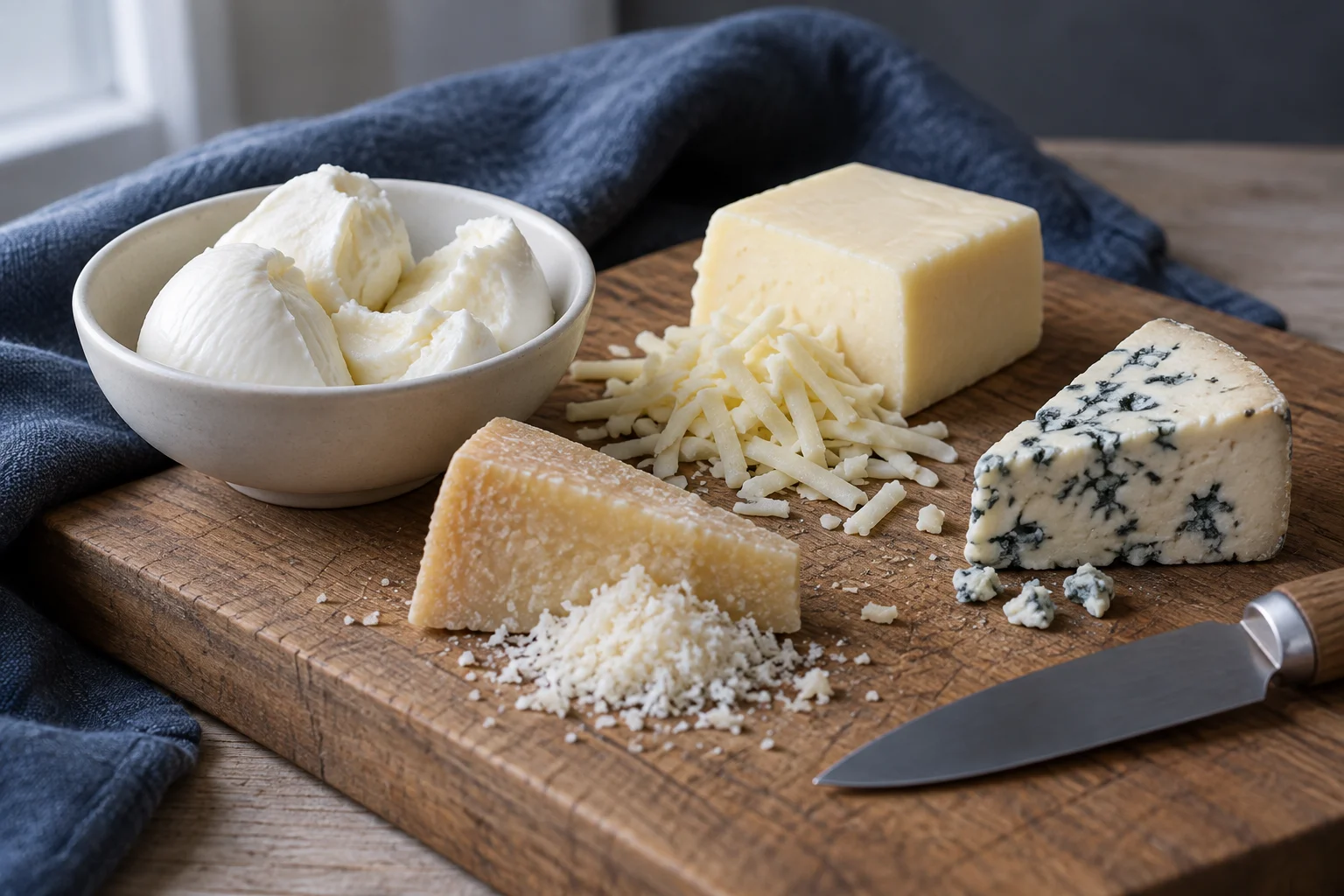
Mozzarella packed in liquid brings substantial moisture along with its mild flavour. Remove it from the liquid before topping and cut or tear it into evenly sized small pieces. Let them drain in a sieve over a bowl, then gently pat the surface dry if necessary. If preparing ahead for a longer period, keep the cheese covered in the refrigerator during this process. A dry surface does not mean the inside no longer contains water. The amount you put on the pizza therefore remains an important factor.
Space the pieces apart rather than building an uninterrupted layer of thick slices. This preserves the milky character without covering the whole centre with a heavy blanket. If a lot of liquid collects around individual pieces, consider preparation, piece size and quantity alongside the sauce next time. Cow's milk and buffalo mozzarella can both be used, but flavour and handling vary with the product. Assess the actual cheese rather than relying only on the animal named on the package. The separate mozzarella guide covers this ingredient in more detail.
Compare firm mozzarella and grated cheese
Firm mozzarella intended for hot dishes can be grated or diced and is useful for distributing cheese evenly. It is particularly worth comparing with fresh mozzarella in liquid when you want broader coverage on a pizza with a longer bake. Choose a product actually described for the intended use. The words fior di latte alone do not establish its consistency because products bearing that name come in several forms. Check the description, cut and ingredient list as well. A product's practical form can matter as much as its general name.
A block is easiest to grate while chilled, shortly before topping. Choose medium-sized shreds that spread easily without immediately forming a fine compact pile. Ready-grated cheese saves this preparation step. Such products may contain anti-caking ingredients such as starch; that tells you about their composition rather than automatically making them inferior. Judge the particular product and its result. When comparing freshly grated cheese with a ready-grated version, keep the amount and baking method as similar as possible so you can sensibly identify the differences.
Use hard cheese as seasoning
Parmesan or Parmigiano Reggiano and pecorino have a different intensity from mild mozzarella. Grate them finely when you want to distribute a small amount evenly. For an ordinary round pizza approximately 28 to 30 centimetres across, about five to ten grams can be a cautious initial seasoning quantity. This is a starting point for adjusting flavour, not a fixed requirement for every recipe. Be particularly restrained when other ingredients are already salty. A small weight on the scales can make a noticeable contribution to the finished pizza.
Decide whether the hard cheese should bake with the pizza or be added to the hot pizza afterwards. Fine cheese can colour quickly in the oven, especially in strongly heated spots. Adding it after baking keeps its own flavour more distinct. Large dry shavings also provide a different bite from finely grated cheese. Do not expect a layer made solely from hard cheese to produce the same soft stretch as mozzarella. If combining them, include the hard cheese in your topping quantities rather than adding an unmeasured extra scatter every time.
Add gorgonzola and strong cheeses sparingly
Gorgonzola can provide a notably savoury, creamy element. Mild and stronger products differ perceptibly. Taste a small piece of the cheese you are using before deciding on the amount. Place small pieces at intervals over the pizza. In a blend, a predominantly mild cheese can cover the surface while gorgonzola adds distinct aromatic patches. There is no need for an equally thick blue cheese layer everywhere to achieve that effect. Thinking in terms of separate accents helps preserve the character of the other toppings.
As one possible quantity combination for a lightly topped round pizza, you could use fifty grams of firm mozzarella with twenty grams of gorgonzola. That makes seventy grams of cheese overall. Whether it suits your pizza still depends on size, sauce and the other ingredients. Figs, squash or onions can place a milder or sweeter component alongside the cheese's savoury character. If guests prefer different levels of intensity, use the mild base blend on some pizzas and add the stronger cheese only to the designated portions.
Use ricotta and burrata for creamy accents
Fresh ricotta works well in small soft dollops. Stir it briefly and check whether much loose liquid has separated. There is no need to transfer that liquid to the pizza. Use a teaspoon to distribute small portions, for example between spinach or sautéed vegetables. Ricotta does not create the same continuous melted layer as grated mozzarella. That difference can make the combination interesting: one cheese brings the topping together while the other remains recognisable as a separate creamy mouthful. Keep the dollops small enough to distribute across the slices.
Burrata works well as a fresh finish after baking. Drain away the surrounding liquid, open it and distribute smaller portions over the finished pizza. One large ball in the centre creates a striking appearance, but concentrates weight and moisture in one spot and makes evenly topped slices harder to achieve. Plan a smaller quantity of the other cheese accordingly, then serve promptly. If you want an entirely hot, baked cheese topping, a mozzarella product intended for that purpose is usually a clearer starting point than adding a cool creamy layer afterwards.
Choose gouda, cheddar and blends intentionally
Gouda or cheddar can also be used on pizza when their flavours suit the variation you want. Age, moisture and product form vary considerably. A young mild cheese contributes something different from a strongly flavoured, long-aged piece. Begin a homemade blend with a straightforward combination that you can reproduce. A small amount on an otherwise familiar pizza gives a clearer comparison than four new cheeses at once. The description pizza cheese alone does not explain which blend is in a bag, so read the actual ingredients.
One simple division could be forty grams of firm mozzarella, twenty grams of young gouda and five grams of finely grated hard cheese. The total is sixty-five grams. Mozzarella supplies the largest share, gouda changes the flavour and the hard cheese seasons it. This is a suggested homemade combination rather than a traditional formula. If you increase the strongly flavoured share, initially reduce another component instead of quietly increasing the overall amount. Compare the baked result with the same sauce and a similarly sized pizza before deciding what to change again.
Watch total quantity and distribution
Weigh the cheese before topping, at least for the first few pizzas. A loosely filled cup of grated cheese and the same cup firmly packed with shreds hold different quantities. Small cubes and large pieces also fill a container differently. Four pizzas with sixty-five grams each require 260 grams overall. This calculation applies whether you use a single cheese or a blend. It does not automatically establish the correct portion for a large tray or a different pizza diameter; use the recipe as your initial guide.
Distribute the cheese evenly over the intended surface. A mound in the middle places extra weight on the thinnest area while leaving little near the edge. With several toppings, it helps to prepare the cheese portion first and distribute the other ingredients moderately too. Planned ricotta dollops or burrata belong to the overall topping idea. Extra cheese can make the flavour stronger, but it also changes moisture and weight. A precise small adjustment is easier to assess on the next bake than an unplanned additional handful whose size you cannot readily reproduce.
Match the timing to the baking method
For many round pizzas, cheese goes on with the sauce before baking. Other methods, such as longer-baked bases, may benefit from adding cheese later. Follow an appropriate recipe and prepare the portion so the oven door is not held open unnecessarily. For an intermediate addition, put the pizza on a suitable heatproof surface and use appropriate oven tools. Cheese added near the end still needs enough time to reach the consistency you want. Plan that stage within the recipe rather than treating it as an unmeasured extra step.
If the cheese is already dark while the base remains pale, examine heat distribution and how fully the baking surface was preheated. Simply extending the bake can continue drying the top. Conversely, pale cheese does not prove that the base is uncooked; some products remain relatively light. Assess the two areas separately. On a later pizza, deliberately adjust the position, addition time or cheese product. Several simultaneous changes make it harder to decide what actually helped. There is no single melting time that applies to every cheese in all of these conditions.
Shop and prepare for your guests
Ask about required dietary preferences when planning and select appropriately identified products. Cheese is not automatically vegetarian: Parmigiano Reggiano, for example, is made with animal rennet. For a vegetarian pizza, a clear manufacturer statement and a suitable alternative for the seasoning cheese help you choose. A vegan variation requires suitable ingredients throughout, including any prepared sauces. Plant-based grated toppings differ in use and melting behaviour. Follow the directions for the specific product rather than planning around it as an identical copy of a particular dairy cheese.
Organise the portions you need in separate clean containers and keep them refrigerated according to the package directions. During a longer series of bakes, set out only the amount currently needed. Record the varieties, weights and addition times of a successful blend. If excess liquid, overpowering flavour or rapid browning later becomes a problem, you can change one component precisely. This produces a selection that fits your oven and toppings. You do not need to buy as many varieties as possible or assume that a particular brand is essential to begin.