Small pieces need close attention
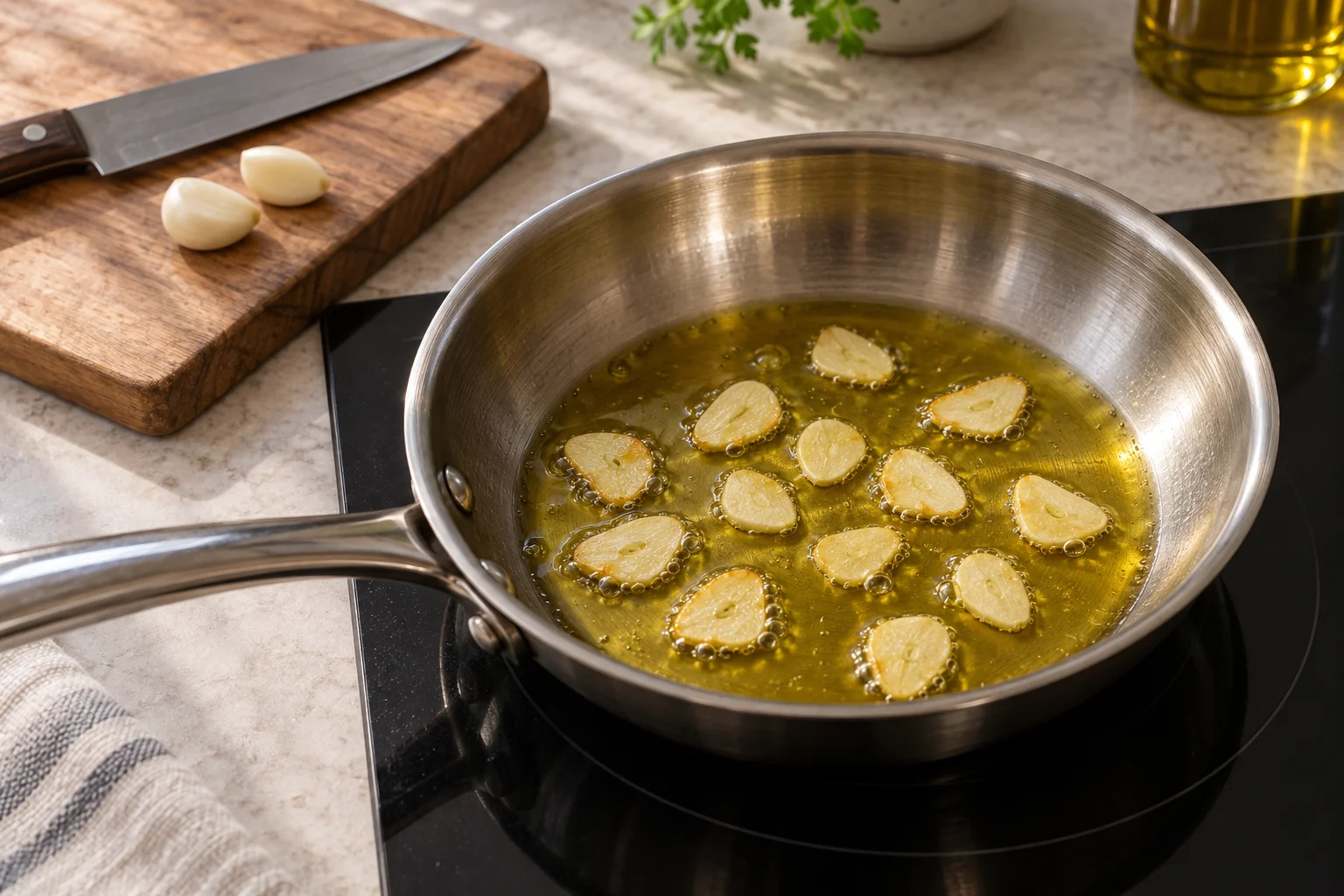
Finely chopped or crushed garlic spreads readily, but its small fragments can darken quickly against a hot pan. Thicker slices and whole lightly crushed cloves behave differently. For an even result, cut pieces to a similar size. Otherwise, tiny fragments may burn while larger pieces have barely cooked.
A recipe that slowly infuses oil with whole cloves and then removes them cannot simply be followed unchanged with a large quantity of finely crushed garlic. The cut is part of the method. Choose it deliberately and prepare the garlic before you begin heating the pan.
Heat gently and watch the pan
Low heat is a useful starting point for a simple garlic-and-oil base. Let the garlic cook gently; heavy smoking and rapid darkening are not desirable intermediate stages. Move the pieces and watch their colour. Pale golden edges differ from dark brown or black surfaces. A fixed number of minutes cannot replace that observation.
If the pan is too hot, move it from the hot hob to a suitable heatproof surface and lower the setting. The pan base remains hot initially and continues cooking. Do not hurriedly pour water into hot oil. Any later addition of liquid specified by the recipe should be made carefully according to its method.
Onions and garlic do not always go in together
Many sauces require onions to soften first. If finely cut garlic goes in at the beginning, it may have to fry much longer than suits it. It often works better to cook the onions first and add the garlic briefly towards the end of that stage, before the tomatoes or other recipe liquid.
This is not a rule for every dish. A complete recipe may use a different cut and cooking sequence. Follow the combination of heat, piece size and order rather than copying just one step. On pizza, exposed tiny pieces of garlic can also darken quickly; a topping method designed for garlic is more suitable than applying a thick layer of raw garlic paste.
Replace a burnt base early
If the garlic is clearly burnt and the oil smells unpleasant, restarting a small base is usually the better choice. Fishing out dark fragments does not reliably remove flavour that has already passed into the oil. Adding sugar or cheese will not make it a fresh base again.
Allow the pan to cool safely, dispose of the failed mixture appropriately and clean the pan before restarting. Use fresh oil and new garlic at a lower heat. Once the entire sauce has been mixed in, bitterness is much harder to correct selectively. A brief check of the pan before adding the next ingredient can therefore save more effort than a later rescue attempt.