Begin with the sauce's texture
If the pasta disappears from a plate but all the vegetable pieces remain at the bottom, the shape and sauce have worked poorly together. A suitable pairing brings both onto the same fork. A few observations help more than a long list of Italian names. Is the sauce smooth or chunky? Light or thick? Will the pasta be tossed, filled or baked? These questions also help when your cupboard contains a different shape from the one specified in a recipe.
Smooth tomato sauce spreads over many different shapes. A sauce with large vegetable pieces or a coarse ragù needs pasta that can carry or catch some of them. Broad ribbons, larger tubes and hollow shapes offer different ways to do this. A thin garlic-and-oil sauce mainly needs good contact with the surface. Combined with a little starchy cooking water and tossed with the pasta, it can coat long strands evenly. Switching shapes alone cannot fix a sauce that has separated into oil and water.
Consider the size of the other ingredients too. A whole broccoli floret is difficult to wind around a fork with a thin strand of spaghetti. Small cooked broccoli pieces can sit comfortably among short shells or tubes. You therefore do not always need to change the pasta. Sometimes cutting vegetables smaller or crushing part of the sauce is enough. Aim for a mouthful that combines pasta, sauce and other ingredients without constant rearranging on the plate.
Spaghetti and linguine for coating sauces
Spaghetti winds around a fork and carries a thin layer of sauce with it. It works well with smoother tomato sauces and with oil, garlic and chilli. Linguine is flat and narrow, and also suits sauces that wrap around long strands. Large loose cubes tend to remain behind when you twirl the pasta. If you want to use them, cut them smaller or combine them with enough sauce to help them cling.
For two portions of aglio e olio, for example, use the 200 grams of spaghetti in our recipe. Have the prepared oil, garlic and chilli mixture waiting in a sufficiently wide pan. Lift the nearly cooked pasta into it and begin with a few tablespoons of cooking water. Toss to form a thin coating rather than a puddle of oil. This technique matters more to the result than whether your spaghetti is a millimetre thicker than the strands in a recipe photograph.
Tagliatelle and pappardelle for more substantial sauces
Broad ribbons give each mouthful a larger continuous surface of pasta. They suit sauces with some substance that cling to the ribbons, such as a finely broken-up ragù or mushroom sauce. Pappardelle is wider than tagliatelle and sits comfortably with robust, fairly coarse sauces. This is a practical starting point, not a compulsory pairing. Smooth tomato sauce can also work when its quantity and consistency suit the pasta.
Check whether the ribbons you are buying are fresh or dried and whether they contain egg. Shape alone does not reliably tell you. Fresh pasta already contains water, so its portion weight differs from that of dried pasta. Its cooking time may also be much shorter. Have the sauce ready before boiling the noodles. Lift and turn broad, delicate ribbons gently instead of stirring them vigorously with a spoon.
Penne and rigatoni for chunks and bakes
Penne consists of short tubes with diagonally cut ends. Rigatoni is usually larger and has straight ends. Small vegetable pieces, ragù or creamy sauce can settle into their openings and the spaces between them. Ridged versions often carry the word rigate. Their ridges provide a textured surface, but the sauce still needs the right consistency. Watery tomato mixtures run off ridged pasta too and collect at the bottom of the plate.
Penne is an uncomplicated choice for a vegetable pasta dish. Cut peppers and courgettes into pieces that fit on a fork alongside one tube. Cook the vegetables first and combine them with the sauce before adding the pasta. Tubes also suit many pasta bakes. Precooking depends on the complete recipe for that bake. Pasta already boiled until very soft may become softer still in the oven. Conversely, uncooked pasta needs enough liquid and a cooking time designed for that method.
Fusilli and farfalle with mixed ingredients
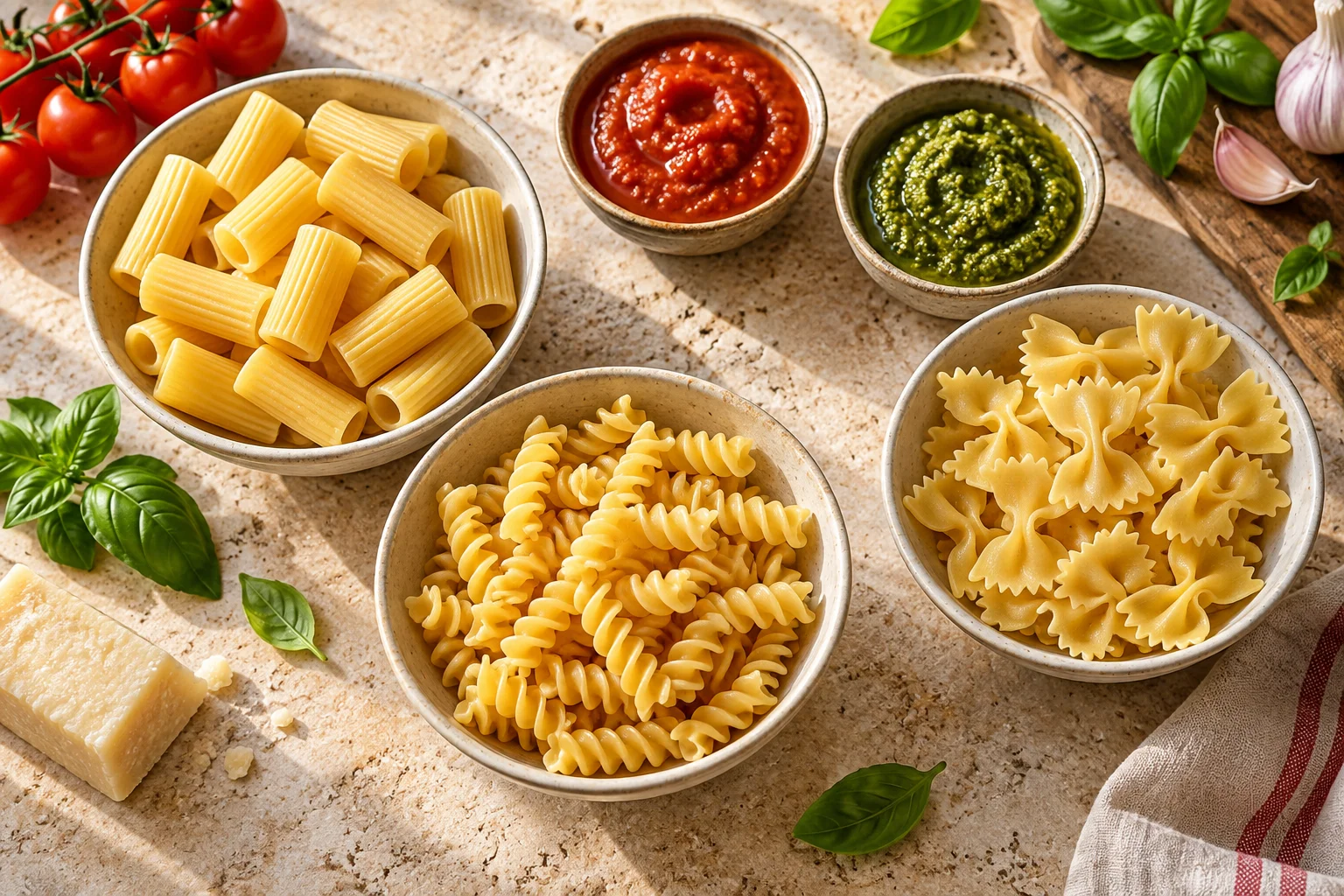
The twists of fusilli provide spaces for finely chopped ingredients and thicker sauces. They are convenient when you want to distribute a vegetable mixture through the dish. Farfalle has broad wings and a pinched centre. Taste that thicker middle when checking whether it is done. Soft edges do not necessarily mean the whole piece has a pleasant texture. The packet timing is a starting point; the actual pasta in your pan determines readiness.
Both shapes are easy to pick up with a fork, making them convenient for meals served in bowls or to guests. They work with pesto when you loosen the sauce with a little cooking water and fold it through away from strong heat. Do not automatically add more oil when pesto is difficult to distribute. Often it needs a little water. Add that by the spoonful so a thick pesto does not become a thin liquid that separates from the pasta.
Shells, orecchiette and small soup pasta
Shells and orecchiette have hollows that can hold smaller ingredients. Peas, crushed broccoli and small vegetable pieces suit them. Match the pieces to the size of the openings. Large shells intended for stuffing are a separate application and need an appropriate method for filling, sauce and baking. Do not confuse them with small shells that you mix directly into a sauce. Similar names reveal little about the preparation required.
Very small shapes such as ditalini or little stars are useful in soups and dishes eaten with a spoon. They should fit on the spoon alongside broth and other ingredients. Remember that pasta continues absorbing hot liquid and softening as it stands. If soup needs to wait, separately cooked pasta can help you combine individual portions only when serving. Use the recipe's quantity for the particular soup. A full main-course portion of dried pasta per person would usually overwhelm a light starter soup.
Give filled pasta's filling room to be tasted
Ravioli and tortellini already contain their own flavour and another texture. A heavy sauce can cover up a delicate ricotta filling. Light tomato sauce, a little butter or another restrained coating makes the filling easier to taste. More strongly flavoured fillings can take a stronger sauce. Taste one cooked raviolo with a little sauce before combining the whole batch. This helps you judge whether there is already enough acidity, salt or fat.
Handle filled pasta gently so seams and thin dough do not tear. Lift it from the water with a slotted spoon and place it in a large enough pan or bowl. A little cooking water can loosen the sauce. There is no need for the vigorous tossing suitable for sturdy short shapes. Cooking time depends on dough thickness, size and filling. A raviolo floating to the surface is not, by itself, reliable proof that every type of filling has cooked completely.
Three combinations from a small cupboard
Spaghetti, penne and one broad ribbon can cover many everyday meals. Spaghetti with our tomato sauce makes straightforward pasta al pomodoro. Penne works with the same sauce when you add cooked vegetable cubes. Ribbons can be combined with sautéed button mushrooms and a sauce that coats them. You do not need a separate packet for every sauce. Choose a shape whose behaviour you know and first vary the ingredients or consistency.
The 200 grams of dried pasta used for two main-course portions in our simple recipes is a useful starting quantity. Adjust it for appetite, starters and the amount of other ingredients. For fresh or filled pasta, use the portion guidance in its recipe or on the product. When replacing one dried shape with another, match dry weight first, not the volume in a cup. Large tubes and tiny shapes can fill the same measuring cup with very different quantities.
Bring sauce and pasta together in the pan
Have the sauce ready and reserve some cooking water before draining. Add pasta shortly before its desired doneness when the recipe includes finishing it in the sauce. Add a little cooking water and move everything until the sauce clings to the pasta. Work away from strong heat with delicate ingredients or pesto. A hot frying pan is not a universal final step for every sauce. Our guide to binding pasta sauce explains these differences in more detail.
Judge a forkful or spoonful rather than looking only at the pan. If the bite is moist and tastes of sauce, without a large pool remaining below, the combination is working. If everything sticks together dryly, it often needs a little liquid. If the pasta is swimming, the sauce may need further reduction after removing pasta that is already done. Extra cheese is not an all-purpose repair. It adds salt and fat and can clump at an unsuitable temperature.
Substitute shapes and finish open packets
If a recipe calls for rigatoni but you have penne, substitution is usually straightforward. Check the different cooking time and cut large ingredients a little smaller if needed. Switching from pappardelle to spaghetti changes the mouthful more substantially. Break a very coarse ragù into smaller pieces so it is easier to eat with the strands. Lasagne sheets, filled pasta and tiny soup shapes cannot be substituted simply by matching weight. Assembly, liquid requirements and cooking methods may be fundamentally different.
Do not pour several unfinished packets into one pot without checking their cooking times. Shapes of different thickness become ready at different moments. Cook them separately, or add them at staggered times if their timings can reliably align. Taste each shape independently. Before your next purchase, ask which sauce you intend to cook and what a combined bite should be like. That narrows the choice and makes the pasta you keep easier to use.