Main meal or late snack?
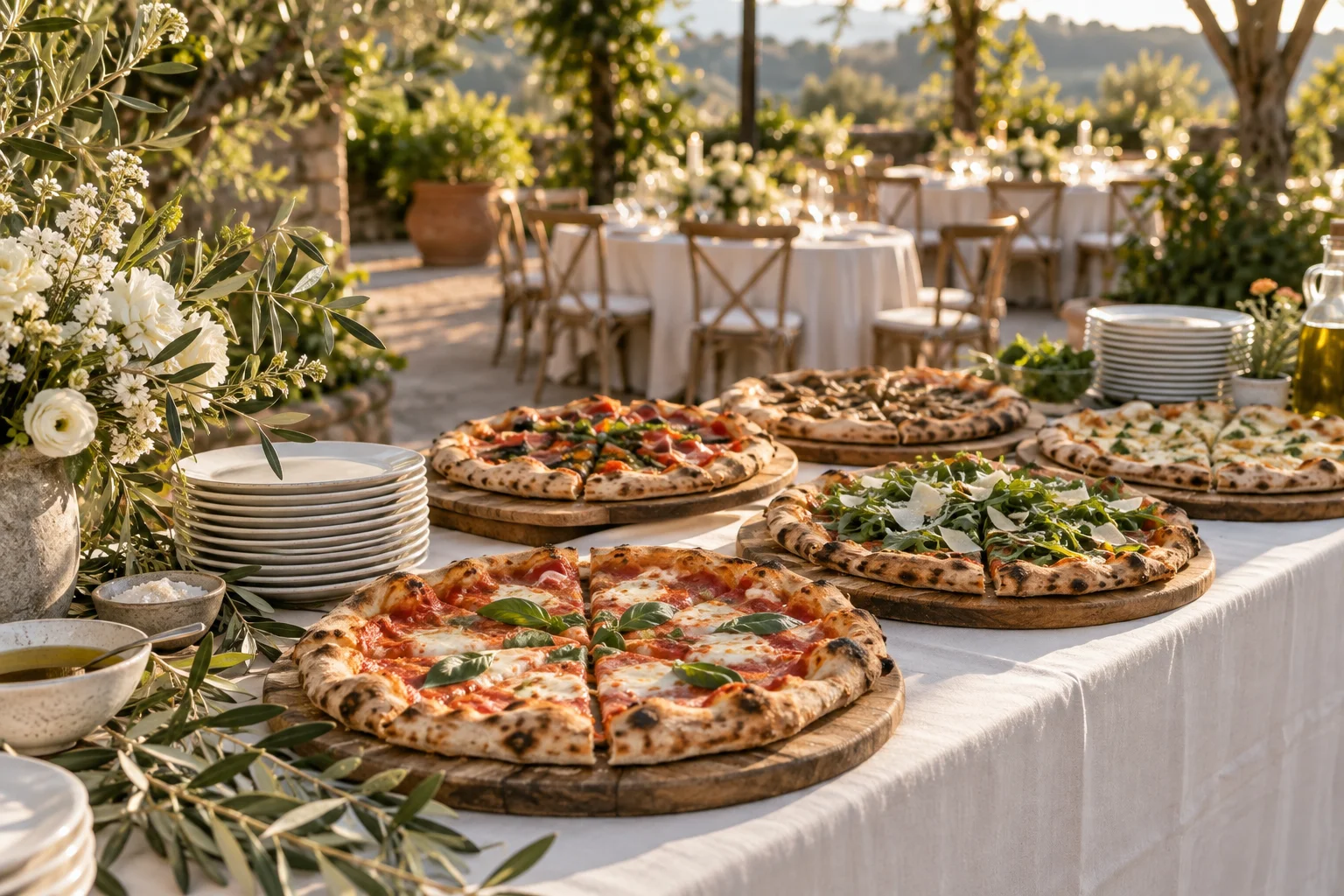
Pizza catering suits a wedding where guests can enjoy freshly baked food and move around informally. A pleasant evening depends on the meal time, serving arrangement and venue working together. An attractive food truck alone says little about how quickly 90 hungry people will be fed. Begin with your celebration's schedule. It determines the catering format, required quantity and questions to ask a provider before booking.
Pizza after a ceremony, drinks reception and a long afternoon has a different job from a small midnight snack following a full dinner. As the main meal, it must satisfy guests and provide first portions promptly. Later in the evening, only some guests may want food. Record when something substantial was last served and what other dishes are planned. Afternoon cake does not automatically replace dinner. Equally, a substantial buffet before the pizza changes demand considerably.
Describe this role explicitly to the caterer. An enquiry giving only a date and guest count leaves too much unanswered. For example, specify a main meal for 80 adults and ten children from 18:30, with salad and dessert later. For a snack, state how many people you expect still to be present and what they will already have eaten. Ask the provider to explain its quantity assumptions. The number invited to the wedding is not always the number who will eat pizza.
Choose how food will reach guests
Whole pizzas made to order give each guest a clear individual portion. They can also create waits when many people request individual changes simultaneously. Continuous service of sliced pizzas distributes smaller first portions sooner and lets guests try several toppings. Table service or circulated slices can reduce walking but requires the corresponding staff. Establish which tasks the provider actually covers. Baking, cutting, handing out and carrying food to tables are separate jobs.
Consider how guests will eat. Someone standing with a plate, glass and handbag needs a manageable portion and somewhere suitable to put things down. Older guests or people with limited mobility should not have to join a long queue again for every second helping. Agreed table delivery may help them. This need not change the whole service. A named person and a clear route from oven to table may be enough if the caterer and venue agree.
Calculate quantities with visible assumptions
Take 80 adults and ten children purely as a planning example. If you initially allow one pizza per adult and half a pizza per child, the total is 85 whole pizzas. This is not a universal consumption recommendation. A 30-centimetre pizza differs from a small snack pizza, while age, appetite, dough weight and side dishes affect demand. Use the number to discuss assumptions with the provider, rather than placing an unquestioned order based on it.
Ask for pizza size and the meaning of a portion. With a per-person package, clarify whether it includes a fixed quantity, a service window or replenishment up to an agreed limit. With per-pizza charging, agree how additional quantities are authorised. Discuss when the final guest count is due and how children are counted. A small reserve may be useful but should be deliberate. Adding an arbitrary safety margin to several already generous assumptions can quickly create unnecessary leftovers.
Examine the first half hour separately
Total quantity alone does not describe the start of service. In the example, 90 people want their first portion. Suppose each should receive two slices within 30 minutes and each pizza is cut into six equal slices. That requires 180 slices, or 30 pizzas, during the half hour. It represents an initial rate of 60 pizzas per hour. Further helpings come afterwards. This is a requirement calculated from the example, not a claim about any particular caterer's output.
Ask about the planned service using your menu, staffing and location. A short oven baking time is not the same as the number of portions actually handed to guests. Shaping, topping, baking, cutting and special requests must all work together. If the opening demand is too concentrated, call tables in stages, offer a suitable starter or agree additional serving capacity. A long queue is not resolved simply because enough dough exists for the total evening.
Connect the schedule to the ceremony and programme
First fix the time when food should actually be handed out. Truck arrival, setup and preheating must happen beforehand. An agreed arrival at 18:00 does not automatically mean the first pizza is ready at 18:00. Give the caterer the relevant schedule, including reception, speeches, group photographs and other activities. Check whether everybody will approach the food together or some guests will still be elsewhere. That determines the initial pressure on service.
Name an accessible contact who can make practical timing decisions on the wedding day. This does not have to be the couple. That person should communicate delays early to the kitchen and venue. Agree beforehand how a later start affects the booked serving period and possible additional charges. An unexpectedly long speech should not leave someone searching for a contract. A short schedule covering arrival, meal start, final service and departure usually supports the practical coordination.
Check access, working space and utilities
A parking place is useful only if the booked vehicle can reach it and work there. Confirm access width and height, load-bearing ground, manoeuvring space and the actual working area needed. A narrow courtyard entrance can matter more than the garden's size behind it. Send measurements and relevant photographs and ask the provider to confirm suitability. Involve the venue before committing to a position; its team knows delivery routes and restricted areas.
Ask what the particular setup needs for electricity, water, refrigeration and other supplies. The existence of a socket somewhere is not sufficient technical coordination. Even a self-contained vehicle may need space, safe routes or other support. Establish who provides appropriate connections and cables and how the serving point will be lit. Keep routes clear for guests and other suppliers. A position beside loudspeakers or in the middle of the photography area can disrupt the evening despite being technically accessible.
Plan for rain and wind before booking
A weather plan means more than a gazebo in a storeroom. Decide where guests will order, wait and eat in rain, and how food will reach them dry. The caterer's working area must also suit the expected conditions. Ask what weather the booked setup can handle and when an alternative becomes necessary. Tents, covers and clearances must suit the equipment and location. An improvised cover immediately over a hot oven opening is not an adequate plan.
Outdoor appliances cannot simply move into an enclosed room. Any indoor alternative must be suitable for that use and agreed with the provider and venue. Decide when the weather decision will be made and who makes it. The venue can then arrange tables and routes in time. Strong wind may require changes to the serving arrangement as well as a roof. Plates, napkins and lightweight decorations need a sheltered place.
Menu choice and dietary requirements
A manageable menu simplifies ordering and production. Agree several clearly different pizzas and understandable labels at the serving point. A plain cheese pizza, a vegetable option and other jointly selected toppings may cover many preferences if they suit your guests. Consider vegan options as complete combinations, including dough, sauce and replacement products. Removing visible cheese does not automatically meet every dietary requirement. Ask for a specific description of the offered variations.
Gather particular requirements early and, where possible, directly from the guests concerned. Allergies and coeliac disease also involve contact with flour, surfaces, tools and other ingredients. An alternative base alone does not answer that question. The caterer must explain what it can provide under the event's conditions. If suitable safe preparation is unavailable, agree another solution with the guest beforehand. Also establish how the correct portion reaches that person without a mix-up at the serving point.
Compare quotes for the same service
Compare the contents before placing per-person prices side by side. Packages may cover different serving periods, travel, setup, staffing, crockery, napkins or cleaning. Ask for the total price for your described event and identify separately charged items. The amount actually payable matters to a wedding budget. Check whether quoted prices already include the stated taxes. You do not need to work out tax treatment yourself to compare the offers.
Check what changes with a different guest count, longer service, later start or another location. Have unanswered points added in writing before booking. A shared service description helps put both quotes on the same basis. A cheaper quote excluding crockery service may suit you if the venue provides it. It is not directly comparable with one that already includes clearing tables and crockery. Account for every required service once, without overlooking it or paying for it twice.
Send a useful enquiry and confirm the details
An effective first enquiry includes the date, exact venue, guest count including children, pizza's role in the menu, intended serving time and preferred serving format. Add known dietary requirements and the key access and supply information. Explicitly identify anything still undecided. The provider can then suggest an appropriate arrangement and ask for missing details. Sending the same brief to several suitable businesses makes their replies easier to compare. Our catering directory helps you look for providers and regions.
Before the wedding, confirm the final schedule with both caterer and venue. Record a contact person, vehicle position, setup time, menu, guest count and final serving time. Agree who packages leftovers, what containers are available and how food will be chilled promptly afterwards. A short written overview prevents questions during the celebration. When the first plate arrives at the agreed time and the last table is reliably fed, the catering has done its job. You can spend more of the evening with your guests.