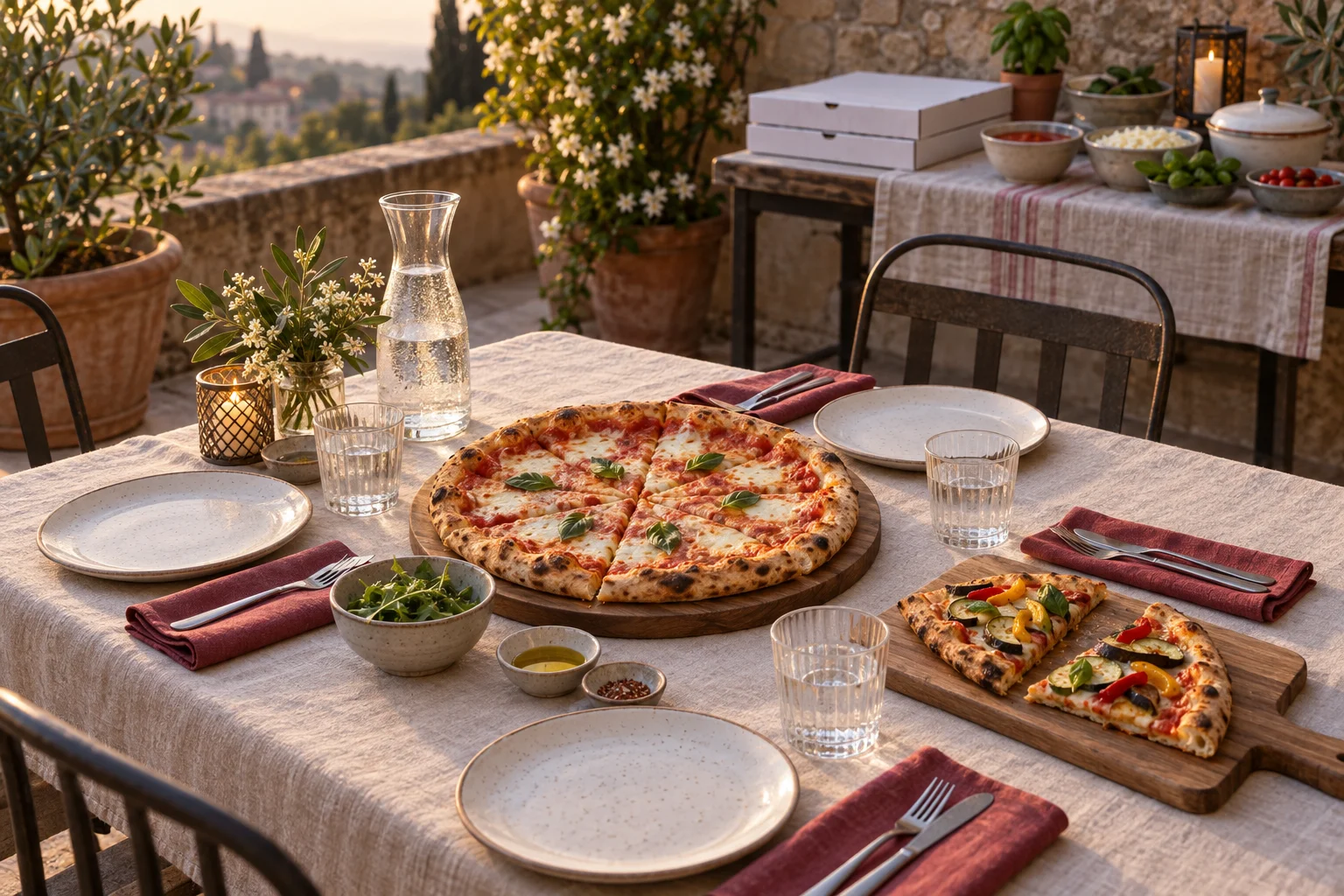
Decide how everyone will eat together
Two common wishes lead to different arrangements: everyone receives a whole pizza at roughly the same time, or the group shares freshly baked pizzas as they emerge. An oven that holds only one pizza usually lends itself better to sharing. You cut and pass around the first pizza while the next one bakes. Explain that arrangement in the invitation, so nobody waits for an individual main course while others have started eating. A small cold starter can bridge the gap before the first round. Include it in the planned meal and account for it when deciding how much pizza to make.
If everyone needs to eat together, a tray pizza made with a suitable recipe may be more practical. It provides several pieces from one baking cycle. Baking two trays at once only makes sense if the oven, shelf positions and recipe support that method; an additional tray does not automatically need the same cooking time. Choose your pizza style before shopping. Thin individual pizzas, generous pan pizzas and small pizzas that guests decorate themselves require different dough quantities, pans and preparation space. One main method is enough for a relaxed evening. A second dough style also adds proofing containers, baking conditions and questions to coordinate during the meal.
Work backwards from the first serving
Set an arrival time and an approximate time for the first pizza. These are two separate points in the evening. If guests arrive at 6 pm and the first pizza should reach the table around 6:30 pm, oven preparation and the necessary dough steps start earlier. Take the actual lead times from your chosen recipe and the oven instructions. Dough with a long refrigerated fermentation needs a different starting time from a same-day recipe. Warming dough balls after refrigeration is not a fixed waiting period that works equally well at every room temperature, with every ball size and for every formula.
Write down the dependencies first: mix the dough, allow the appropriate fermentation, divide it, give it any further proofing required, preheat the oven as instructed, then shape and bake the first pizza. Some steps overlap, while others need the same person or work surface. Add shopping, refrigerator space and ingredient preparation. This avoids an apparently generous schedule that requires shaping dough, grating cheese and setting the table in the same place at the same time. Leave a little unallocated time before guests arrive to absorb a late shopping trip or missing crockery. It cannot replace dough fermentation, and it is no reason to leave perishable toppings on the counter for a long time.
Keep the menu small and specific
A manageable selection is easier to bake consistently and share. You might offer a margherita, a vegetable pizza and a version with a meat topping requested by your guests. This is an organisational example, not a mandatory three-pizza menu. What matters is that ingredients overlap usefully and that each combination follows an appropriate recipe. One tomato sauce can serve several pizzas, while a few individual toppings provide variety. Consider which ingredients belong on the pizza after baking. Rocket, fresh herbs or another intended cold finish need space at the serving point, so they do not have to crowd the topping station.
Ask about dietary preferences and allergies before shopping. Vegetarian is a different requirement from dairy-free, and a list of wheat-free ingredients does not answer the question of accidental flour contact. Where an allergy is involved, discuss with the guest whether your actual kitchen and preparation arrangements are suitable. A different-coloured plate cannot resolve that by itself. Keep agreed variations on a short list so they are not forgotten during a busy round. Last-minute changes can still work when ingredients and the schedule allow them. An entirely new pizza requiring several unprepared ingredients can quickly delay the next batches.
Prepare what will save time later
Prepare dough and sauce according to their recipes and store them appropriately. Portion or grate cheese, wash vegetables and cut them for the intended method. Particularly wet toppings or ingredients that require cooking need their own preparation: draining, precooking and subsequently cooling safely are different jobs. Keep raw meat away from ingredients that are ready to eat. If a recipe specifies a precooked topping, it must actually be sufficiently cooked; a short stay in a pizza oven cannot reliably replace that step. Germany's Federal Institute for Risk Assessment, the BfR, recommends reaching at least 70°C for two minutes throughout food when cooking it thoroughly. Oven air temperature does not establish the temperature inside an ingredient.
Start with small amounts of perishable toppings in clean bowls. Keep the remaining supply refrigerated and bring it out as needed in fresh, clean containers. Do not repeatedly add new ingredients to leftovers that have already been standing around. For perishable food, the BfR recommends a refrigerator temperature no higher than 7°C, preferably below 5°C. Fit preparation to your available cold storage: tightly stacking many warm containers does not reliably chill a large party supply. Set out dry utensils as well, open necessary packages in advance and place serving boards, knives and plates where they will be used. These small jobs directly reduce the workload once baking begins.
Connect preparation, baking and serving
The first workspace is for shaping and topping. Keep only the dough balls and ingredients currently needed there, along with the appropriate work surface and tools. The second is the oven, with clear access and a sturdy, heat-resistant resting surface. The third is for cutting and serving. Arrange this sequence so people do not have to cross one another's paths. Someone fetching a drink should not need to pass between a hot pizza and the oven door. In a small kitchen, the spaces can sit next to each other. Their function matters more than a large piece of furniture or a separate purchase for each job.
Keep tools suited to their individual uses. A launching peel needs an appropriate clean surface; a serving board smeared with sauce cannot casually take over that job. Put cooked pizza on a clean serving board, rather than back on the surface used for raw dough. Clean hands and used surfaces as appropriate, particularly after contact with raw animal ingredients. Choose a fixed place for dirty dishes so they do not collect between dough and toppings. Children can take part at a suitable cold workspace under supervision. Operating the oven, handling hot trays and transporting pizza straight from the oven remain the responsibility of a designated adult.
Allow for the complete baking cycle
Your schedule depends on the time between one pizza being ready to serve and the next. That includes shaping and topping, launching, baking and turning, removing the pizza and, where necessary, allowing the baking surface to recover its heat. The baking time quoted on a product page does not describe this whole sequence. While one pizza bakes, a second person can prepare the next, provided it does not then sit topped on the peel for too long. Avoid lining up numerous raw pizzas on their launching tools in advance. Moisture and waiting can make them harder to release. An empty oven offers little advantage if the next pizza is stuck to its board.
A hypothetical calculation shows the scale: if finished pizzas reach the table at average intervals of five minutes, eight pizzas require seven further intervals after the first, or 35 minutes. Measured from the start of the first complete cycle, assuming that also takes five minutes, the total would be 40 minutes. This assumed output is not a promise for your oven. It simply explains why eight pizzas and a fixed mealtime need to be planned together. Choose a generous serving window instead of announcing an exact minute for every pizza. If the baking surface recovers heat more slowly, adjust the pace. Sending in more consecutive pizzas will not improve a pale base.
Involve guests without crowding the serving point
Briefly explain the planned pizzas and the sharing arrangement at the start. Guests who want to add their own toppings need a suitable spot and a manageable selection. One person could collect requests for the next round while another cuts finished pizzas. The person at the oven then does not have to take orders, search for cheese and move hot dishes simultaneously. A small gathering can remain informal, of course. It is simply useful to avoid three people starting the same task while nobody notices that the next pizza still needs preparing.
Help freshly baked slices reach guests promptly. A clear serving point works better than a crowded table where fresh and older slices become indistinguishable. Cut pizzas reasonably evenly and identify each variation. Handle agreed special portions using the actual separation arrangements they require; a quick spoken comment cannot replace that preparation. After a few rounds, ask who is still hungry and which pizza they would like. You can then adapt the remaining toppings to the group. There is no need to use every prepared ingredient or immediately bake every dough ball that remains.
Plan for delays and unsuitable weather
If guests are running late, all the dough need not come out of the refrigerator at once. Follow the recipe plan and take out further portions as the evening develops. Keep perishable toppings chilled for as long as practical too. If the start moves substantially, adjusting the announced mealtime is more useful than rushing every subsequent job. If equipment develops a fault, stop operating it according to its instructions and use only an alternative that is actually suitable. A different appliance may require another pizza style, baking surface or temperature. A tray pizza in a domestic oven is therefore a separate method, rather than a simple oven swap halfway through baking.
For a garden party, plan somewhere suitable to eat if the weather changes. That is separate from deciding where the appliance may operate. An outdoor gas, wood or pellet oven must not be moved into the house, garage or an unsuitable enclosed shelter because it starts raining. Follow the manufacturer's location and clearance requirements. An electric appliance is not automatically suitable for every indoor or outdoor location either. Decide in advance whether unsuitable weather means using an appropriate indoor cooking method or changing the menu. The group can then continue eating without an improvised, unsafe appliance location being introduced during operation.
Include the last round and leftovers
Announce the final baking round and ask again about appetite before topping more dough balls. Unused ingredients can often be stored separately according to their individual requirements more conveniently than numerous extra finished pizzas. Whether they can be frozen or stored longer depends on the recipe, product and temperature history. Do not leave leftover pizza on the table until the end of a long evening. If you intend to keep it, promptly transfer it to suitable shallow containers and cool it so that it reaches below 7°C within a few hours. Divide large quantities; cooling completely at room temperature is not a necessary preliminary step.
For food deliberately held hot, the BfR recommends at least 60°C throughout. A low oven setting or a plate that still feels warm does not demonstrate that temperature. At a private gathering, serving pizzas freshly in succession is therefore often easier to arrange than a prolonged hot buffet. After eating, organise the chilled ingredients, leave hot equipment safe according to its instructions and postpone cleaning until it has cooled appropriately. For the next party, note only observations that help your quantity planning: the number of guests, pizzas actually eaten and ingredients left over. A useful schedule comes from these concrete decisions, rather than offering as many simultaneous variations as possible.