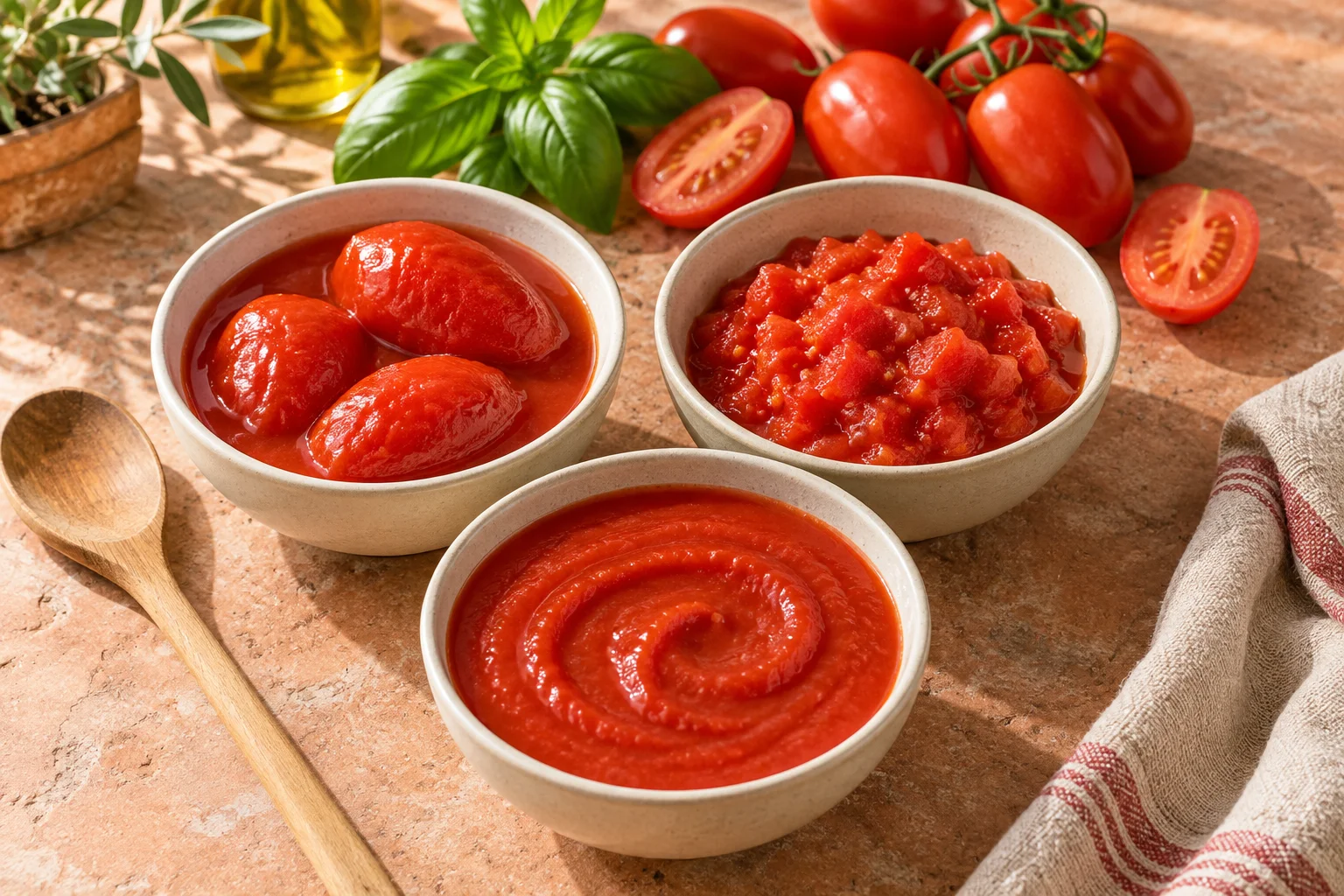
Start with the pizza you want to make
First consider what the tomatoes need to do. A thin red base layer calls for an easily spreadable sauce. Visible tomato pieces are a topping in their own right. Sauce for a thicker tray pizza may have a different consistency from the restrained tomato layer on a small pizza baked at very high heat. The word pizza on a package does not settle that question. What matters is how the contents work with the intended quantity, dough base and remaining ingredients.
Your baking method also belongs in the decision. A longer bake is not permission to add unlimited liquid. Equally, there is no need to reduce every tomato product to a thick paste in advance. Begin with the actual pizza recipe and its topping quantities. When substituting a product, check its consistency before assembling the pizza. A jar of thick prepared sauce and a can of tomatoes in plenty of thin juice are not automatically interchangeable by weight. This simple check is often more useful than searching for one supposedly best brand.
Crush whole peeled tomatoes yourself
Whole peeled tomatoes, often labelled pelati, let you decide the size of the pieces. Put them in a bowl and crush with clean hands, a fork or a potato masher. Remove any particularly firm stem attachment areas if present. Small uneven pieces are enough for a rustic sauce. For a finer result, pulse briefly in a blender. Check between pulses instead of blending until all the texture you wanted has disappeared. The appropriate degree of smoothness depends on how thinly you intend to spread the sauce.
Assess the juice separately from the fruit. If there is plenty of thin, clear liquid, let some drain through a sieve into another bowl first. Crush the tomatoes, then return only enough liquid to make the mixture spreadable. There is no universal requirement to drain every can completely; some products are already quite thick. Keep the collected juice available initially. If the crushed fruit turns out too firm, you can adjust it deliberately without introducing extra water or a different tomato preparation.
Choose chopped tomatoes and passata by their texture
Chopped tomatoes save some preparation. However, labels such as chopped, diced and polpa can cover different piece sizes and amounts of juice. Stir the contents and examine a spoonful. Large cubes create small raised patches on a lightly topped pizza, while finely chopped pulp can spread more evenly. If the pieces are noticeably firmer than you want, crush them further or choose a finer product next time. The name alone reveals relatively little about the result on your particular dough base.
Passata is strained tomato and is generally smooth. It is particularly useful when you want an even red layer. Smooth does not automatically mean either thick or thin, though: assess passata after opening as well. Check whether it already contains salt, basil or other ingredients. Whole peeled and strained tomatoes can both make suitable pizza sauces. Choose according to the texture you want and the preparation required, rather than treating one format as inherently higher quality. A familiar product that spreads as expected can make a busy pizza evening easier to organise.
Understand tomato paste and prepared sauce
Tomato paste is concentrated and is not a like-for-like replacement for passata by weight. Substituting one hundred grams of paste for one hundred grams of strained tomatoes substantially changes flavour and consistency. If a recipe includes some paste, that measured amount belongs to its particular sauce. Do not automatically add it because another tomato preparation looks lighter in colour. Nor should a thick layer of undiluted paste be treated as a universal pizza base. A sauce deliberately made from paste needs an appropriate ratio of paste, liquid and seasoning.
A prepared pizza sauce can be convenient when its seasoning suits the planned toppings. It may already taste strongly of garlic, oregano or other ingredients. Taste a small amount before adding more seasoning. A heavily salted sauce has a different effect beneath anchovies, capers or strong cheese than beneath mild vegetables. Note the product you used if you want to repeat a successful result. A similar-looking label on your next shopping trip may not be enough because formulations and varieties can differ. Check the actual product rather than relying only on the front of the pack.
Distinguish uncooked sauce from cooked sauce
Ordinary commercially canned peeled tomatoes can be made into sauce without an additional cooking stage. Uncooked pizza sauce describes your preparation here; it does not mean that the packaged tomatoes were never heated during manufacture. Crushed tomatoes with a little salt may already provide a suitable base. Keep the initial seasoning simple when cheese and other toppings should contribute their own flavours. A long simmer is not necessary merely because sauce is supposedly unable to taste like pizza without it.
Pre-cooking is useful when you specifically want to reduce liquid or develop a particular cooked seasoning. Use a sufficiently wide saucepan or frying pan and simmer gently without a lid. Stir regularly, especially as the sauce thickens. Judge the consistency rather than following a fixed number of minutes for every tomato product. Allow cooked sauce to cool before topping the dough. Include that time in your preparation instead of spooning a hot panful onto already shaped bases. The separate tomato sauce guide provides a complete recipe to follow when you want specific quantities and steps.
Check moisture before topping
Draw a small trail through the sauce with a spoon. It should move easily enough to form a thin film. If a lot of thin juice immediately gathers around solid pieces, consider whether draining or reducing would help. If instead a stiff mass remains that requires pressure to spread, add a little reserved tomato juice. This is a practical preparation check, not a standardised measurement. The sauce needs to work on the dough, rather than merely looking attractive inside its bowl.
Use the back of a spoon to spread the weighed portion without pressing deeply into the base. Work from the centre towards the outside, leaving the intended rim clear. Small gaps are less troublesome than a thick pool of liquid in the middle. If spreading the sauce drags the soft dough along with it, assess both the sauce thickness and your hand movement. More pressure can tear a weak area. Add toppings shortly before baking so a thinly shaped base does not spend unnecessary time sitting beneath the sauce while you finish other preparations.
Plan quantities for several pizzas
Choose the amount per pizza from your recipe first. As a calculation example only, using sixty grams of finished sauce per pizza means 240 grams for four pizzas or 360 grams for six. A bowl containing 300 grams would cover five pizzas at that same rate. This is not a universal recommendation for every diameter. A small pizza, a large New York-style pizza and a full tray need different amounts. Weigh the first portions so an initially thin layer does not gradually become larger spoonfuls without you noticing.
Calculate your supply from the sauce you will actually use. A can containing four hundred grams does not still provide four hundred grams of finished base after substantial draining. Weigh what remains rather than using the original can weight to promise too many portions. A cooked sauce also loses weight as water evaporates. Keep a little reserve separately if you are still learning how much you need. Leftover sauce can be used according to its storage directions; it does not all need to go onto the final pizza merely to empty the bowl.
Prepare fresh tomatoes as a separate topping
Fresh tomatoes bring visible pieces, skins and juice. Choose ripe, flavourful fruit, wash it and cut it to suit the topping. Thin slices or halved small tomatoes spread differently from large thick wedges. With very juicy fruit, let loose liquid drain away. Lightly salting and then draining is one possible preparation; account for that salt when seasoning the finished dish. Pat the cut surfaces gently dry if necessary without squeezing the tomatoes completely. The aim is to manage excess liquid while retaining the pieces you want to eat.
Decide whether fresh tomatoes will supplement a sauce or largely replace the red base layer. A full sauce portion, an uninterrupted layer of juicy slices and wet mozzarella all add up. Space the pieces out and observe the first pizza. Roasted tomatoes offer another variation with their own flavour; let them cool before adding them and drain excess liquid. Fresh fruit is not automatically the better choice than a suitable preserved tomato product in every season or for every sauce. Choose what works for the particular topping you are preparing.
Adjust flavour without burying it
Taste the tomatoes before seasoning and the finished sauce afterwards. Salt should round out the flavour without dominating the entire topping. Start cautiously when the product already contains salt. Dried herbs, garlic and oil are possible additions, not compulsory ingredients in every pizza sauce. Select a few that suit the dish. Garlic plays a different role in a marinara from its role beneath a delicate cheese or several strongly flavoured toppings. One standard seasoning blend need not be equally useful for every combination you make.
If the sauce tastes unpleasantly sharp, first consider whether you like the underlying tomatoes and whether the seasoning is balanced. A little sugar can soften the perceived flavour, but it does not automatically turn unsuitable tomatoes into a good base. Avoid repeatedly adding sugar, salt and herbs without tasting between additions. Extra seasoning is also unlikely to help a burnt flavour. For the next batch, compare another product using the same straightforward preparation. That lets you notice differences between the tomatoes instead of mainly comparing different amounts of seasoning.
Make a targeted adjustment after baking
A watery centre can come from sauce, cheese, vegetables or several ingredients together. Look beyond the can. If liquid is mainly gathered around mozzarella pieces, their preparation also matters. If the whole base is pale and soft, check the baking surface and preheating. If only the centre received a particularly thick coating, start by adjusting the distribution. Change one thing on the next pizza where possible. You can then judge whether that action addresses the problem you actually observed instead of attributing every difference to the tomatoes.
A few notes are enough for the next shopping trip: tomato product, preparation, quantity per pizza and the result with your usual cheese. After opening, follow the package directions for refrigeration and use, and work with clean containers and spoons. The appropriate pack size depends on your real needs as well as the price per kilogram. Selecting form, moisture and seasoning deliberately makes tomatoes a predictable part of pizza preparation. You do not need to assume a particular brand or geographical origin is essential before you can get started.