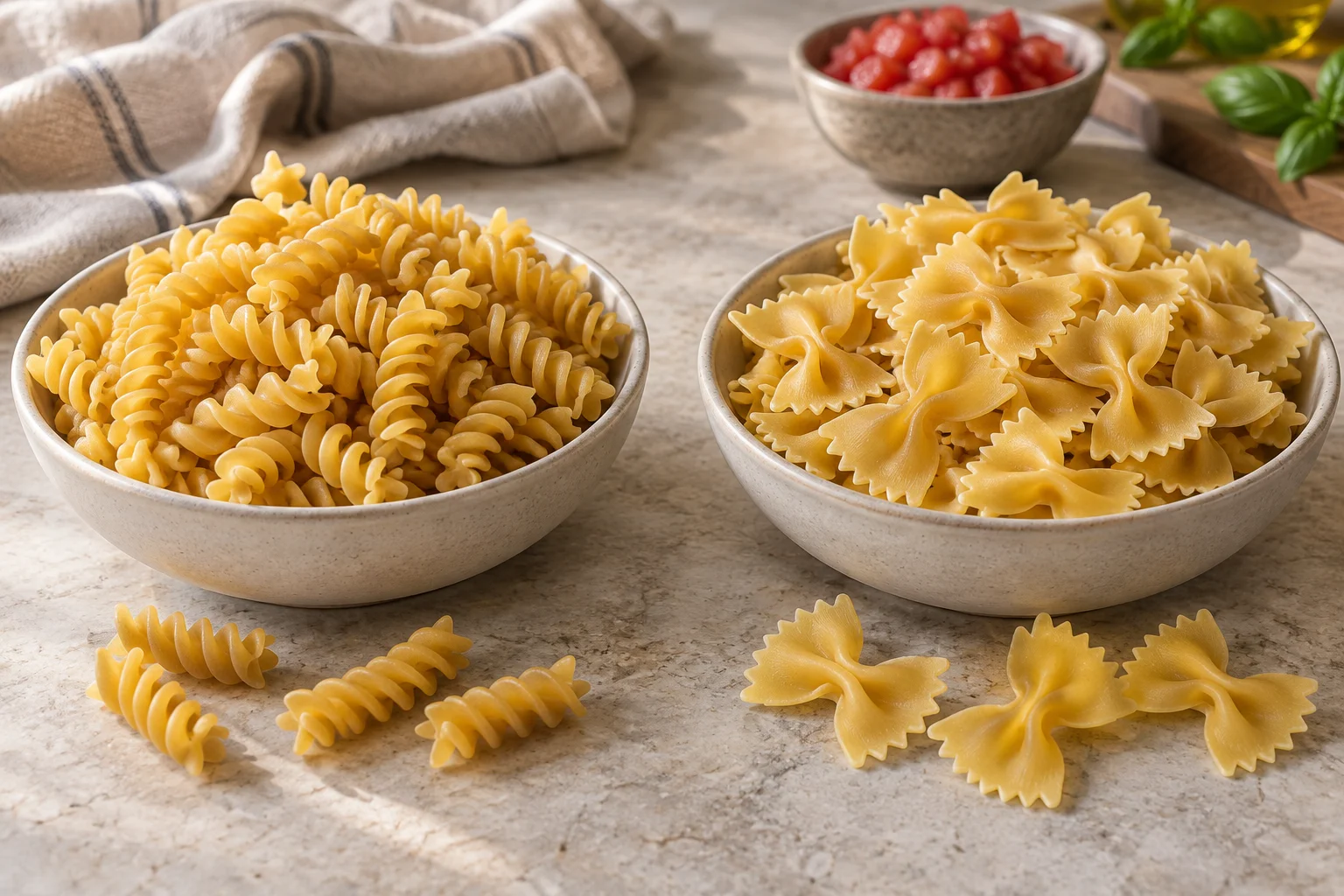
Recognise the spirals and bow ties
The classic fusilli discussed here are short twisted spirals. Small pieces of sauce can settle between their turns. Farfalle are flat pasta pieces pinched together in the middle to form a bow tie. Thinner wings meet a thicker folded centre. Size and construction vary between manufacturers.
Check the ingredients as well as the shape. Durum wheat pasta, egg pasta and gluten-free versions each need their own preparation. Colour or an Italian name does not reliably tell you what a product contains. A single shape can also come in smaller or larger versions, so one package’s cooking time does not apply to all fusilli or farfalle.
Prepare compatible sauce and ingredients
Fusilli are useful with small vegetable cubes, ricotta sauces or evenly distributed pesto. Farfalle offer broad surfaces for creamy sauces, tomatoes and lighter vegetable dishes. These are suggestions rather than fixed pairing rules. It matters more that the sauce remains loose enough to mix, instead of sitting in a dry lump beside the pasta.
Cut firm accompaniments so that pasta and vegetables can be picked up together with a fork. Long raw pepper strips among small spirals, for example, are less convenient than appropriately sized cubes. Add liquid in small amounts as needed. Follow the specific method for pesto or delicate cheese sauces; the pasta shape is no reason to bring them to a vigorous boil.
Check the centre of farfalle too
Cook according to the package and stir gently, especially at the beginning. Towards the end of the stated time, remove a piece, let it cool briefly and check its bite. For farfalle, include the folded centre in that check. Soft wings alone do not show that the thicker part is ready.
Do not mix dry fusilli and farfalle with different cooking times in one pot without planning their timing. When replacing one shape in a recipe, the same weight is a useful starting point for comparable dried pasta. Counting individual pieces is less helpful for portioning because their size and weight vary.
Plan pasta salad through to serving
Both shapes suit salads. Fusilli distribute small ingredients between their turns; farfalle display their broad wings on the plate. Cook them to a pleasant bite rather than deliberately leaving a hard centre. A universal instruction to reduce the time by two minutes does not suit every product.
Follow a complete salad recipe for whether to rinse, and cool cooked pasta promptly in shallow portions. Combine it with prepared dressing and vegetables at the stage specified by the recipe. Keep a small dressing reserve refrigerated in case the mixture becomes drier before eating. Our guide to preparing pasta salad provides a complete method with quantities and storage steps.