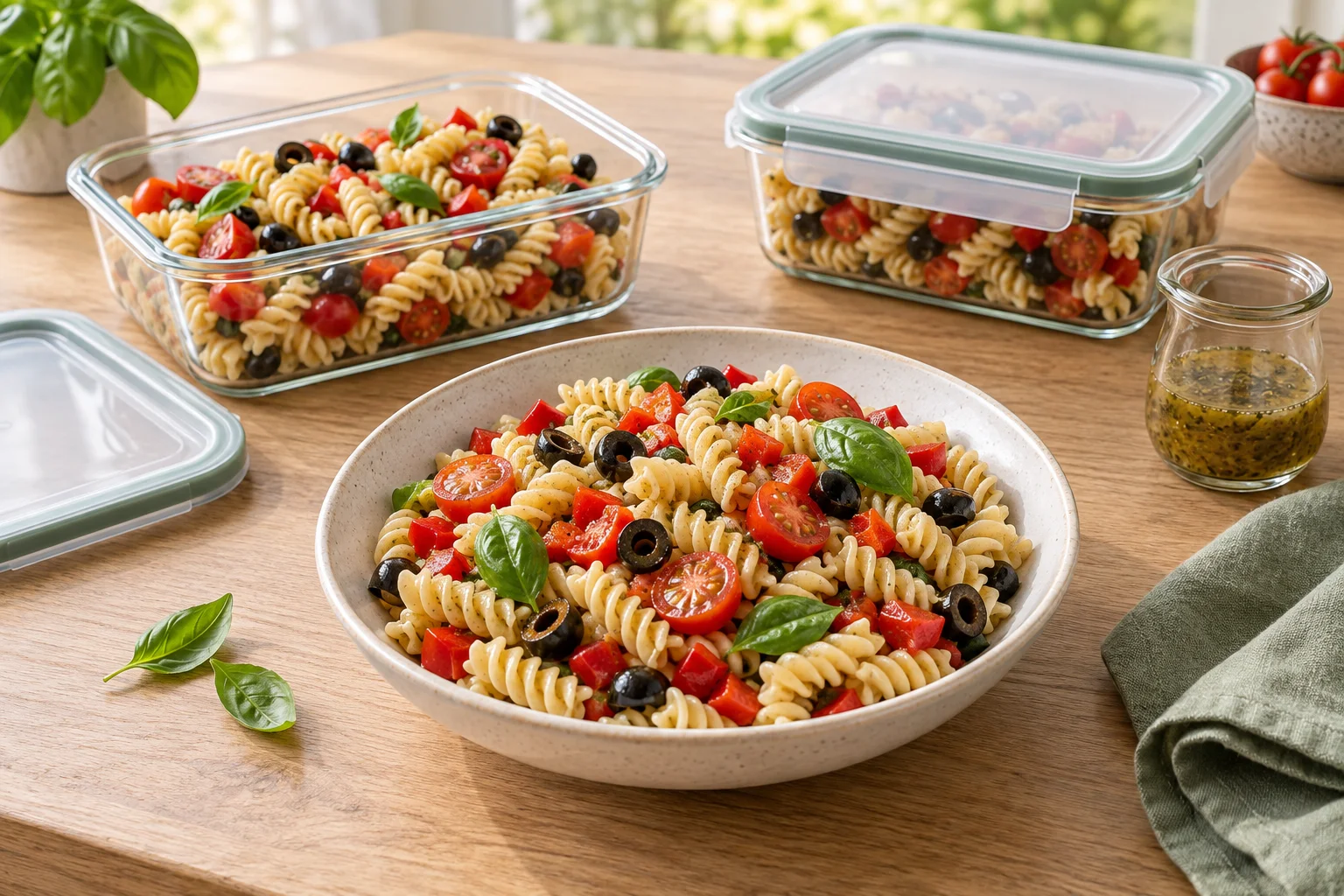
Decide its role in the meal first
A pasta salad served as the main dish needs different portion planning from one of several barbecue sides. Start by considering what else will be on the table and how many guests will actually eat it. The practical starting point here is our own version using 300 g dried fusilli for four lighter main portions or six side portions. That means 75 g or 50 g dried pasta per person respectively, with vegetables and dressing added. Appetite and the other dishes determine whether this allocation suits your group; it is not a fixed portion rule.
Next, plan refrigeration. Several shallow containers are often more suitable for preparation and storage than one large, deeply filled bowl. Before cooking, check that they fit in the fridge and that a cool bag with ice packs will be available for transport if needed. The attractive serving bowl does not have to hold the food through every preparation stage. If you can replenish small amounts, the reserve remains refrigerated until it is needed. This also makes mixing easier: a bowl with some spare space around the top is gentler to work with than a container filled to the brim.
Prepare a manageable basic mixture
For this version, use 300 g dried durum-wheat fusilli, 250 g cherry tomatoes, 200 g usable raw pepper flesh and 80 g drained, pitted black olives. You also need 4 tbsp olive oil in total, 2 tbsp white wine vinegar, 1 tsp medium-hot mustard, 1 tbsp drinking water, 10 g fresh basil leaves, salt and pepper. One tablespoon of the oil is for the drained pasta; the remaining three tablespoons go into the dressing. The olive quantity refers to the drained contents, rather than the weight of a jar including its brine.
Set out a clean colander, shallow food-safe containers, a small container with a lid for the dressing and a sufficiently large mixing bowl. Allow roughly 35 minutes of active preparation, plus the necessary cooling time. Wash the tomatoes, pepper and basil carefully under running drinking water. Remove the pepper stalk and seeds before weighing its usable flesh. Pat the basil dry. Cut the pepper into cubes roughly one centimetre across and slice the olives into rings. If preparing the day before, leave the tomatoes whole initially and halve them on the day of the meal.
Cook the pasta and cool it promptly
Cook the fusilli in sufficient salted water according to the packet instructions. Towards the end, lift out a piece, let it cool briefly and check its bite. The pasta should be pleasantly firm without a hard or floury centre. This version does not deduct a fixed number of minutes from every packet: thickness, shape and actual cooking time differ. Cooling later will not restore over-soft pasta to its original condition. Drain the finished fusilli thoroughly. Add the allocated one tablespoon of olive oil and distribute it by turning the pasta gently.
This method does not rinse the pasta with cold water. Instead, spread it shallowly in clean, heat-suitable containers so that it cools quickly, and transfer it to the refrigerator promptly. Divide large hot quantities among several containers; do not wait hours for a deep saucepan to become cold on the worktop. Avoid placing hot containers directly against sensitive foods that are already chilled. Once the pasta is chilled, keep it covered. Other complete salad recipes may call for brief cold rinsing. The useful approach is to follow one method consistently and drain well, rather than combine several different sequences halfway through.
Mix the dressing separately and add it gradually
For the dressing, combine the two tablespoons of wine vinegar with one teaspoon of mustard and one tablespoon of drinking water. Work in the remaining three tablespoons of olive oil and season lightly with salt and pepper at first. The olives already contribute seasoning. The small lidded container makes mixing easy and can then be kept in the refrigerator. Stir the dressing thoroughly again before using it, or shake it with the lid securely closed. Visible separation after standing is not automatically a preparation mistake with this kind of vinaigrette; mixing brings its components together again.
On the day of the meal, combine the cold pasta with roughly three quarters of the dressing, the pepper and the olives. Gently fold in the tomatoes, which should now be halved. Keep the remaining dressing portion refrigerated separately and add it shortly before serving if needed. You can then adjust the consistency without immediately pouring in more oil or vinegar. Leave the mixture to rest in the fridge for about 30 minutes if your schedule allows. This is for flavour and does not replace adequate chilling. Tear the patted-dry basil roughly and fold it through just before eating.
What makes sense to prepare the day before
The day before, you can cook the pasta, cool it promptly and keep it covered in the fridge with its allocated small quantity of oil. The dressing can also be made in its separate container. Label containers with their contents and preparation date if you are making several dishes for the gathering. This keeps everything clear without repeatedly opening similar-looking boxes. For this fresh version, preferably prepare chopped vegetables and herbs on the day of the meal. The work is divided into two short stages, while water-rich ingredients avoid releasing unnecessary liquid into the pasta overnight.
If you cut vegetables earlier, keep them chilled separately and use them promptly. The storage life of the complete salad depends on its most sensitive components and actual storage conditions. Freshly added dressing does not restart the pasta's storage time. Nor does mixing in a vegetable leftover that has already been stored for some time make that ingredient newly prepared. For a manageable plan, use ingredients in good condition and keep track of when they were prepared. Especially when hosting, bringing together a few clearly prepared components is easier than trying to combine every fridge leftover just before the meal.
Correct dryness or watery dressing
As the salad rests, its dressing can seem thicker and the pasta may become less moist. First stir gently and add some of the reserved dressing. If that reserve is already used up, begin loosening the mixture with a teaspoon of drinking water, mix again and check the result. A larger bowl may need further small additions. Extra liquid does not automatically mean extra flavour, so adjust the seasoning afterwards. Avoid immediately pouring in a large quantity of oil: it changes the mouthfeel but does not replace every missing water-based component of a vinaigrette.
If a lot of thin liquid collects underneath instead, consider its source. Poorly drained pasta, wet herbs, olive brine or tomatoes cut early can all contribute. More dressing will not necessarily improve it. If there is a substantial excess puddle, gently transfer the solids to a clean bowl and adjust the seasoning sparingly afterwards. For the next batch, drain the components more carefully and add tomatoes later. Fresh tomatoes do not need to produce a perfectly uniform result: a little juice belongs in the dish. A heavily diluted pool beneath otherwise dry pasta is less useful.
Choose additions and other dressings deliberately
Cheese, cooked beans or roasted vegetables can turn the basic mixture into a different meal. Choose one or two additions and adjust the salt and portion planning accordingly. Use already cooked beans after draining; raw dried beans do not go straight into the salad. Warm roasted vegetables must cool promptly before being combined with already cold ingredients for storage. For cheese, follow the packaging instructions and check that it is made using vegetarian methods if that matters for the meal. A dairy addition also changes what was previously a fully plant-based recipe.
For a creamy version, use a mixture designed for that purpose, perhaps with suitable shop-bought mayonnaise or yoghurt and corresponding ingredient quantities. Do not simply replace all the vinegar and oil with an equal weight of mayonnaise: seasoning and consistency change. Refrigerate these dressings according to the packet and keep supplies in the fridge until needed. Oil-and-vinegar salad also needs refrigeration; leaving out mayonnaise does not automatically make it suitable for a long, warm afternoon. If guests need to avoid particular ingredients, check the pasta, mustard, dressing and every addition together.
Prepare for transport and buffet service
For the journey, transfer the fully chilled salad to clean containers with secure lids. Pack them in the cool bag with enough ice packs just before leaving, and return them to refrigeration at your destination. An insulated bag without a cold source will not chill a warm salad. Allow for journey time and the actual facilities for keeping food cold at the venue. A small pre-chilled quantity is easier to manage over a longer journey than a large warm saucepan. Keeping the food chilled is part of the plan from the beginning, rather than only a question about what remains after the meal.
Put out small serving bowls and keep the reserve in the refrigerator. An appropriate chilled serving arrangement can help, provided meltwater cannot enter the salad. Bring replenishments in a fresh, clean bowl instead of adding them to leftovers that have already stood for a long time. Use a dedicated serving spoon and position the dish away from direct sunlight. Shade alone, however, is not active refrigeration. If you cannot maintain the required cooling during a longer serving period, plan smaller amounts that will be eaten promptly and replenish them more frequently from the fridge.
Scale larger quantities clearly
For twelve side portions, double the basic mixture: 600 g dried fusilli, 500 g cherry tomatoes, 400 g usable pepper flesh and 160 g drained olives. Use 8 tbsp olive oil in total, with two for the drained pasta and six for the dressing, plus 4 tbsp wine vinegar, 2 tsp mustard, 2 tbsp water and 20 g basil. Continue to adjust salt and pepper to taste. The initial dressing addition remains roughly three quarters, with the remainder reserved in the fridge. This increases the whole dish in the same proportions, rather than just increasing the amount of pasta.
Twice the quantity does not mean twice the cooking time. Pasta cooks according to its actual condition; a fuller saucepan may simply take longer to return to the boil. Provide sufficient water and space or cook two batches. Prompt cooling becomes especially important afterwards: a layer twice as deep does not cool as quickly as the original shallow portion. Divide the salad among additional containers and plan refrigerator space for them. If only a limited number of small portions can be chilled, adjusting the quantity to that capacity is more useful than leaving a large container unrefrigerated for a long time.
Plan leftovers and later meals
Keep unserved reserves that have remained continuously chilled covered at no more than 7°C, preferably below 5°C. Any stricter ingredient instructions take priority. BfR's general guidance is to use meals containing raw components no later than one day after preparation; this is not a guarantee independent of condition and refrigeration. Preferably plan the salad for the day of the gathering, with any clean, properly chilled reserve intended for the next meal if appropriate. A portion that has stood unrefrigerated at a buffet for a long time does not become reliably usable merely because it is put back in the fridge afterwards.
For a later occasion, a fresh small batch is generally more useful than freezing the fully assembled salad. Tomatoes, fresh herbs and some dressings change texture considerably. If you prepare meals regularly, keep dried pasta, suitable cupboard ingredients and a simple dressing recipe ready instead. Add fresh components to suit each meal. This division keeps pasta salad practical: the larger cooking step can be finished in advance, while flavour, fresh texture and the amount actually needed come together shortly before serving.