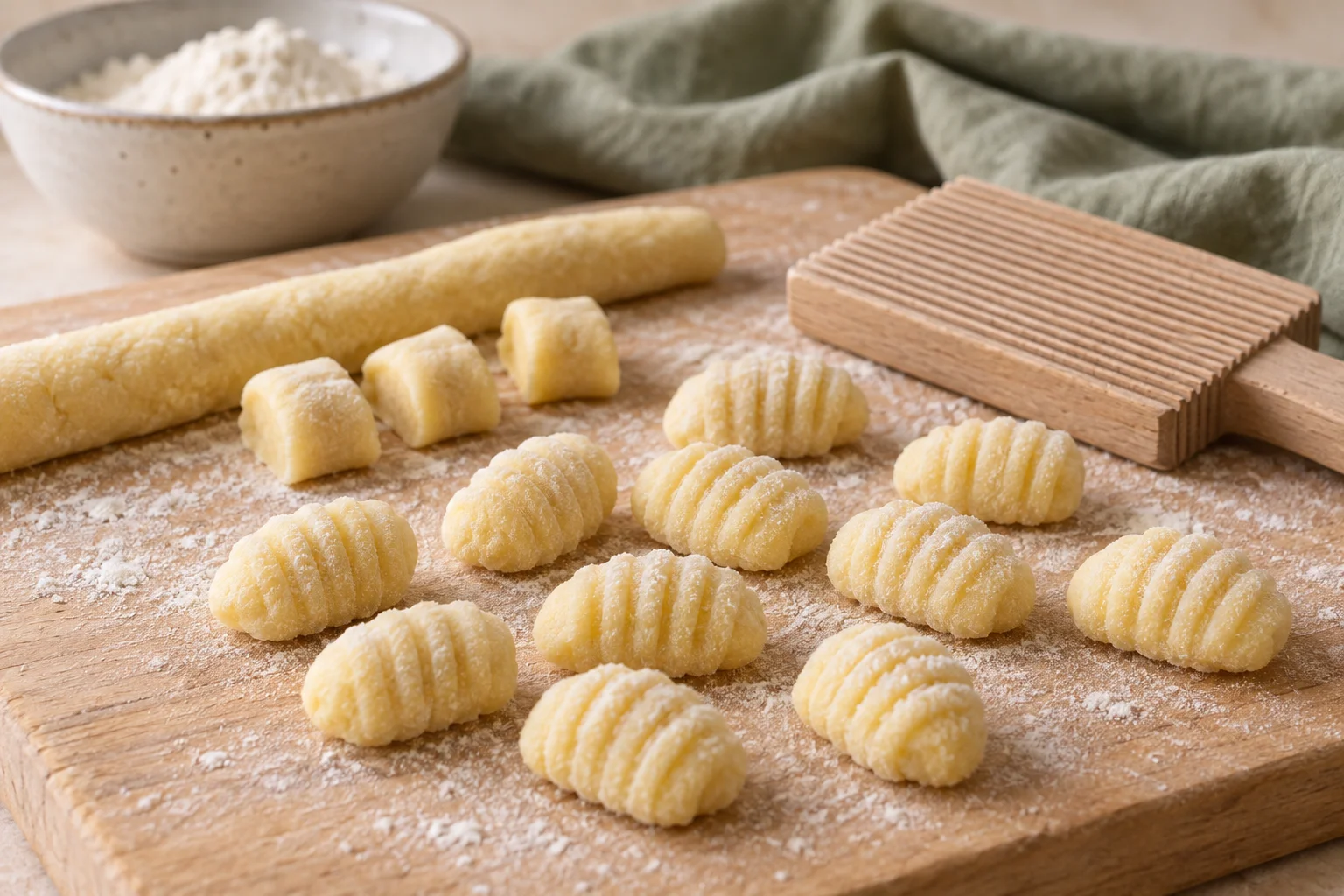
Choose potatoes and prepare the workflow
For this batch, use one kilogram of floury potatoes, weighed raw and with their skins on. Choose similarly sized medium potatoes so that they finish cooking at roughly the same time. A floury cooking classification is more useful when shopping than a particular skin colour. Even potatoes within one cooking group vary in moisture and starch content. The flour required therefore cannot be calculated solely from their raw weight. Very moist potatoes generally need more binding, which can also produce firmer gnocchi. Start with a suitable variety, then assess the cooked potato you actually have.
Set out a saucepan, potato ricer or masher, scales, a dough scraper and two lightly dusted trays. A fork is enough to make ridges; a gnocchi board is optional. Allow around 90 minutes before eating on your first attempt, and a little longer for large potatoes or slower shaping. Prepare a simple sauce while the potatoes cook. This prevents the finished dough from having to wait later. Keep enough worktop space clear as well: a long, narrow rope of dough needs more room than the bowl used to bring the ingredients together.
Cook in the skins and check the centre
Wash the potatoes, place them unpeeled in the saucepan and cover with cold water. Bring to the boil, then cook evenly without letting them knock against one another in violently bubbling water. For medium potatoes, around 30 to 40 minutes from boiling is a useful guide. Check the largest with a thin knife or fork: the tool should reach the centre without hard resistance. A soft outer layer is not enough, because uncooked pieces would remain in the dough and interfere with shaping later. Judge the centre rather than the clock alone.
Drain the cooked potatoes thoroughly. Do not leave them in their cooking water while searching for the ricer. Keeping the skins on during cooking avoids exposing numerous cut surfaces to water. Very large potatoes need longer; remove smaller ones when they are already done. Some gnocchi recipes use potatoes cooked in the oven instead. Their moisture loss can differ. Do not switch between cooking methods halfway through this batch and then expect identical flour absorption from exactly the same ingredient weights. Choose a method first and keep its effect on the potatoes in mind.
Rice while warm and let excess steam escape
Peel the potatoes as soon as you can hold them safely with a clean cloth or a suitable peeling fork. Protect your hands from the hot potatoes and steam. Press the warm flesh through the ricer onto a clean work surface or into a wide bowl. If using a masher, work carefully enough to remove firm pieces. A smooth mixture makes even, narrow ropes easier to form. Large potato lumps cannot be corrected later by kneading the dough longer and harder once the flour has already been incorporated.
Spread the riced potato loosely and briefly let strong steam escape. It should remain warm, but not so hot that the egg added next immediately sets. There is no need to leave it exposed for a long time. During this short pause, clear away the skins and place the weighed ingredients nearby. Any visible water collecting at the bottom of the bowl does not belong in the dough. After peeling and cooking, the original one-kilogram raw weight is no longer the weight of potato flesh used. Remember that distinction when comparing quantities later.
Measure flour and egg clearly
Weigh 300 grams of German Type 405 wheat flour or a suitable fine plain wheat flour. Add 250 grams initially and keep 50 grams for possible adjustment. You also need 50 grams of beaten whole egg without shell, five grams of fine salt and, if wanted, a small pinch of nutmeg. Weigh the egg because its size classification does not specify an exact shell-free weight. This batch makes roughly four main-course servings with sauce; its actual dough weight depends on peeling losses and the amount of flour ultimately needed.
The reserved 50 grams of flour are a contingency, not a compulsory final ingredient. If the dough already holds together well, leave the remainder unused. Conversely, 300 grams is not a magic upper limit that makes every wet potato mixture workable. If you need considerably more, the texture will generally become heavier; reconsider the potato variety and steam release next time. Do not calculate this mixture like a wheat pasta dough with a simple water-hydration figure either. Potatoes contain water and already cooked starch whose proportions cannot be established reliably from the purchase weight alone.
Mix only until the dough holds together
Scatter the initial 250 grams of flour, salt and optional nutmeg over the warm potatoes, then add the beaten egg. Gently bring everything together with a scraper, followed by your hands. Lift and press the mixture instead of kneading it like bread for several minutes. Aim for a soft, cohesive dough that can be rolled into a short rope. It should feel delicate. A particularly tight, elastic ball is not a quality marker here. Stop mixing once the ingredients are distributed evenly and no pockets of dry flour remain.
If only the surface is slightly sticky, lightly dust the worktop before mixing more flour through the whole batch. If a separated piece instead slumps and cannot be rolled at all, add the reserved flour in small amounts, around ten grams at a time. Briefly incorporate each addition and reassess. One gnoccho from the first small shaped portion can be cooked in gently boiling water to check whether it holds together and cooks through. Cut the cooked piece to inspect its centre. Do not taste the raw egg-and-flour dough.
Make even ropes and small pieces
Divide the dough into several working portions. Cover the mixture you are not using and begin with one manageable piece on the lightly floured surface. Start in the middle and move your hands outwards with gentle pressure. A rope around two centimetres thick is a useful target for this method. If it becomes too long for the board, divide it rather than letting it hang over the edge. Even thickness matters more than a perfectly straight line, because pieces of very different sizes will take different times to cook.
Cut pieces roughly one and a half to two centimetres long. Leave them as small pillows or give them ridges. For ridged gnocchi, lightly press each piece against the back of a fork or a gnocchi board and roll it across with gentle thumb pressure. Aim for a shallow indentation, not a hole right through the piece. If the dough sticks to the tool, dust it lightly and remove any stuck residue. Do not repeatedly knead already shaped gnocchi back into the full batch merely because the first few look uneven.
Keep shaped gnocchi in separate pieces
Place the pieces apart on the prepared trays. A thin dusting helps them release later; a little semolina or flour is enough. Gently shake off loose excess before cooking. A pile of soft gnocchi may save space but can quickly join into a mass that is difficult to separate. Several small trays are more useful. Once a manageable cooking portion has been shaped, you can cook it if the sauce is ready and someone is watching the pot. This avoids making every dumpling wait until the entire batch has been ridged.
This dough needs neither the long rest used for rolling egg pasta nor yeast fermentation. Work through it promptly. If there is an extended interruption, refrigerate the pieces covered instead of leaving them beside the hob. Raw egg and flour remain raw ingredients even within a potato mixture. To prepare a supply for later, preferably freeze the already shaped pieces. They are easier to use than a large frozen block of potato dough. Freezing does not replace clean preparation or the refrigeration required during longer pauses in the work.
Cook gently in small batches
Bring a large saucepan of salted water to the boil. Add only enough gnocchi for them to move freely. Once the water has returned to temperature, keep it at a gentle boil. Carefully release any pieces stuck to the bottom without stirring vigorously. Rising to the surface means you should now examine the gnocchi more closely; it does not automatically establish that every piece, whatever its size, is cooked inside. For these small fresh shapes, begin checking around two to three minutes, depending on thickness and the dough itself.
Lift out one piece with a slotted spoon and cut it open. Its centre should be evenly cooked and soft, with no raw, floury area. If the middle is not ready, give the batch more time and check again. Around another minute after floating may be needed; size and condition decide. Lift cooked gnocchi gently from the water and let them drain briefly. Tipping them forcefully into a large colander can damage the soft pieces unnecessarily. Before adding the next batch, wait until the water is boiling evenly again.
Bring the sauce and gnocchi together gently
Have the sauce ready before cooking the first batch. A flowing tomato sauce is particularly easy to control: put a small amount in a wide warm frying pan, then lift in the drained gnocchi. Move the pan gently or turn the pieces with a broad spoon. They should become coated without being crushed beneath a heavy mound of sauce. If the mixture is too stiff, a few spoonfuls of cooking water help. Add more liquid only after distributing the existing sauce and assessing its consistency, rather than automatically pouring in a large amount.
For pan-frying, the gnocchi must already be cooked and well drained. Use a sufficiently wide pan with an appropriate amount of fat and turn them once their surfaces release. This additional browning is a separate step, not a substitute for cooking a raw centre. If making a bake afterwards, account for that further cooking too. Gnocchi alla Sorrentina combines cooked potato dumplings with tomato and cheese. Avoid planning both extensive pan-browning and a long oven bake when the texture you actually want is a tender, soft dumpling. Match the finishing method to the intended dish.
Diagnose problems and plan the freezer portion
If gnocchi disintegrate in the saucepan, first check water movement and batch size. Vigorous boiling or an overloaded batch can damage otherwise workable dough. If the raw rope is already almost impossible to shape, there may be too little binding or too much moisture in the potatoes. Hard, rubbery pieces more often point towards excessive flour or handling. More kneading is not a useful correction in that situation. Next time, compare one factor first, such as the potato variety or the actual flour quantity incorporated, so that the observation remains useful.
For later meals, place uncooked shaped gnocchi separately on a suitable tray and freeze until firm. Only then transfer them into freezer bags or a suitable container, label and store closed. Cook directly from frozen in small batches; allowing them to soften first can make the surface sticky. They may need longer to cook, so check the centre again. Freezing fits naturally into the workflow when the shaped quantity exceeds today's meal. Clear space for that portion before mixing instead of leaving finished gnocchi waiting unchilled while you rearrange the freezer.