Decide which pasta belongs in the freezer
Fresh uncooked pasta can be shaped completely before freezing. Cut the ribbons, finish short shapes and seal ravioli fully. This removes the time-consuming work from the day you cook. A lump of dough can also be frozen, but it will still need thawing, rolling and shaping later. If your aim is a quick evening meal, fully shaped pasta therefore offers more help. Before starting, decide how much you will serve today and how much will go straight into storage. Give each its own space so that the portions remain easy to identify.
Unfilled noodles and ravioli receive similar treatment during initial freezing, but need separate cooking plans. Thin ribbons cook differently from a doubled seam surrounding a filling. Potato gnocchi are another distinct case: their soft dough needs small cooking batches and particularly gentle handling. Cooked leftovers are different again, being a completed dish that needs cooling and later thorough reheating. Do not pack these supplies under one vague label. Knowing whether the contents are raw or cooked matters more later than recognising the exact colour of the pasta through the bag.
Prepare space and containers before shaping
First check that a small baking sheet or tray fits level inside your freezer. A full-size oven tray is often too wide. Two smaller suitable trays may be more practical, but both need space without crushing existing packages. Line them with material suitable for food contact and freezing, adding a light dusting of flour if the dough is sticky. The pasta should lift off later without being prised from the frozen tray with a knife. A thin coating is enough; thick piles of flour simply follow the pasta into the cooking water unnecessarily.
For subsequent storage, use freezer bags or tightly closing containers intended for freezing. A rigid box protects delicate ravioli from pressure better than a bag beneath heavy frozen packages. Flat bags save space for sturdier short shapes. Have labels and closures ready before removing the first portion from the freezer. Set the appliance to around minus 18 degrees Celsius and check its temperature as directed in its instructions. A compartment that merely feels cold does not establish that it can freeze food and keep it frozen for longer storage.
Divide portions around the meals you plan
Weigh the pasta you have actually produced after shaping. As a calculation example, 600 grams of fresh unfilled pasta makes four packs of 150 grams each. For two people, that gives two meals using two packs per meal. Decide whether this quantity suits your appetite, sauce and any other courses when planning. It is not a universal serving recommendation. Filled pasta includes the weight of its filling: 800 grams of finished ravioli could become four bags of 200 grams each, without implying that this contains the same amount of dough as ribbon pasta.
You can group ribbons into the chosen quantities while arranging them on the tray. For a larger portion, two small loose nests are often easier to handle than one dense ball. Leave short shapes separate and weigh them into portions after freezing. For ravioli, a piece count on the label can help as long as you also record the total weight. Twelve small pieces may weigh much less than twelve large ones. If you cook for one, individually removable portions avoid having to soften an entire family-sized supply or break apart frozen clumps.
Freeze ribbons and short shapes separately first
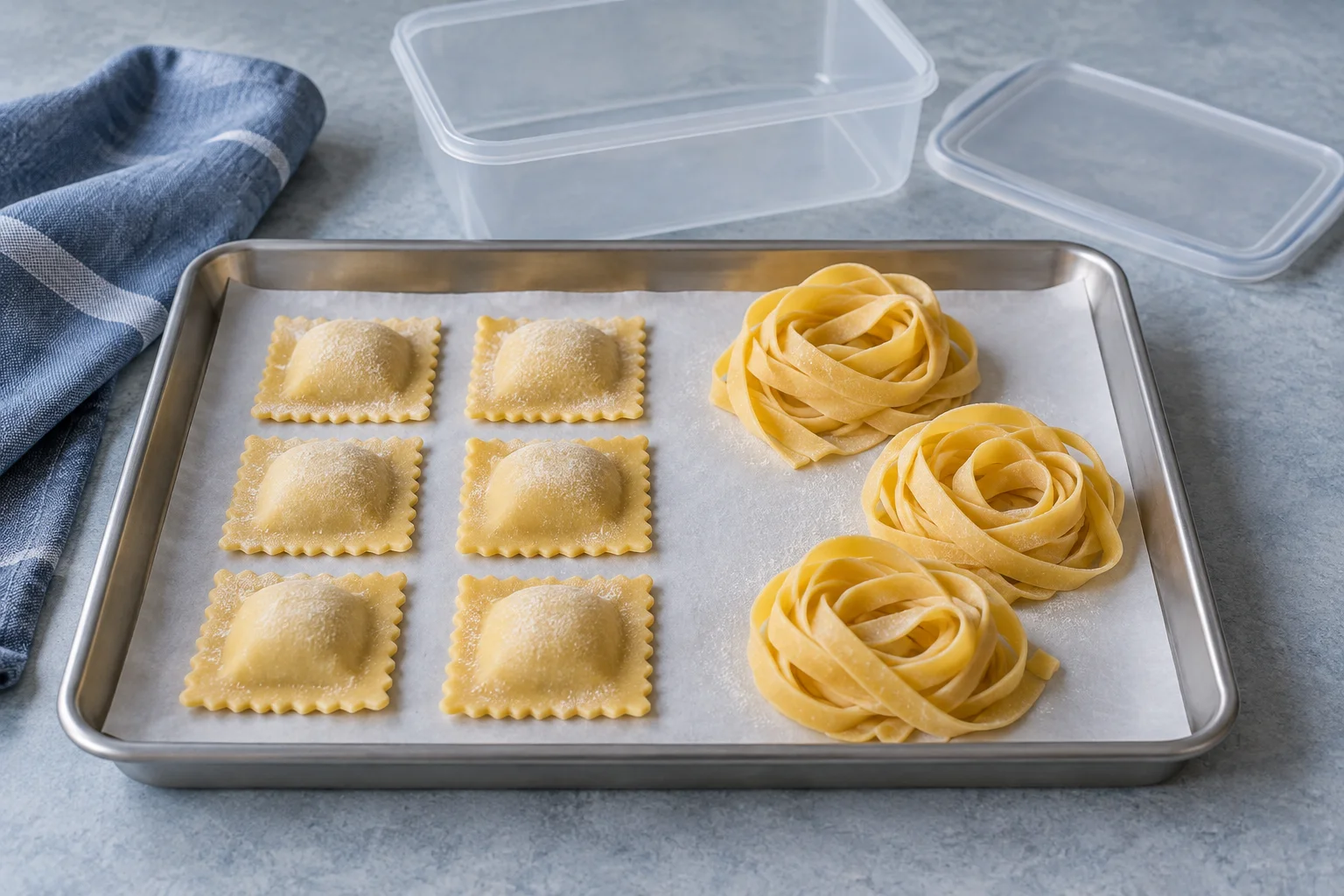
Arrange long ribbons loosely so that the loops are not tightly pressed together. A little flour on contact surfaces helps separate sticky strands. Nests can sit beside each other but should not touch. Spread short shapes in a single layer where possible, leaving small gaps. The purpose is to give each piece a stable shape before combining them in one package. Complete drying is unnecessary. Freshly shaped pasta does not need to spend hours on the worktop before it can be frozen. Move it into the cold promptly once the tray is ready.
Put the loaded tray directly into the freezer. Wait until the pieces are firm and can be lifted without changing shape. One fixed number of minutes would not be useful here: thickness, starting temperature, the freezer load and appliance performance affect the time required. Check briefly and close the compartment again if any parts remain soft. Only then transfer the pasta quickly. Once it is firm, do not leave it on the open tray for longer than necessary; the closed packaging that follows protects its surface during continued storage.
Ravioli need clean seams and a cool filling
Prepare the filling so that it holds its shape without releasing free liquid. Squeeze or drain cooked vegetables as the recipe requires and drain loose whey from ricotta. A cooked filling needs prompt cooling and refrigerated storage until use; hot filling does not belong on a thin sheet of dough. Gently press out trapped air when sealing and keep filling away from the seam. Freezing will not close an open edge. Repair such pieces before storing them, while the dough is still flexible enough for the edges to join properly.
Lay ravioli flat on the prepared surface without overlapping. Once the first layer is solidly frozen, stack it carefully in a suitable container, using appropriate separating sheets if needed. Avoid pressing on the filled centre. For this straightforward storage method, choose a recipe with clear cooking instructions, such as a ricotta filling or one made from fully cooked ingredients. A thick raw meat filling requires a method designed for it; the brief cooking time of thin ribbons cannot be transferred. Label different fillings separately even when their pasta wrappers look identical.
Work promptly and count all time outside refrigeration
A useful freezer supply starts with fresh ingredients and clean handling. Do not taste raw flour or raw egg dough. Keep the total time that egg pasta spends outside refrigeration short; around two hours at ordinary room temperature is the upper guide, with less time in warm conditions. Mixing, resting, rolling and filling all count together. If an elaborate batch takes longer, work with smaller amounts and refrigerate the remaining ingredients and dough during extended pauses, keeping them covered. The freezer cannot rescue dough that has already spent an unknown or excessive time warm.
Freezing suppresses the growth of many microbes but does not make raw ingredients sterile. Pasta must still cook thoroughly after freezing. For refrigerated pauses, use a cold refrigerator, no higher than seven degrees and preferably below five degrees Celsius; stricter instructions on ingredient packs take priority. Do not leave prepared fillings beside a warm hob. If interrupted, return the perishable ingredients to refrigeration first. This keeps the later meal straightforward without making you reconstruct the history of an unidentified portion when you eventually open its bag. Cold storage is part of preparation, not a final repair step.
Pack, label and keep the supply manageable
Transfer firm pasta to the prepared packaging and gently remove excess air without crushing nests or filled shapes. Close the bag completely or check the container lid. Record the shape, filling, approximate portion quantity, freezing date and whether the contents are uncooked or cooked. A label such as ricotta ravioli, uncooked, 200 grams tells you considerably more on cooking day than pasta alone. If you use several doughs, add egg or egg-free. This also helps match the appropriate cooking instructions and avoids accidentally cooking shapes of very different thickness together.
Plan to use the pasta when you freeze it, perhaps for two evening meals over the next week or two. That is practical stock planning, not a blanket shelf-life guarantee for every filling. For longer storage, follow the specific recipe or product guidance and maintain a suitable freezer temperature throughout. Place older portions where you will notice them first. Dry, rough patches caused by freezer burn are initially a quality issue, not proof of spoilage. Unknown breaks in refrigeration or visible spoilage are separate concerns; conversely, an ordinary smell does not prove safe storage.
Cook shaped raw pasta straight from frozen
Prepare the sauce, plates and a sufficiently large pot of salted water first. Keep the frozen pasta in the freezer until shortly before cooking. Add a manageable amount to boiling water so that the pieces can move and the water quickly returns to temperature. Gently separate thin ribbons once they soften in the water. Move ravioli carefully without pressing a spoon onto their seams. Then maintain a gentle boil suited to the shape. A crowded pot bubbling violently can damage delicate filled pasta, while too much frozen food at once cools the water unnecessarily.
Cooking usually takes longer than for fresh pasta, but not by exactly the same extra minute for every shape. Start with the underlying recipe's guidance and check particularly thick parts. With ravioli, both the seam and filling centre matter; floating alone is not a sufficient doneness check. A hygiene guide for filled dishes is at least 70 degrees Celsius for two minutes throughout. If unsure, use a suitable kitchen thermometer. Combine fully cooked pasta with the prepared sauce. Cold pesto provides no extra cooking stage, so the pasta must already be done in the water.
Treat cooked leftovers separately
When cooked pasta remains after a meal, you are freezing a different product from raw shaped noodles. Promptly divide larger amounts between shallow containers and cool them quickly instead of leaving a deep warm pot standing for a long time. Refrigerate the portions promptly, then freeze the amount intended for storage. Note the sauce on the label, because a plain tomato sauce behaves differently on reheating from a delicate cheese emulsion. Leftovers that have already stood unchilled on the table for too long do not become fresh again through later freezing.
Depending on the dish, reheat in a pan with a little water and a lid, or in a suitable microwave container. Stir or turn the food so that the centre heats too, bringing the entire portion to at least 70 degrees Celsius for two minutes. Follow the preparation instructions for purchased meals. Cooked noodles can become softer after freezing than freshly made ones. For a supply whose final bite is easier to control, uncooked shaped pasta is therefore often the more useful starting point. Reheating leftovers nevertheless remains a separate, practical option.
Prevent common problems in the next batch
A solid block of noodles often forms when soft pasta goes straight into a bag or is crowded too closely on the tray. Do not force the pieces apart with a knife. Smaller loose groups and freezing until firm before packing help with the next batch. If already firm ribbons break during packaging, use less pressure and a more protective container. For ravioli with split edges, also check dough moisture when sealing, seam width and protection against drying. A freezer cannot subsequently strengthen a pocket that was never properly closed in the first place.
If pasta emerges soft outside but unevenly cooked inside, check the amount added to the water and the thickness of individual pieces. Cook shapes with noticeably different cooking times separately. Keep a brief note of the dough and result alongside your recipe planning. Specific observations such as two small nests per bag or ravioli frozen separately before boxing are particularly useful. They make the next supply easier to plan without changing the recipe, filling, packaging and cooking quantity all at once. You can then identify which adjustment actually improved the pasta you served.