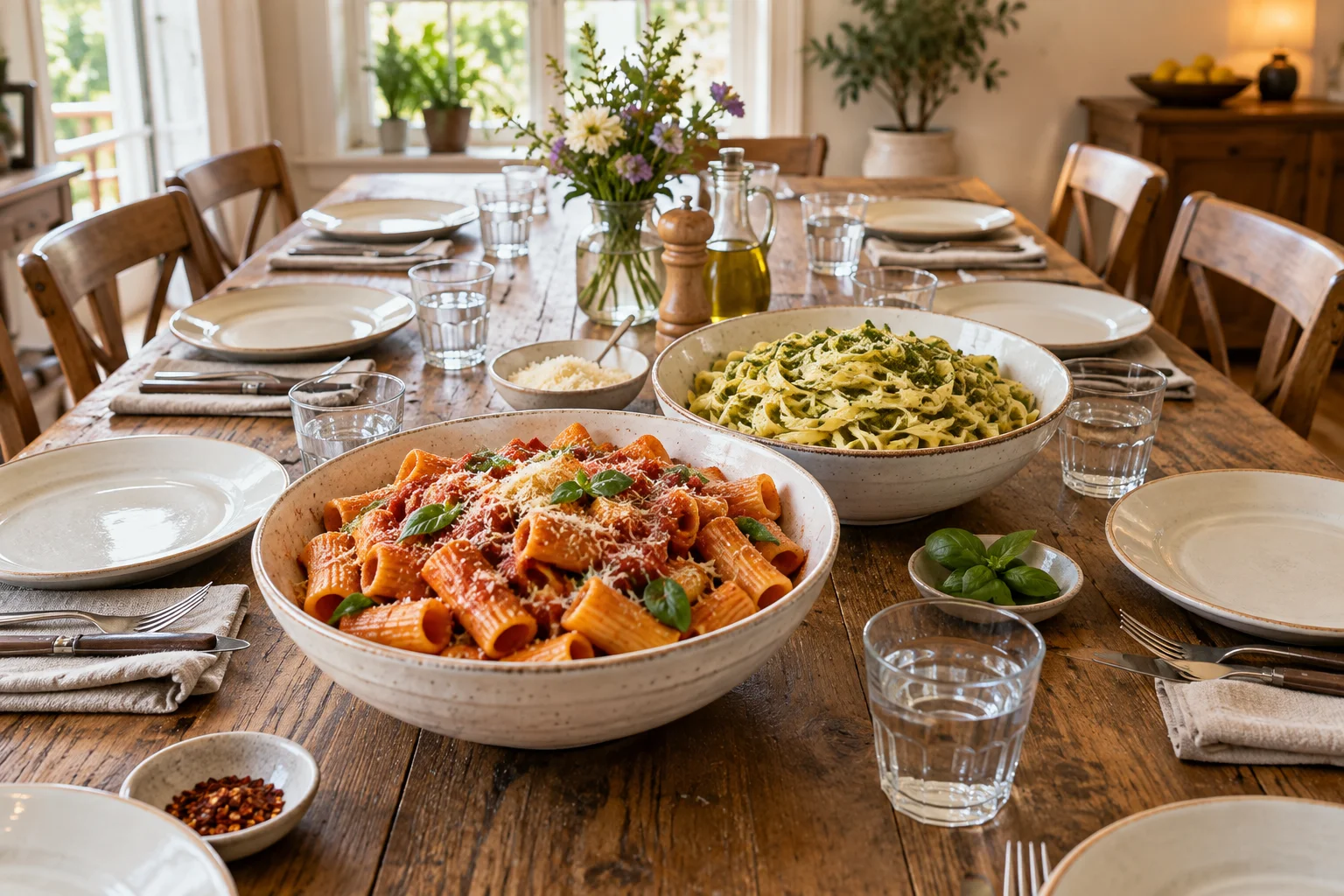
Start with a specific menu
Cooking pasta for eight rarely fails because of the sauce. The pressure usually comes when a large batch needs draining, combining with sauce and dividing among plates at the same moment. Plan backwards from serving. Which pans can hold the finished quantity? How many pots can boil simultaneously on your hob? Who will carry the plates? Once those questions are settled, you can prepare much of the meal ahead and reduce the final minutes to a few clear tasks.
In this example, eight people receive a main course of penne with tomato sauce and a green salad. We allow 100 grams of dried pasta each, or 800 grams altogether. That matches the portion size in our pasta al pomodoro recipe. Adjust it for a meal with several courses or smaller appetites. At 80 grams each, the total would be 640 grams. These are planning quantities for dried pasta, not a general rule for fresh or filled shapes.
For the sauce, multiply our two-person recipe by four: 1.6 kilograms of tinned tomatoes, eight tablespoons of olive oil, four garlic cloves, basil and salt to taste. The tomato quantity is its weight before reduction. Prepare cheese to serve separately if wanted. This keeps dairy out of the sauce itself. Check your pasta and other side-dish ingredients when guests avoid particular foods. A separate cheese bowl alone does not make an entire menu suitable for every intolerance.
Your hob and pans set the practical capacity
For this example, split the 800 grams of pasta between two pots, with 400 grams in each. Around four litres of water per pot is a useful starting point if the pots are large enough to leave room for boiling. A pot with a nominal capacity of roughly six litres may suit. Check whether both large pots fit on your hob simultaneously and whether their cooking zones can heat them effectively. A full pot is heavy, so plan a safe route for draining it.
You also need two sufficiently large vessels for combining pasta and sauce. Two deep, wide frying pans or suitable pots are often easier than one overcrowded pan. Cooked pasta takes up considerably more space than dried pasta. Picture where the actual finished quantity will go. If you have only one large pot and a small pan, deliberately serve in two rounds or choose a recipe designed for oven cooking. Adding ingredients alone cannot increase the number of guests your equipment can serve at once.
Jobs you can finish the previous day
Tomato sauce can be cooked ahead. Warm the garlic gently in the oil, add the tomatoes and reduce uncovered until the sauce is cohesive but still moves easily. Four times the quantity does not necessarily need four times the cooking time. Pan width and evaporation have a greater influence. Divide a large batch among shallow containers for prompt cooling and refrigerate it. Store covered at no more than 7 °C, preferably below 5 °C.
Set the table, prepare serving utensils and weigh the dried pasta into two batches. Wash and thoroughly dry the salad; keep chilled ingredients refrigerated until needed. Add dressing shortly before the meal. Note the pasta packet's cooking time so nobody needs to find it once the water boils. This preparation removes more pressure than trying to keep a large batch of fully cooked noodles warm for a long time.
A schedule for eating at 19:00
The following schedule assumes pasta with an approximate eleven-minute packet time and two usable pots at once. Begin the sauce around 18:10 if cooking it fresh. Reheat prepared sauce thoroughly in good time, bringing every part to at least 70 °C for two minutes. Put the pots of water on by around 18:30. How long your hob takes to bring them to the boil depends on water quantity and power. Allow a buffer and do not leave them unattended to boil over.
By 18:45, have the sauce, salad, plates and both finishing pans ready. Add pasta to boiling water around 18:48 and stir at the start. Begin tasting around 18:56. When it is just short of your preferred doneness, reserve cooking water and divide the pasta between the sauce pans. Combine for the final one or two minutes and serve around 19:00. Adjust the starting time for a different packet instruction. Tasting takes priority over the minute-by-minute plan.
Salt and cooking water for a larger group
Salt the water deliberately. A salty sauce, Parmesan or other salty additions affect the final dish. There is no need to follow a vague rule that every pot should taste like seawater. For this example, you could begin with around 25 to 30 grams of salt in four litres of water and adjust the sauce at the end. This is a starting point for this tomato sauce. If you prefer less salt, begin lower and season the finished portion as needed.
Set out two heatproof mugs and scoop out some cooking water from each pot before draining. Begin combining each pan with just a few tablespoons. You may need more, but not automatically the whole mug. Too much water at once makes the sauce thin, while the pasta may become overcooked during subsequent reduction. Add small amounts and watch whether the sauce coats the pasta. Our guide to binding pasta sauce explains this final stage in greater detail.
Offer two sauces without doubling the rush
If you want a choice, keep the second sauce simple and prepare it completely ahead. Divide the pasta according to likely demand while weighing it. For eight people, you might plan five portions with tomato sauce and three with pesto. At 100 grams of dried pasta each, those batches are 500 and 300 grams. Choose pot sizes accordingly. Two equally sized pots do not mean they must contain equal amounts of pasta.
Combine pesto with hot pasta and a little cooking water away from strong heat. Plan a separate bowl or pan for it. Put cheese, chilli and other extras on the table rather than creating a different hob-cooked version for every guest. With allergies, removing an ingredient afterwards is insufficient. Establish beforehand which ingredients and contacts must be avoided, and use appropriately separate equipment and procedures. If you cannot provide that separation, tell the affected guest in advance.
Serve while the pasta is still moist
Avoid decorating eight plates elaborately one after another while the remaining pasta waits in its pan. Two large warmed serving bowls can simplify things if they hold the quantity and reach the table promptly. Check the consistency immediately before transferring. Pasta continues absorbing liquid after cooking. Sauce that still looks loose in the pan may cling much more tightly after several minutes on the table.
If you prefer individual plates, arrange them in a row. Another person can offer cheese and carry finished plates while the cook concentrates on portions and sauce. Serve portions intended to be eaten together as promptly as possible. For an informal meal, an announced second round is often more pleasant than eight lukewarm plates. Choose the serving method before cooking. Once the pasta is ready, there is little time to find serving dishes or clear table space.
Why lengthy warm holding disappoints
Pasta continues cooking and absorbing liquid in hot sauce. Half an hour in a warm pot can substantially change its bite and consistency. Adding more sauce initially only partly addresses the problem. For a meal with a fixed start, it is usually easier to have sauce ready and cook the pasta shortly beforehand. If guests are delayed, postpone the pasta. A pot of water can wait much more comfortably than cooked noodles.
A long buffet requires a different method from this dinner. Small freshly prepared batches are easier to replenish. Hot-held food must remain at least 60 °C throughout; a lukewarm pot is unsuitable. Pasta quality also suffers during prolonged holding. A bake or another dish with an appropriate recipe may be easier to organise. Match the food to the eating window. Do not transfer a method for eight people eating together directly to a party lasting several hours.
When the plan changes
If one pot boils more slowly, do not add both batches merely because the clock says so. Work from genuinely boiling water and check each batch separately. If one becomes ready first, put it into its sauce and serve that group promptly. If sauce is too thick, add cooking water by the spoonful. If it is thin, reduce it further before adding pasta whenever possible. Cooling or adding oil cannot restore a firm bite to noodles that have already become too soft.
If some guests will arrive later, hold back their uncooked pasta and delay that batch. Do not automatically cook everything at once. A small reserve of dried pasta is easy to store for extra appetites, although it still requires a fresh cooking round. Offer the planned portion first, then decide. Cooking an entire extra packet in advance tends to create leftovers rather than improve an otherwise well-organised evening.
Leftovers and the next dinner
Chill remaining pasta and sauce promptly after the meal, preferably in shallow containers. Use refrigerated leftovers within two to three days and reheat thoroughly. If sauce and pasta are still separate, package them separately. You can then combine the amount needed for another meal and adjust the liquid. Food left on the table for a long time cannot be treated like freshly cooked leftovers simply by refrigerating it later. Decide early which food will no longer be served.
After dinner, note only what will help next time: whether the dry quantity was right, whether the pans were large enough and whether all portions reached the table on time. This creates a reliable plan for your own kitchen. Perhaps six portions fit comfortably into your usual method while eight require two rounds. Knowing that limit is more useful than a blanket quantity formula. Your guests should eat well together, and you should get to sit down with them too.