Decide who the pizza is for
Start with the working day at the stand. Feeding ten colleagues who take lunch in turns requires a different service from a reception for invited customers. For the team, scheduled deliveries across several breaks may work well. At a meeting, portions should be ready together and comfortable to eat at the table. An open counter serving passing visitors brings another pattern of demand and movement. First write down who will eat, when they are likely to arrive and whether pizza is a meal or a small accompaniment. The total number of visitors attending the exhibition does not answer those questions.
Keep visitor hospitality separate from the team's breaks if you are providing both. Otherwise the planned staff lunch can disappear into the open reception while colleagues remain on duty until late afternoon. Decide who will meet the caterer and accept deliveries, too. Someone giving a product demonstration at the scheduled time cannot also wait at the delivery entrance. A small stand will often need only a clear assignment in the existing daily schedule. There is no need to create another layer of organisation: what matters is a reachable contact and a substitute while that person is talking to customers.
Check the event's requirements before choosing a supplier
The venue may have its own catering services, contracted partners and conditions for outside suppliers. Messe Frankfurt, for example, names Accente as its hospitality partner and offers catering services accordingly. That does not establish a general right to bring in any food truck, or a nationwide ban on outside deliveries. Ask specific questions about your event: may the proposed supplier deliver or work on site, what registration is needed, and which services must be ordered through the organiser? Provide the hall, stand number, event date and proposed method. Permission relating to an outdoor area is of limited use if you intend to serve food inside a hall.
Baking at the stand also involves the equipment. Appliance type, fuel or power source, heat, vapour and installation must fit the permitted arrangement. Messe Frankfurt's technical guidelines for 2026, for instance, contain specific restrictions on fuels and cooking appliances. A rule allowing a displayed appliance to be demonstrated does not authorise continuous catering with it. Even an electric oven needs suitable positioning and a sufficient electrical supply. Have the responsible parties confirm your actual arrangement before booking a mobile oven. Current event rules and the appliance instructions apply together; a photograph of a similar exhibition stand replaces neither.
Choose between delivery and cooking on site
Delivery of fully baked pizza requires reliable receipt and serving at the stand, but no baking operation of your own. It can suit a scheduled team break very well. The actual transport distance, desired arrival time and size of each delivery matter. A service that drives to the exhibition grounds does not automatically reach the correct hall entrance or your stand. Establish whether the pizzas arrive cut, which plates or other serving items are supplied, and who removes the packaging afterwards. A pile of boxes behind the reception counter soon occupies space that the team needs for working materials.
On-site preparation allows successive fresh batches and can suit a longer reception. It also requires working space, staff, ingredient storage and the agreed technical setup. A mobile pizzeria outdoors is a different arrangement from a small hospitality area inside an exhibition stand. Compare complete services accordingly. A delivery-only price cannot usefully be set alongside a quotation covering setup, several hours of staffing and subsequent cleaning. Ask both suppliers when the first portion will actually be ready to eat and how further deliveries or baking batches will work during the agreed period. The comparison then becomes a decision about the service you need.
Calculate quantities by portion and serving window
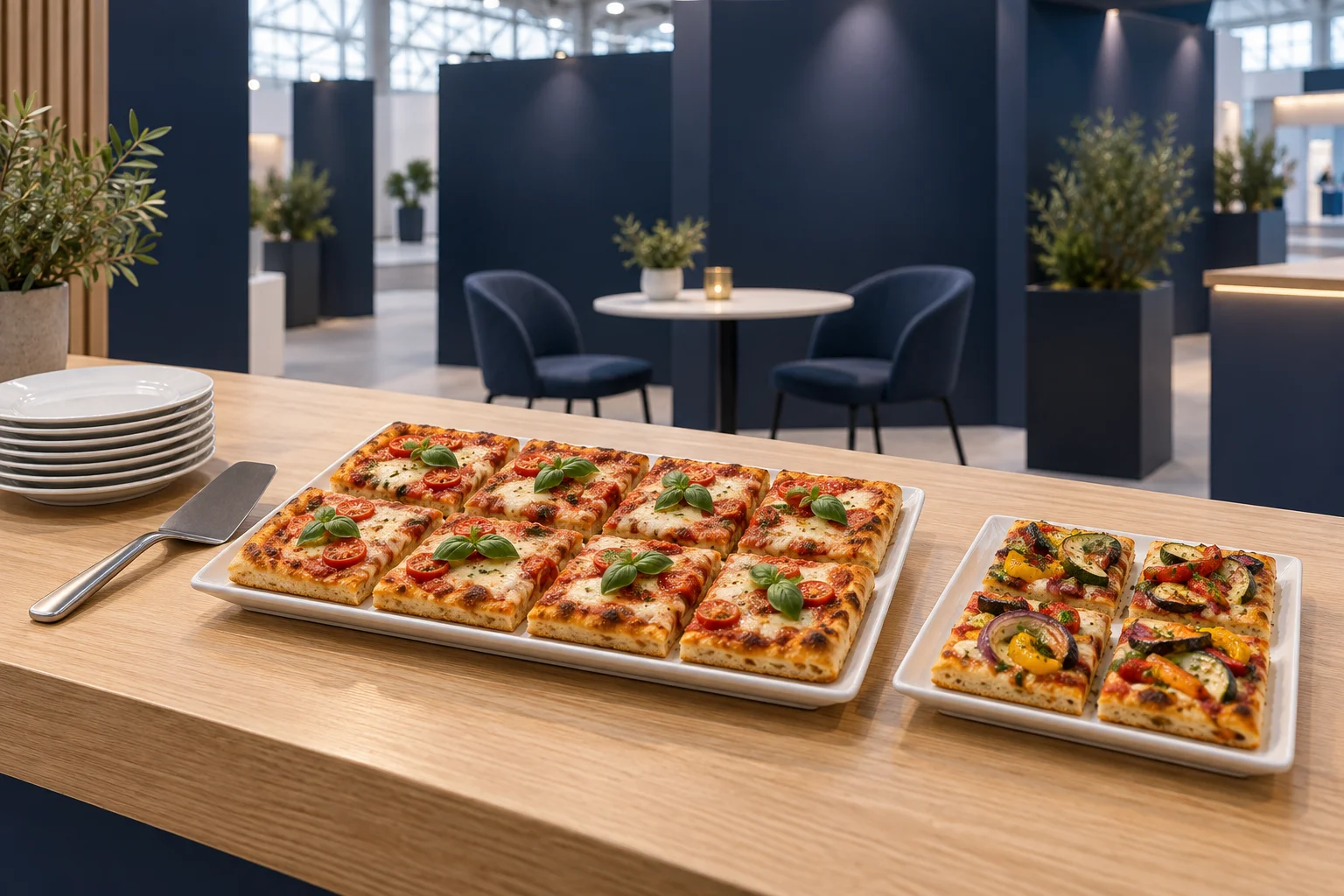
Small pieces are often easier to distribute at a reception than whole round pizzas. The quotation must still define a portion. A small tasting sample is not a full meal. Agree the size, cutting pattern and intended amount to be eaten with the supplier. In a hypothetical example, you want to offer 60 invited guests two small pieces each. That requires 120 pieces. If the agreed pizza size is divided into eight equal pieces, the total is 15 pizzas. This calculation depends on that particular size and purpose. It is neither a general recommendation per guest nor evidence that everyone will have eaten enough.
Next place the quantity into the schedule. Offering those 120 pieces over 90 minutes is different from serving all of them during a 15-minute break. The latter requires an average of eight pieces a minute. The caterer must confirm whether the proposed staffing, cutting and serving arrangements can meet that demand. The baking time of one pizza does not describe the complete service capacity. You can agree a limited extra quantity for second helpings or additional guests. Record it as one explicit reserve so that it is not counted again in every variety and every delivery round.
Plan the final journey to the stand
Send the caterer more than the venue's public postal address. They need the particular event, hall and stand number, the agreed entrance and a telephone contact for the handover. Find out whether vehicle registration, access passes or time slots are required, and who arranges them. Messe Frankfurt, for example, manages access during setup and dismantling through registration and check-in. That does not prove the same procedure applies throughout every exhibition day. Check the traffic information for your event and distinguish deliveries, setup and collection. Also establish whether the vehicle must leave the grounds once it has unloaded.
Consider the route from the unloading point: distance, lifts, door widths and possible queues all affect the handover. A hot meal cannot wait indefinitely at access control. Agree a realistic procedure and suitable transport arrangements with the supplier. If the stand becomes accessible only shortly before the break, arriving much earlier without suitable interim storage achieves little. For a multi-day event, check the contacts and times for each day even if the food order stays the same. Collection on the final day may coincide with general dismantling. Include that potential bottleneck in the order so that crockery and equipment can be returned in time.
Give food, conversations and returns enough space
Mark the serving point on the existing stand plan. Guests should be able to collect food without obscuring demonstrations, dirtying working equipment or spilling into the exhibition aisle. A place to put a plate is particularly helpful when visitors are also carrying bags, coats and literature. Keep circulation and escape routes clear, and agree any additional counter with the stand builder. The space outside your stand is not an unrestricted extension of your floor area. Where space is tight, a small staffed service at a table may work better than a buffet with several people queuing simultaneously.
Used crockery needs a return route. Plan an identifiable collection point, enough clean plates and the agreed removal of used items. Drinks and pizza do not necessarily need to be served from the same narrow spot. Supplies, clean utensils and waste also need space that should not have to be found during the reception. If the caterer stores ingredients at the stand, suitable refrigeration and hygienic work surfaces must actually be available. The existing coffee machine, lighting and presentation equipment may share the proposed supply with new appliances. Have the combined requirements properly assessed: adding power strips does not increase the available electrical capacity.
Offer a small, understandable menu
A short selection makes serving easier while still giving guests a real choice. Choose contrasting flavours instead of several nearly identical versions. For an international exhibition audience, clear ingredient descriptions in the relevant languages are helpful. An invented Italian dish name alone explains neither the toppings nor how spicy a pizza is. Manageable pieces with restrained toppings often suit standing conversations. Very soft pizza can also work if plates, cutlery and seating match it. The actual pizza matters, rather than an assumption that every variety can be eaten neatly with one hand.
Include special dietary requirements early in the enquiry. A vegan option encompasses the dough, sauce, cheese alternative and finishing ingredients. For allergies, the team needs dependable supplier information and a contact who knows how the food is actually prepared. A separate sign or a second pair of serving tongs does not establish safe separation. Explicitly agree any individual portions and their handover. If the caterer changes an ingredient at short notice, the information at the serving point must change too. Keep the current ingredient mapping where food is served. An older menu in someone's inbox is of little help when a guest asks a question beside the plate.
Request a complete quotation
The enquiry should state the date, service window, location, guest group, portion assumptions, menu and chosen supply method. Add the confirmed access conditions and division of tasks at the stand. Request a total price with clearly identified services and taxes. Check travel, setup, staffing, crockery, packaging, return transport, cleaning and any services charged by the organiser in particular. Two quotations can cover the same food while differing substantially in their overall scope. Ask about minimum quantities, deadlines for changes and how additional portions will be charged. An open-ended promise to deliver more when needed also requires a reachable contact and a realistic lead time.
For multi-day events, quantities and service periods should be identifiable for each day. Some teams are larger during setup than during the exhibition; others need less food on the final day. A venue delivery service's opening hours and ordering terms may also apply specifically to setup and dismantling days. The published Accente pizza flyer states such a scope, so do not assume that an older flyer's prices or times form a current offer for your reception. Have availability for your particular booking confirmed. Decide internally who may approve chargeable additions, so that several colleagues do not independently place the same extra order.
Manage service through to the final collection
A short joint briefing before the first delivery should establish where food will be received, who checks the allocation, when serving begins and who decides on the next quantity. Keep food protected and at the appropriate temperature using the agreed method. An ordinary pizza box is not evidence of adequate hot holding. If service continues for a longer period, the supplier should plan replenishment and temperature management accordingly. Fresh pieces belong on clean serving surfaces; used plates and leftovers with an uncertain history do not return to the supply. The exhibition team should take on only the tasks it has actually agreed to perform.
At the end, distinguish the last serving time from collection. Establish which supplies the caterer takes back and whether suitable leftovers can be handed over safely at all. Without appropriate storage at the stand and during the journey home, taking food away is not a workable default. Afterwards, record a few useful observations: portions served, peak demand, delivery waiting time and remaining quantities. A longer queue does not in itself prove greater exhibition success. More useful questions are whether guests and staff were well fed and whether the planned conversations could take place. Those observations provide a concrete basis for the next booking.