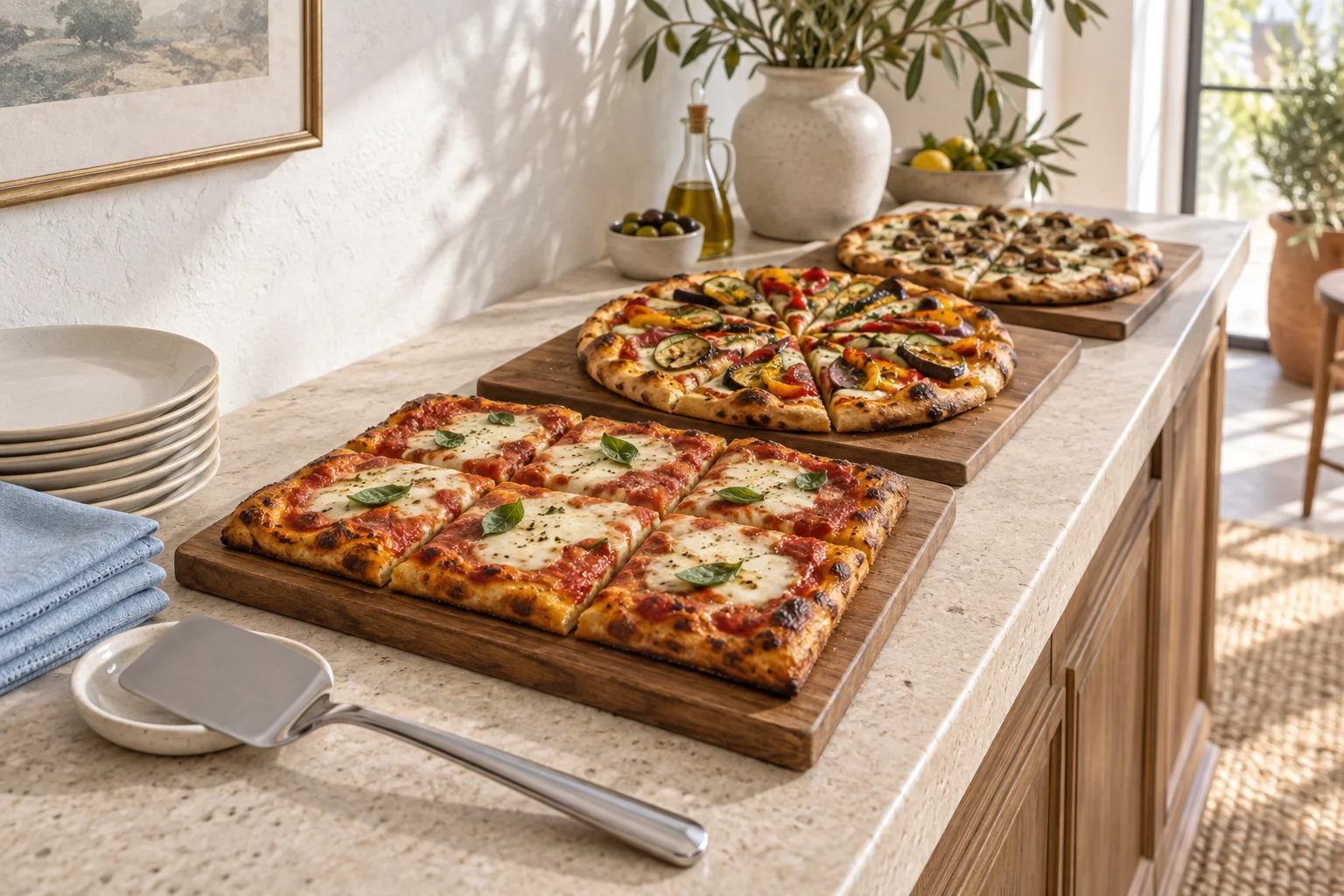
Treat the buffet as a serving point for fresh batches
A pizza buffet does not require every planned pizza to be on the table simultaneously. For a private celebration with one oven, a selection replenished throughout the meal can be manageable: the first varieties open the meal and others follow gradually. This keeps the table clear and avoids holding a large quantity of cooked pizza for a long time. Explain that more pizzas will be baked. Guests then need not collect several large slices just in case, mistaking an empty board for the end of the food. A short gap between varieties is also easier to understand when the serving arrangement is clear.
The situation differs when an entire team needs to eat during a brief break or all guests reach the buffet together. The opening quantity matters: how many slices are ready when serving starts, and how quickly will more follow? Base this on actual baking cycles or a specifically agreed catering schedule. An advertised oven baking time covers neither preparation nor cutting and serving. A provider with appropriate capacity may suit a large group eating within one fixed break. For a private gathering, you can instead spread out the serving period or choose a pizza style that provides more pieces per baking cycle.
Choose pizza styles for cutting and handling
Rectangular tray pizza can be cut into consistent pieces and arranged clearly on flat platters. You can bake different toppings on separate trays without shaping each piece individually. Use a recipe that suits the available pan and oven. A thick base needs a different process from a thin pizza; area alone does not establish the dough quantity. With round pizzas, similar diameters and a consistent number of slices make sharing easier. Long narrow tips can bend when lifted, whereas smaller, properly supported pieces are easier to handle on a suitable plate.
Softer pizza remains an option when served freshly with suitable crockery and cutlery. Do not present every pizza as crisp finger food. A soft Neapolitan base and generous topping call for different expectations from firm pieces of tray pizza. Decide whether guests will mainly sit or stand while eating. When standing, sturdy plates and pieces that can be picked up without additional cutting are useful. Smaller pieces can suit children without implying a fixed amount they should eat. A buffet allows people to return for more, which is often more helpful than providing a particularly large first portion.
Create a small menu with clear differences
Choose varieties that differ in flavour while fitting your preparation arrangements. A tomato-and-cheese pizza, a vegetable version and another requested variety can already provide sufficient choice. Different names alone do not create a useful selection if every pizza carries almost the same ingredients. Conversely, an extensive menu may require numerous opened packages, extra bowls and differing cooking conditions. Start with the guests: which varieties are likely to be popular, and which have specifically been promised? Allocate quantities accordingly instead of automatically preparing equal amounts of everything. A popular simple pizza can reasonably make up a larger share of the menu.
Prepare wet toppings as the recipe requires. Drain mozzarella packed in liquid when appropriate, and precook mushrooms or other vegetables where the method calls for it. Overlapping layers add moisture and weight to the base. More toppings therefore do not solve the problem of feeding more guests; that requires more suitable portions. Consider ingredients added after baking too. Fresh herbs or rocket can be added at an attended serving point rather than sitting beneath hot slices for a long time. Where recipes allow, offer spicy additions separately. Give them a clear label and their own utensil so every variety does not unintentionally become spicy.
Calculate whole pizzas and ready-to-serve slices
Establish the pizza quantity from portion preferences, pizza style and the other dishes. Then translate it into slices for serving. As a worked example, suppose twelve equally sized pizzas have been agreed for a particular group. Eight slices per pizza produce 96 slices. If four pizzas are ready initially, the buffet opens with 32 slices; the remaining 64 arrive in later rounds. This calculation only describes an assumed arrangement. It does not mean twelve pizzas always feed a particular number of guests, or that every oven can bake four pizzas simultaneously.
Divide the planned total between varieties before shopping. In this example, six pizzas might receive a basic topping, four vegetables and two another agreed combination. The total remains twelve pizzas. A specifically planned vegan pizza counts within that quantity unless it represents an additional portion. Derive dough and ingredients from the individual recipes. Include a deliberately chosen reserve once in the total. Rounding up to whole packages may leave further ingredients, which do not all need to go on the pizzas. Keep usable supplies separate where possible and decide during the meal whether the reserve is actually needed.
Arrange the table from plates to finished portions
Put plates at the start of an accessible route. Follow with pizzas in a clear order and then any side dishes. Cutlery and napkins can go at the end or already be placed at the seats, so guests do not have to hold everything while helping themselves. Give drinks a separate position if possible. Someone refilling water then does not block a guest choosing pizza. A narrow, accessible table can be more practical than a deep surface that requires people to lean across it. Keep tall decorations away from hands, serving tools and hot food, and leave a clear route back to the seating area.
For a larger group, offering the same popular variety in two accessible places may help. Replenishment must genuinely work at both points, however. Two labels beside a single small board do not double serving capacity. Consider whether guests of different heights can reach the platters safely. Particularly hot pans need suitable heat-resistant supports and a protected position away from an easily touched table edge. Route cables for any warming equipment as instructed, avoiding trip hazards or tension that could pull an appliance. An ordinary serving board is not a heating surface; appliances, supports and buffet furniture must suit their intended use together.
Coordinate cutting, labels and utensils
Cut cooked pizza on a suitable surface and separate the pieces completely. If guests need to pull at connected cheese edges with tongs, toppings and neighbouring slices can easily become disordered. A suitably broad server supports soft bases better than a small tool gripping only the tip. Provide each variety with its own clean serving utensil and a suitable rest. This keeps handles out of food and reduces swapping between varieties. Have a replacement available in case a tool falls on the floor. Replace and clean a dirty utensil rather than quickly wiping it on a napkin and passing it back.
Short menu cards describing actual toppings are more useful than invented names with no explanation. Add promised dietary descriptions only where ingredients and preparation support them. A vegan label becomes incorrect if dairy cheese is spontaneously added later, and one separate pair of tongs cannot make an open buffet suitable for every allergy requirement. Discuss particular needs with the guests beforehand. If a reliably separated portion has been agreed, prepare and serve it accordingly rather than leaving it among shared boards awaiting collection. Someone should know the ingredients used or be able to answer questions from retained product information and recipes.
Replenish without stacking new slices over old ones
Freshly baked pizza goes onto a fresh clean platter or serving ware that has been emptied and cleaned. Do not continually pile new hot slices over older ones. That makes it unclear how long individual portions have been out, and upper slices can damage the toppings and shape of those beneath. A shallow, clear arrangement reveals which variety needs replenishing. If only a few pieces of one type remain, consider their condition and previous time and temperature history first. Do not keep moving them among fresh portions merely to make the buffet appear full. Less food on display can be entirely appropriate towards the end of the meal.
Choose the next baking round according to actual demand. If vegetables prove popular, unfilled dough balls can be allocated accordingly, provided the ingredients are available and suitably prepared. A simple note of how many pizzas have been baked helps keep track of the planned total. Raw prepared pizzas should not wait for a long time on their launching tools. Prepare them to match the oven's pace. Keep topping replenishment equally manageable: small clean bowls at the work surface, with remaining perishable supplies refrigerated. Someone watching replenishment needs and returning empty platters can substantially help the person at the oven without requiring a complicated service arrangement.
Treat hot holding as a separate job
Serving newly baked slices promptly differs from keeping a hot buffet available for a prolonged period. For food deliberately held hot, Germany's Federal Institute for Risk Assessment, the BfR, recommends at least 60°C throughout. The number on an oven dial, a water bath temperature or a warm board does not demonstrate this. Use appropriate equipment according to its instructions and check food temperature with a suitable clean probe. An infrared thermometer measures the surface and cannot replace checking inside. Warming equipment is not automatically suitable for heating cold food thoroughly and quickly enough either. Its intended purpose needs to match your process.
Texture is a separate consideration. Moisture can collect under a closed lid, while a base held in dry heat may become firmer over time. A high holding temperature does not turn long-held pizza back into freshly baked pizza. Keep the serving period as short as practical and replenish small amounts. If suitable hot holding is unavailable, plan clearly bounded rounds of fresh pizza instead of leaving food unrefrigerated for hours. Replenish cold side dishes as needed and keep them appropriately chilled too. For perishable food in the refrigerator, the BfR recommends no higher than 7°C, preferably below 5°C. A shaded position cannot replace refrigeration.
Bring the buffet to an orderly close
Announce a final round and check whether more pizza is wanted. The table need not look as fully stocked at the end as it did at the beginning. Store remaining supplies according to their individual requirements and previous handling. Promptly divide cooked food you intend to keep into suitable shallow containers and cool it below 7°C within a few hours. A large warm stack of pizza cools more slowly than portions spread in shallow layers. Leaving food at room temperature for a long time does not become harmless because it will later be reheated. If safe storage cannot be established or food has clearly become contaminated, do not keep it for another meal.
Put food and used utensils away methodically while hot equipment is left safe to cool according to its instructions. Afterwards, consider the few details that will help the next buffet: which varieties were popular, how many pizzas were eaten, where a queue formed and which ingredients remained unused. If you hire a caterer, discuss those findings when making another enquiry. An earlier serving start or smaller replenishment batches may be needed rather than simply more food. A good pizza buffet offers a clear selection and suitable service through to the end. Its quality depends more on that arrangement than on a table that remains completely covered throughout the event.