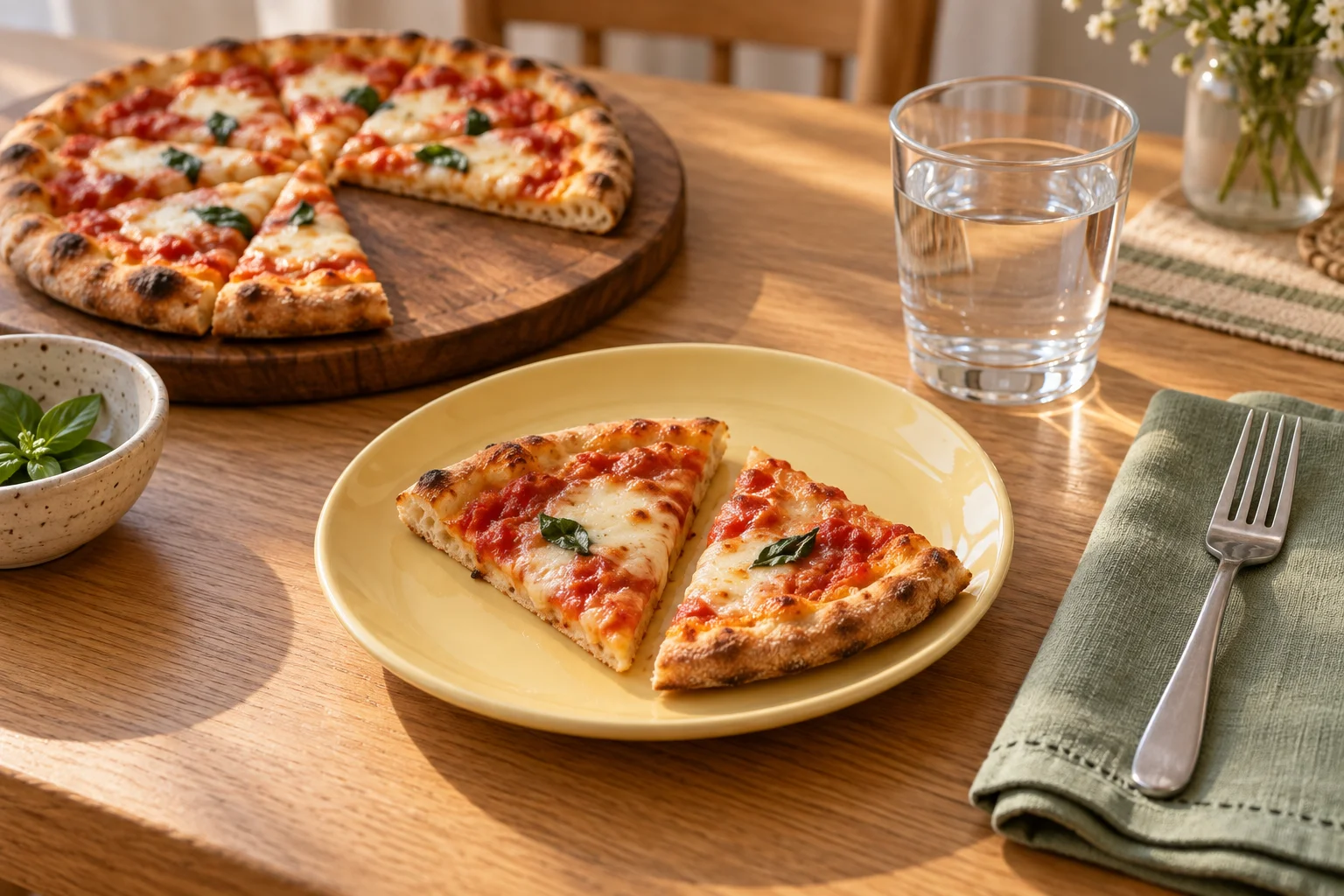
Start with appetite, not an age formula
Ask parents beforehand roughly how much their children eat and which ingredients work for them. The time of day, earlier meals and side dishes all affect appetite. An afternoon that includes cake needs a different plan from pizza after a long outing. A fixed number of grams for each year of age does not capture that. Counting every child as half an adult can also be misleading.
Start with a small serving on the plate and have more available. Children can tell you whether they are still hungry. Putting a whole pizza in front of them does not mean they have to finish it. For younger children, adults should cut suitable pieces and check that both crust and toppings have cooled enough. Melted cheese may still be uncomfortably hot when the crust feels easy to hold.
Shared slices or an individual small pizza
Sharing pizzas works well when people want different amounts. Cut the baked pizza into small pieces and offer a few at first. The number of slices alone tells you little about the amount of food. An eighth of a large, thick pizza can contain more than several pieces of a small, thin one. Compare pizza size and dough style, rather than counting cuts.
Small individual pizzas are another option when children want to choose their own toppings. Match the dough quantity to the area. As a calculation example, a pizza measuring 20 cm across has about 44 percent of the area of a 30 cm pizza. At the same thickness, that would mean around 111 g of dough instead of 250 g. This is a way to resize a recipe, not a nutrition recommendation or a standard child-sized portion.
Agree on a simple selection
Choose a few familiar toppings that you have discussed beforehand. A mild tomato-and-cheese pizza and a suitable vegetable version are easier to prepare than ten different special combinations. Adults can add hot sauces separately at the table. Younger children should help in a safe area with support. An adult who understands the equipment handles the oven and hot peels.
Discuss allergies and intolerances directly with parents, including how food will be prepared. A pizza without visible nuts or without cheese is not automatically suitable. Check the ingredients in the products you use and the required separation of work surfaces and tools. If you cannot meet those conditions at home, agree on an appropriate alternative before the party rather than trying to improvise during the meal.
Include second helpings in the total
For planning, record adults, younger children and older children separately. Use the replies to estimate quantities for your chosen pizza size, then add a deliberate reserve. An extra pizza for second helpings already counts towards that reserve. Do not add it again as a general safety margin in the dough calculation. Any planned salad or other food should also inform the estimate.
Watch which pizzas people enjoy in the first round before topping the next ones. Unused dough balls leave you more choices than finished pizzas nobody wants. Offer another helping without pressure and accept a no. The aim is for children to enjoy the meal, without making an empty plate the evening's achievement.