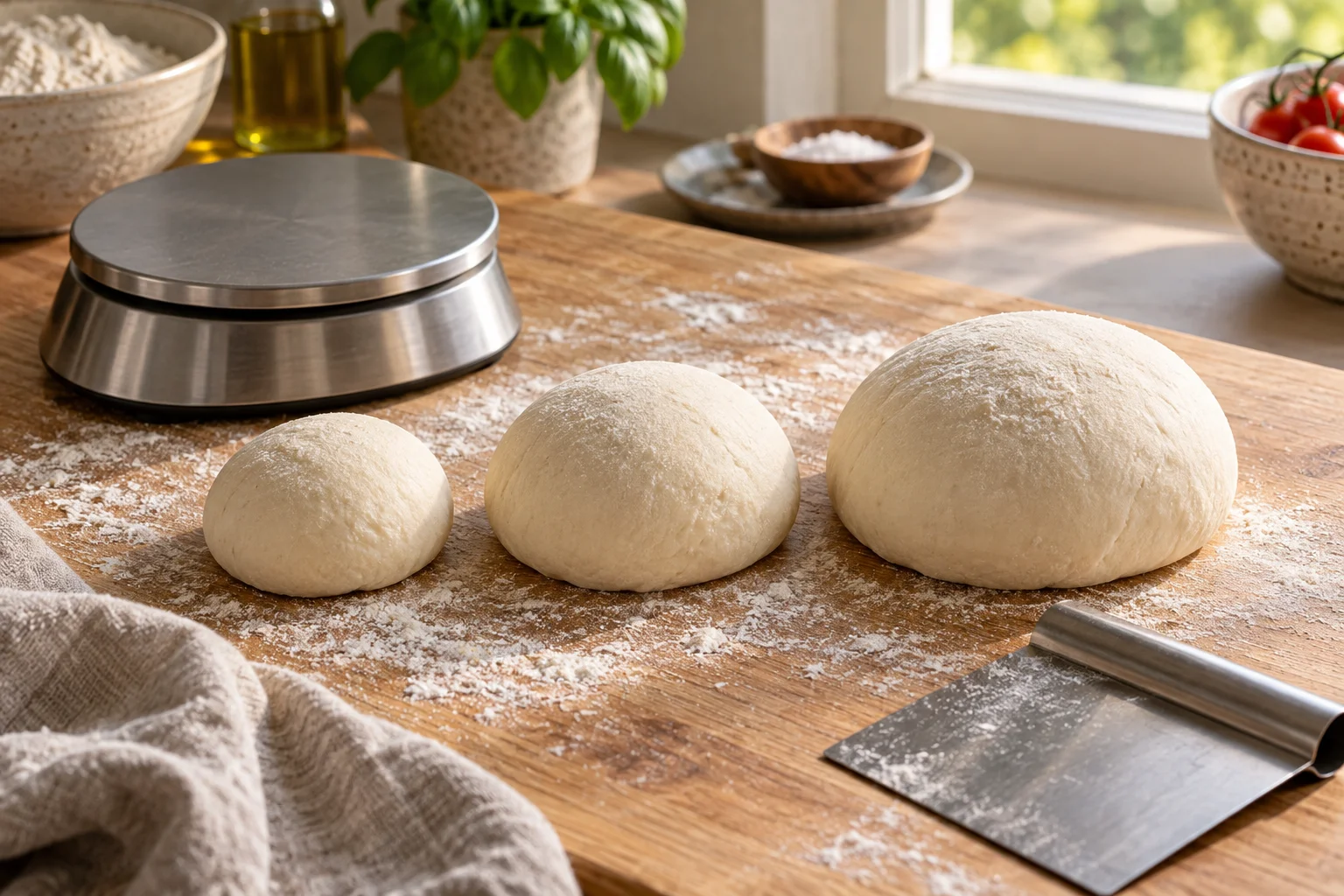
A starting weight needs a pizza style
For a round pizza around 30 centimetres across, 250 grams of dough is a useful starting point for a Neapolitan-inspired style. It is not a universal target: a very thin pizza, a substantial rim and a tray pizza need different distributions and suitable recipes.
The weight means the complete dough ball, including flour, water, salt and any other dough ingredients. It is neither the flour quantity nor the weight with toppings. Weigh before rounding so you do not later have to tear large pieces from an already relaxed dough ball.
Convert round pizzas using diameter
For approximately the same dough thickness, use: new weight = previous weight × (new diameter ÷ previous diameter)². Starting with 250 grams for 30 centimetres gives a calculated 160 grams for 24 centimetres. For 32 centimetres it is about 284 grams, and for 36 centimetres 360 grams.
This is an area calculation, not a guarantee of identical rims. Leaving a much wider border on the larger pizza changes the distribution. Treat the figures as a starting point and keep the dough recipe, rim width and shaping technique as consistent as possible when comparing.
Plan rectangular trays and total dough
For rectangular trays, compare the internal base area. Moving from 20 × 30 to 30 × 40 centimetres doubles it from 600 to 1200 square centimetres. For the same tray pizza style and thickness, begin by doubling the dough recipe; the baking time does not automatically double.
Four dough balls weighing 250 grams each require 1000 grams of finished dough altogether. An existing batch of 840 grams instead gives four pieces of 210 grams. Plan the total before mixing and allow for small losses on the bowl and your hands rather than stretching out an inadequate batch with extra flour later.
Allow for the baking surface and handling
Before choosing a size, check the usable area of your peel, stone or tray and the space for moving the pizza inside the oven. The largest circle that fits on paper is not necessarily one you can launch and turn comfortably. Begin smaller while learning to handle the equipment.
If a dough ball keeps shrinking back, extra weight will not solve that problem. Check its temperature and relaxation. A tearing centre may have been stretched unevenly thin. Record weight and diameter when diagnosing a problem so shaping difficulties do not get confused with the wrong quantity of dough.