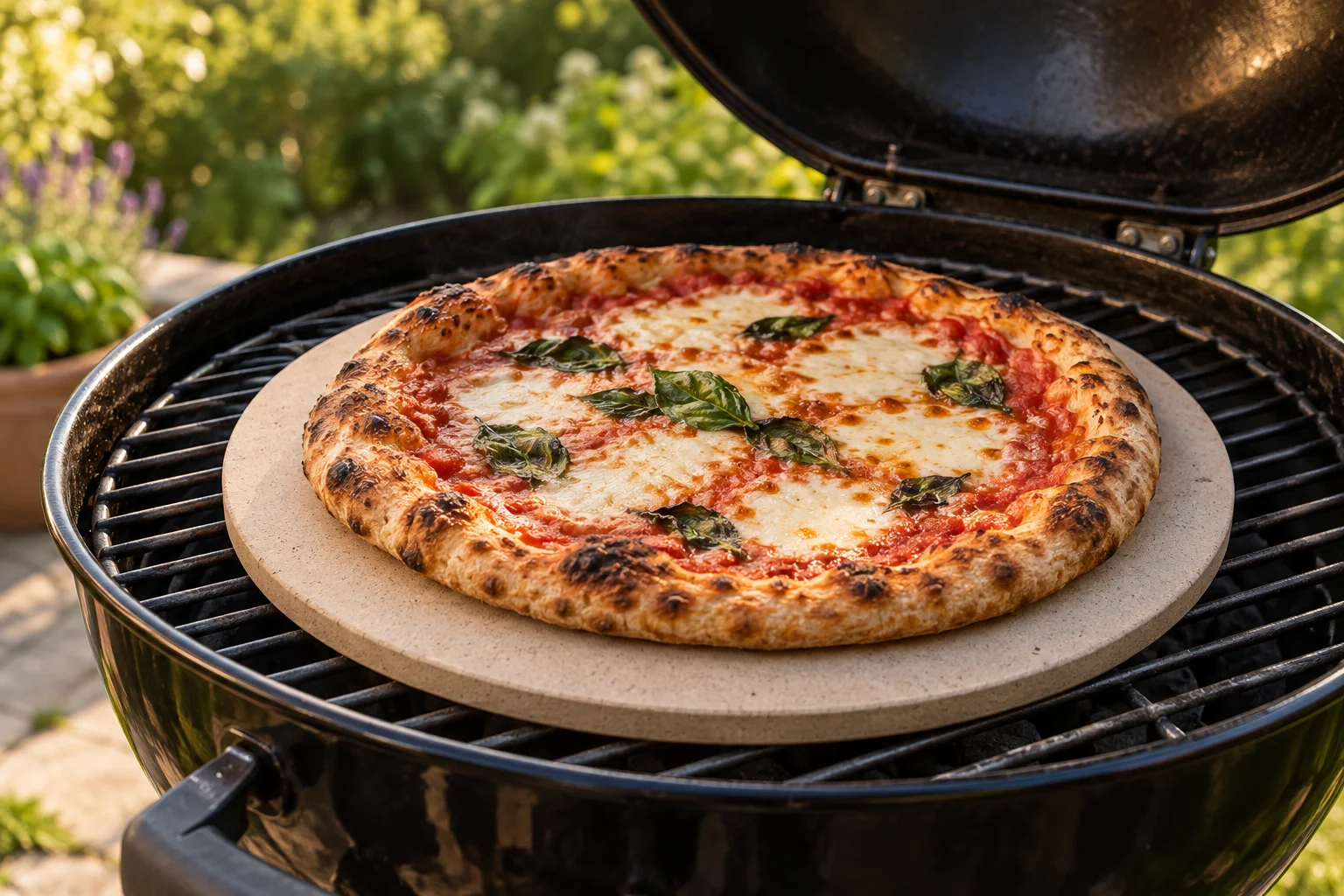
Choose between a pizza stone and the cooking grate
With a pizza stone, the process resembles oven baking: shape the dough, add the toppings and launch the whole pizza onto the hot surface. The stone distributes contact heat beneath the base. The topping also needs enough heat in the cooking chamber, which makes a suitable barbecue with a lid useful. A stone does not, however, turn any open grate into a complete pizza oven. If little heat reaches the top, the underside may be dark long before the cheese and upper dough are ready. Treat the stone, barbecue arrangement and recipe as one combination.
Cooking directly on the grate follows a different sequence. First, grill one side of a thin, untopped piece of dough. Then remove it, turn the cooked side upwards and add the toppings. During the second grilling stage, the other side cooks while the topping becomes hot. This avoids dragging soft, heavily topped dough across the bars. The method produces visible grill marks and works particularly well with manageable, lightly topped pizzas. Choose your approach before preheating, rather than deciding on the arrangement with a topped pizza already waiting on the peel.
Match the barbecue and its accessories
Check that your stone is approved for the barbecue and its operating temperature range. It must rest securely and must not obstruct the required airflow. Manufacturers may specify particular frames, positions or burner settings. These matter more than a general recommendation in a recipe. A kitchen tile or unidentified stone slab is not a suitable substitute. A baking steel is not automatically approved for every barbecue arrangement either. Use accessories with a known material and intended application, and inspect a stone for damage before heating it. An existing crack remains relevant even when you are only cooking a pizza.
Set out a suitable peel, heat-resistant barbecue gloves and a sufficiently large heatproof landing area. Keep that area clear even if a pizza needs to come off earlier than expected. Where possible, leave the hot stone in its intended position rather than carrying it between pizzas. Gas and charcoal barbecues belong outdoors in a suitable, well-ventilated location; a garage is not a substitute when it rains. Observe the appliance's clearance requirements and safety instructions. Baking pizza does not require improvised supports or a cover that was not designed for the barbecue.
Use direct and indirect heat appropriately
Direct heat means the heat source is immediately beneath the cooking area. With indirect heat, the food is not directly above that source. Depending on the design, a gas barbecue can provide these areas through different burner settings; a charcoal barbecue uses the arrangement of the coals. With pizza, it is especially useful to consider the heat beneath the base alongside the heat in the cooking chamber. A strongly heated stone can supply considerable bottom heat, while an open lid quickly releases warmth from above the pizza. Repeated long inspections shift this balance further.
There is nevertheless no rule that every pizza stone must always operate exclusively over indirect heat. Some approved systems are designed for direct heat, while others require a different arrangement. Follow the settings for your accessories and adjust within those instructions. For the grate method, a less-hot area is useful for continuing to cook without immediately burning the underside. Decide in advance where you can move the pizza. If the entire surface is heated equally strongly, that option will be unavailable precisely when the base starts browning faster than expected.
Preheat the stone thoroughly
Place the dry, suitable stone in the barbecue as instructed and heat it together with the appliance. The lid thermometer measures the temperature at its own location, rather than inside the stone. A quickly reached reading on the lid therefore does not mean the baking surface has stored sufficient heat. Begin with the preheating time specified for your system. Requirements can differ considerably with the material and arrangement. If the instructions call for twenty minutes, a high reading after five minutes does not turn that into a completed preheat.
An infrared thermometer can help you assess the surface of a suitable stone. Observe the measuring distance, spot size and instrument setting for the material. Measuring through the lid or at a shiny metal edge does not reliably describe the exposed baking surface. Many barbecue pizza recipes use cooking-chamber temperatures around 230 to 260°C, but this is not a universal setting for every design. The permitted temperatures and settings of the barbecue and accessories take priority. A barbecue does not need to reach the temperature of a specialist pizza oven to bake a thin pizza through.
Prepare the dough and toppings for the first pizza
Use fully proofed dough from an appropriate recipe. Barbecuing does not shorten the fermentation that comes beforehand. For a first attempt, a smaller pizza is easier to move and control evenly than a very large one. A dough ball around 200 grams for a pizza roughly 22 to 25 centimetres across can be a starting point, depending on the thickness you want. Shape it evenly without holes in the middle. If mature dough pulls back strongly, cover it and let it relax for ten to fifteen minutes rather than stretching it forcefully across the surface.
Keep the topping manageable and cook slow-cooking ingredients in advance. Browned mushrooms, tender peppers and already cooked meat mainly need reheating on the pizza. Raw meat pieces do not belong in a method whose short cooking time is judged solely by the browning of the base. Drain fresh mozzarella well, keep the sauce fairly thick and cool hot prepared ingredients before topping. As a simple example of our own, about 50 grams of tomato sauce and 50 grams of drained mozzarella can top a small pizza. This is a starting point for distribution rather than a quantity rule for every recipe.
Bake a topped pizza on the stone
Finish topping the pizza only when the barbecue is ready. It should move freely on the peel; a little flour or suitable dusting material helps, but cannot replace a dry, intact dough base. Check its movement before topping and again afterwards. If one area sticks, loosen it carefully before approaching the barbecue. Launch the pizza onto the stone with a controlled movement and close the lid. Stay nearby. While it bakes, prepare the next dough ball rather than leaving to collect more ingredients from a distant room.
In an appropriate setup around 230 to 260°C, a thin pizza may take roughly seven to twelve minutes. Carefully check the underside and top after about five minutes; a hotter stone or thinner base can cook faster. If it browns unevenly, rotate the pizza with suitable tools, provided your arrangement allows this safely. It is ready when the base has baked through and the topping is cooked as required by the recipe. A browned rim alone does not establish that the middle of the base is ready. These times are guidance rather than an automatic stopping rule.
Grill directly on the grate in two stages
For the grate method, preheat the clean barbecue to medium or medium-high heat according to an appropriate recipe, and include a less-hot area. Avoid heating the entire surface at maximum power. Shape a small, evenly thin piece of dough and lightly brush the first contact side with oil. Excess oil can drip down. Place the untopped dough on the grate in a controlled movement using suitable equipment. Close the lid if the recipe and appliance call for this method. Check early for colour on the base rather than repeatedly lifting the dough during the first few seconds.
After roughly three to four minutes, the first side may be sufficiently firm and golden; judge its condition rather than the clock alone. Remove the dough to a clean work surface and turn the grilled side upwards. Lightly top that side with prepared sauce and cheese. Return the still-ungrilled underside to the grate, moving to the less-hot area if necessary. Cook under the closed lid for roughly another three to five minutes, until the second side is cooked and the topping is hot. If browning happens quickly, check earlier and move the pizza as appropriate.
Respond when the base and topping cook at different speeds
If the underside turns black while the cheese is barely warm, the solution is neither extra topping nor, usually, more time in the same hot position. Remove the pizza promptly and change the heat arrangement for the next round within the manufacturer's instructions. Less direct heat beneath the stone or a suitable cooler zone may help, if your system permits it. At the same time, sufficient heat must remain in the closed cooking chamber. A heavily topped pizza makes this balance harder to achieve. Reduce the topping quantity too, and use cooked ingredients that have been thoroughly drained.
If the base remains pale, the baking surface may not have preheated sufficiently, or may have cooled after several pizzas. Allow it time to absorb heat again. Check the dough thickness as well: a thick base needs a different approach from a thin pizza. Dark stripes from direct grilling are contact marks from the grate; they do not automatically mean the areas between them are cooked through. Lift the pizza with an appropriate tool so that you can assess the underside. When serving, cut a slice and look for a baked-through crumb beneath the topping.
Organise several pizzas in sequence
Prepare individual dough balls and small bowls of measured toppings, but keep them separate until needed. For four small pizzas following the example, 50 grams each of sauce and mozzarella per pizza means 200 grams of each ingredient in total. If adding vegetables, scatter them lightly and account for their moisture. Ingredients requiring refrigeration should remain in the fridge or suitable cooling equipment until shortly before use. Put only small portions beside the barbecue. This also makes it easier to see which ingredients remain available as you work through the pizzas.
Between pizzas, the stone may need a pause to recover enough heat. A fixed production interval is therefore less useful than observing your particular setup. Do not assemble the next pizza on the peel several minutes ahead: sauce and warmth make the dough sticky. A cool tool for launching and a separate one for retrieval can simplify the work. Serve finished pizzas promptly instead of keeping them warm in a tight stack. Trapped steam will soften bases that were previously crisp. Sharing slices works well when you have a single baking position.
Cool and clean the equipment appropriately
Shut down the barbecue according to its instructions and let the stone and accessories cool completely in a safe place. Pouring cold water onto a hot stone can damage it through thermal shock. A surface that no longer appears intensely hot can still retain heat for a long time. Do not place it on wood, glass or another unsuitable surface. Later, remove loose residue with the tool recommended for the accessory. Cleaning depends on the material: a glazed stone can have different care instructions from an unglazed, porous one. One blanket rule about washing-up liquid will not suit every product.
For the next pizza evening, record only details that help you repeat the process: barbecue arrangement, preheating time, approximate temperature, dough weight and topping quantity. Add a short observation such as base already dark after six minutes or second pizza slower than first. This lets you adjust one specific part of the method. Settings from someone else's barbecue may be less informative than your own sequence. When the stone, dough and toppings work together, baking becomes more predictable without requiring every pizza to have exactly the same shape or the same number of dark spots.