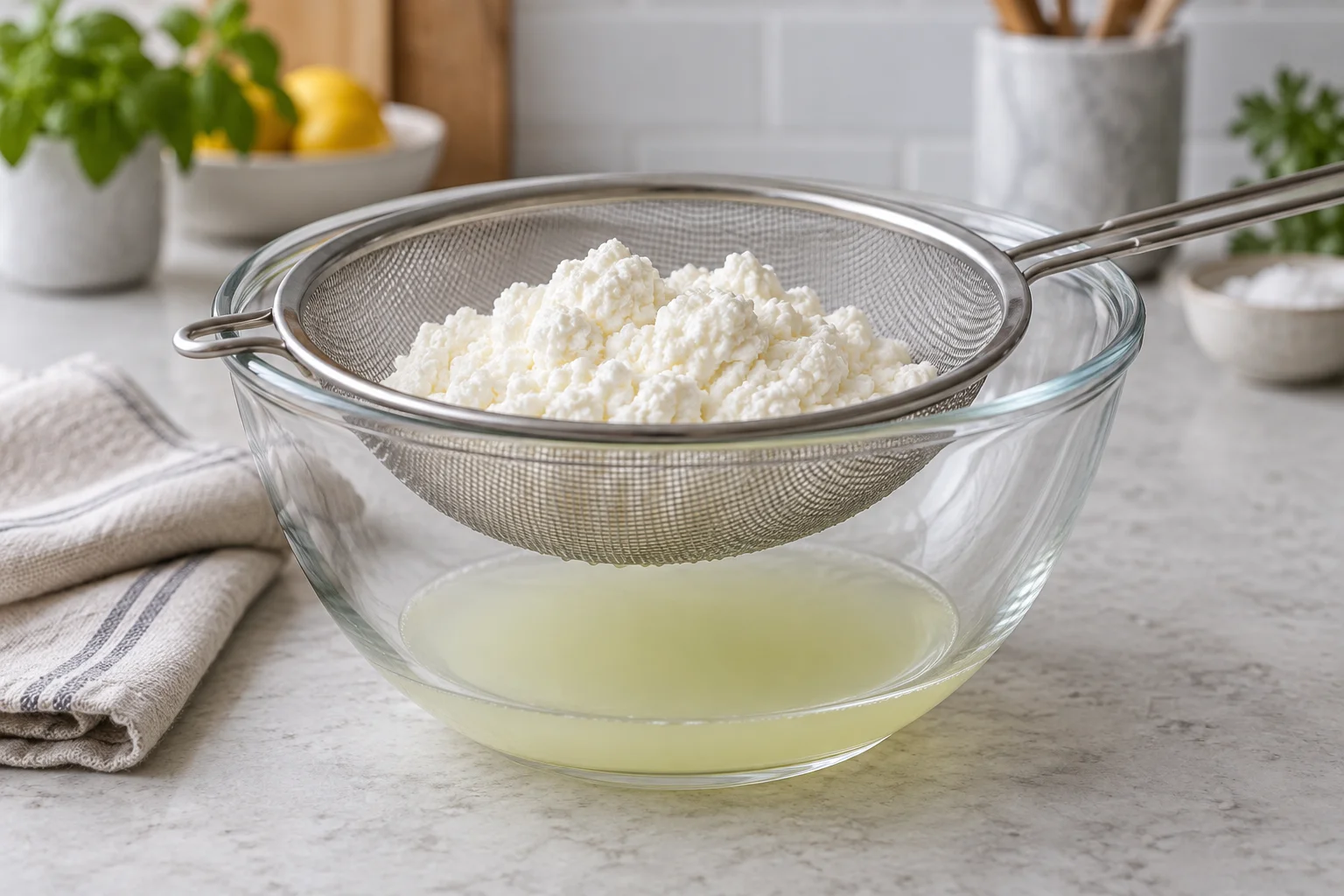
When draining is useful
If liquid surrounds the ricotta when you open the pack, pour it away carefully. Then check the texture needed for your filling: a spoonful should hold as a soft mound rather than immediately forming a puddle. Some products are already firm enough, while others contain considerably more free whey.
That same moisture may be useful in a sauce. Make the decision according to the intended recipe. A firm ravioli filling and a creamy ricotta sauce do not require the same starting texture. Thoroughly drying ricotta in advance offers no universal benefit and does not extend the storage life of the opened dairy product.
Set up the sieve and bowl
Place a clean fine-mesh sieve over a sufficiently deep bowl. Its base must not sit in the collected liquid later. If the mesh is too coarse, line it with a clean, neutral-smelling thin straining cloth suitable for food use. Add the ricotta and cover the arrangement appropriately.
Let it drain in the refrigerator, following the package’s chilling instructions. In the absence of a stricter requirement, keep the refrigerator at no more than 7°C, preferably below 5°C. Check the texture after about an hour; this is a checkpoint rather than a universal completion time. Very moist ricotta may need several hours. Follow package storage limits even when starting the previous evening.
Account for drained weight and other ingredients
If a recipe specifies 250 g of DRAINED ricotta, weigh that quantity after draining. A pack initially containing 250 g will leave less after losing liquid. Buy a little extra or reduce the entire recipe proportionally. There is no fixed percentage loss that applies to every product.
Squeeze cooked spinach well and let it cool before mixing it in. Pumpkin purée or mushrooms can introduce extra moisture too. More hard cheese changes saltiness and flavour; adding raw flour as an improvised binder changes cooking behaviour and the recipe. Address the source of the liquid first, instead of disguising an overly wet mixture with arbitrary dry ingredients.
Draining is different from passing through a sieve
Draining removes free liquid from ricotta. Passing it through a fine sieve afterwards means pressing the cheese itself through to produce a finer texture. If you press firmly with a spoon at the beginning, you may collect cheese rather than just whey in the bowl. Let gravity do the initial draining.
Use the suitably firm ricotta according to a complete filling recipe, keeping it refrigerated until then. A photograph or a firm spoon mark does not demonstrate storage safety. Record the opening date on a pack if useful. This keeps texture, required weight and refrigeration clear without turning a simple preparation step into a separate recipe project.