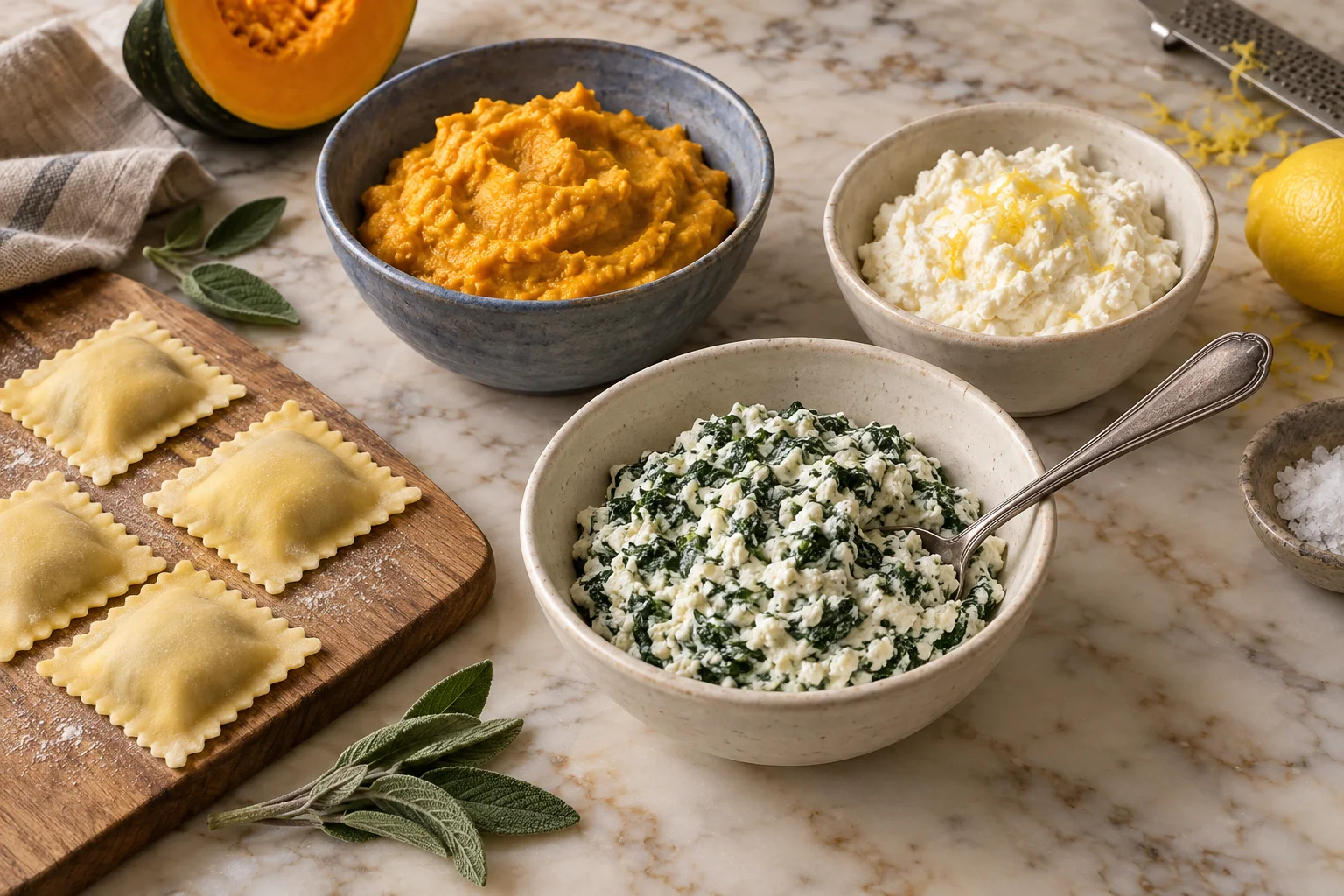
A filling should hold a neat mound
A good ravioli filling stays where you place it on the pasta sheet but still spreads smoothly under a spoon. It should neither release a puddle nor crumble into dry lumps. This consistency makes the rest of the work easier: you can portion it evenly, drape the upper sheet over it without stretching and seal the edges without squeezing the mixture out. Check the finished filling before rolling your dough thinly. Once an uncovered sheet is waiting on the worktop, it is an awkward moment to start squeezing spinach or draining a tub of ricotta.
The three variations below are separate fillings, not ingredients to combine in one batch. Spinach and ricotta gives a more pronounced vegetable flavour, lemon ricotta is mild and fresh, while squash provides a sweeter, dense base. Choose one for your first batch. Keeping the dough thickness and parcel size consistent makes it easier to find the right amount than juggling three bowls at once. Each mixture weighs roughly 320 to 330 grams. The number of ravioli it fills depends on the size of your parcels and the amount used in each; a fixed yield without those details would be misleading.
Drain the ricotta before weighing it
Open the ricotta and look for visible whey. If there is a lot of liquid, put the cheese in a fine sieve over a bowl and refrigerate it, covered. The base of the sieve should sit above the liquid that drains out. A clean cloth suitable for straining food can help if needed. Check the texture after about 20 to 30 minutes; a particularly wet ricotta may need longer. It should remain creamy and easy to spoon. Pressing it very hard can leave a compact mass that is more difficult to mix evenly with vegetables.
Every ricotta quantity in this guide refers to its drained weight. A tub containing 250 grams therefore does not necessarily provide 250 grams of prepared ricotta. If you are short, reduce the other ingredients in the same proportion instead of replacing the missing weight with drained whey. For example, the lemon filling can be made with 200 grams of ricotta and 20 grams of hard cheese, two thirds of the batch below. Grate the hard cheese finely. Larger shards distribute unevenly and can press against the thin wrapper as you shape the parcels.
Spinach and ricotta with a clear spinach weight
For this version, combine 200 grams of drained ricotta, 100 grams of cooked, thoroughly squeezed and finely chopped spinach, and 30 grams of finely grated hard cheese. Add a little black pepper, a small pinch of nutmeg and salt as needed. The 100 grams of spinach explicitly means its weight after cooking and squeezing. Fresh leaves or frozen spinach contain much more water before preparation, so weighing the same amount at that stage would produce a different mixture. If using frozen spinach, choose an unseasoned leaf product and cook it according to the packet before continuing.
Wash and trim fresh spinach, then wilt it in a large pan with a little water still clinging to the leaves and cook until tender. Transfer it to a sieve, let it cool just enough to handle safely and squeeze it thoroughly in small portions. Chop finely, cool promptly and refrigerate until mixing. Long strands should not hang from the spoon. Mix the ricotta and cheese first, then work in the cold spinach. This filling does not need an extra raw egg. Add salt after the hard cheese, because its saltiness varies considerably between products.
Lemon ricotta without extra liquid
For a pale, mild filling, stir together 300 grams of drained ricotta, 30 grams of finely grated hard cheese and, initially, half a teaspoon of finely grated lemon zest. Wash a lemon whose peel is suitable for eating and grate only the outer yellow layer. A little black pepper complements the mixture. Add more zest gradually to reach the flavour you want. The filling should taste of ricotta and lemon; a thick layer of bitter white pith would be difficult to balance later with extra cheese or butter.
Leave lemon juice out of this version. Zest supplies citrus aroma without thinning the filling with added juice. If you want more acidity when serving, add a few drops to the finished sauce and adjust it there. A few finely sliced basil leaves or a little thyme work as a herb variation. Wash and dry herbs thoroughly beforehand. Large leaves and long stems make the mixture uneven. For a vegetarian dish, select a hard cheese labelled as suitable for vegetarians; Parmesan is not automatically suitable because it is made with animal rennet.
Cook the squash, then weigh the filling quantity
The squash filling uses 250 grams of cooked, finely mashed and cooled squash, 40 grams of drained ricotta and 30 grams of finely grated hard cheese. Add a little nutmeg, pepper and salt as needed. To prepare it, cut about 400 grams of peeled, deseeded squash flesh into roughly two-centimetre cubes and spread them on a tray with two teaspoons of oil. Roast at 200 °C in a conventional oven for approximately 25 to 35 minutes, checking from 25 minutes. The pieces must mash easily right through the centre. Variety and cube size affect the cooking time.
Weigh the required 250 grams after cooking. Roasting changes the weight: 250 grams of raw cubes will not reliably produce 250 grams of mash. Mash the squash without adding milk or water. If it is still very wet, cook it in a broad pan over moderate heat, stirring to evaporate some moisture before cooling. Spread it shallowly, cool promptly and mix it with the ricotta and cheese only when cold. Hard, dark roasted edges do not belong in a fine filling. Keep surplus cooked squash separate to use in a sauce or as a side dish.
Too loose, too dry or simply too coarse?
Place a small spoonful of filling on a clean plate. Liquid running out around it is different from a soft but cohesive cream. If the mixture is visibly wet, first identify the source: was the ricotta drained sufficiently, the spinach squeezed thoroughly and the squash concentrated enough? These ingredients are easiest to correct before mixing. Do not try to rescue a finished filling by heating it indiscriminately or adding large amounts of flour. That changes its texture and introduces further requirements for cooking the mixture fully inside the pasta.
A slightly loose mixture may firm up with a little more finely grated hard cheese. Add small amounts and check the salt level as you go. If the filling is dry and crumbly, work in some more well-drained ricotta. Start with about a teaspoon at a time rather than changing the entire bowl abruptly. A mixture that holds its shape but contains awkward fibres or chunks needs finer chopping. Extra binding ingredients will not solve that problem. When the texture is badly wrong, turning the mixture into a cooked pasta sauce is often more useful than forcing it into delicate parcels.
Match the filling amount to the available dough
For square ravioli measuring roughly six centimetres across, start with about eight grams of filling per parcel. This is a starting point to adjust to your actual shape. There must be enough clear dough around each mound to seal it. If the upper sheet is stretched tight or filling moves onto the edge as you press, use less. A kitchen scale is helpful at first: ten portions of eight grams weigh 80 grams together. You can then continue more consistently with the same small spoon or a piping bag.
Calculate the filling requirement from your planned number of parcels, rather than from flour weight alone. Thirty ravioli containing eight grams each require 240 grams of filling, plus a small allowance for what remains on the bowl and spoon. A 330-gram batch theoretically supplies just over 41 such portions before those losses. That does not mean every quantity of dough will make exactly 41 ravioli. Sheet thickness, trimming and cutting dimensions change the amount used. If filling remains near the end, resist making the last mounds suddenly larger. Even parcels are easier to close and cook consistently.
Clean seams start with careful portioning
Roll out a manageable length of pasta and keep the remaining dough covered. Place the filling in the centre of each intended parcel. Two small spoons let you release it neatly; if using a piping bag, make the opening large enough for the finely chopped ingredients. Carefully wipe any filling from the surfaces that will meet. Dough adheres less well over cheese, oil or wet spinach. If the sheet needs moisture to seal, lightly dampen only the clear edge. A visible puddle makes the dough sticky and can distort the seam.
Drape the upper sheet loosely over the mounds. Press air out from the filling towards the outside, then close the clear borders. Leave the mound itself largely untouched. Flattening it spreads filling onto the contact surfaces. Cut the parcels apart after sealing carefully and check each individual seam. A fluted wheel creates an attractive border but does not remove trapped air or filling sandwiched between the layers. Arrange the finished ravioli separately on a prepared surface dusted lightly with flour. Keeping them apart now avoids the damage caused by pulling stuck parcels loose later.
Match cooking and sauce to the filling
Cook fresh ravioli in batches in plenty of gently boiling salted water. For parcels roughly six centimetres across, start checking at around five minutes; the required time depends particularly on sheet thickness and the double layers at the seams. Cut one open and check both the pasta and its centre. The filling must be hot throughout. A useful thorough-heating target is at least 70 °C for two minutes in every part; use a clean food thermometer if uncertain. Floating alone proves neither that a seam is cooked nor that the filling is hot enough. Do not taste raw flour or raw egg dough.
Prepare the sauce before the pasta is ready. A light tomato sauce or a little sage butter suits spinach and ricotta, while lemon ricotta works with a restrained coating of butter and herbs. Squash can take sage and a small amount of a stronger hard cheese. These are flavour suggestions, not compulsory pairings. Decide whether the sauce should support the filling or supply a noticeable contrast. Lift the ravioli out with a slotted spoon, let them drain and turn them gently in the sauce. Vigorous tossing and prolonged further cooking can tear a parcel that was shaped neatly in the first place.
Preparation, refrigeration and leftover filling
Prepare cooked vegetables before rolling whenever possible, cool them promptly and keep the finished filling covered in the refrigerator. Take out only small amounts for shaping. The fridge should be no warmer than 7 °C and preferably below 5 °C; follow any stricter instructions for individual ingredients. Egg dough should spend only about two hours at room temperature in total, including mixing, resting and shaping, with less time in warm conditions. Refrigerate during longer pauses. For a larger batch, work with one part of the dough while the rest stays tightly covered and chilled.
For a later meal, freeze ravioli separately on a suitable tray until firm, then pack them in a closed container labelled with the date and filling. Cook them directly from frozen and check the thickest part again. Surplus filling that has remained clean and chilled can be used promptly in a cooked sauce or a thoroughly cooked bake. If it has touched raw dough or flour, heat it fully as well and stop tasting it cold. Freezing does not make leftovers safe again after prolonged or uncertain warm storage. Preparing an amount close to your actual needs makes the whole process easier.