Check the ingredients from the dough to the finishing sauce
A simple pizza dough made with flour, water, yeast and salt contains no animal ingredients. Olive oil also fits this approach. With bought dough, check the ingredient list nevertheless: milk, butter, egg and honey do not belong in a vegan version. Looking like bread tells you little about the actual recipe. The same applies to a ready-made sauce. Its ingredients matter more than the colour of the packaging or a picture of a tomato. When cooking for guests, keep the packaging until the meal so that you can answer questions about ingredients easily.
Small additions are particularly easy to overlook. Green pesto may contain cheese, a seasoning sauce may contain fish, and a spread may contain milk ingredients. Choose suitable products explicitly or make straightforward mixtures yourself. For example, a basil oil made with washed, thoroughly dried basil and olive oil needs no Parmesan. Vegan also does not automatically mean suitable for every food allergy. Nuts, soya and wheat may still be present; a warning about possible milk traces matters to someone with a milk allergy. Establish these requirements separately from the question of whether a guest eats vegan food.
Choose a familiar dough that fits your timetable
Vegan pizza does not require a special substitute dough. Use a regular yeast dough with suitable ingredients and a schedule that fits your day. If it needs several hours or an overnight rise, plan accordingly. A fully proofed dough ball is different from freshly mixed dough. Do not let the short baking time in a topping recipe mislead you: it does not include mixing or the preceding fermentation. For a first attempt, a manageable wheat dough is easier to assess than a new wholemeal blend, unfamiliar yeast and a new cheese alternative all at once.
Shape the dough so that the base stays evenly thin, without translucent weak spots in the centre. A dough ball of about 250 grams can be a starting point for a pizza roughly 28 to 30 centimetres across; how easily it stretches depends on the recipe and its maturity. If it pulls back strongly, cover it and initially give it ten to fifteen minutes to relax. This helps an already proofed dough become easier to shape, but does not replace missing fermentation. A slightly smaller, intact pizza is easier to top and launch than a large circle with several thin tears.
Prepare vegetables according to their cooking needs
The short time on a pizza is not sufficient for every vegetable. Aubergine cubes should be soft inside before they go onto a quickly baked base. Thick pepper strips also benefit from cooking beforehand. Fry or roast different vegetables separately when necessary, as they finish at different times. This avoids continuing to cook already tender mushrooms while the aubergine remains firm. Cut pieces small enough for several toppings to fit on each slice. Large, heavy heaps of vegetables are more likely to drag the rest of the topping off when you take a bite.
Brown mushrooms in a wide frying pan. Give them room and allow most of the released water to evaporate. An overcrowded pan collects liquid that can subsequently end up on the dough. Courgettes can be sliced thinly and used raw in moderation, or cooked first; the two approaches produce a different bite. Cool cooked vegetables before topping the pizza, and drain off excess oil or water. Liquid released by thawed frozen vegetables should also stay off the base. Weigh any planned topping quantity after this preparation, so that a substantial part of its weight is not unnoticed excess liquid.
Consider sauce and vegetables as one moisture balance
Tomato sauce contributes flavour and keeps a cheeseless topping pleasantly juicy. A thin, even layer is often enough. It should spread easily without forming puddles on the dough. If your sauce is very thin, simmer it uncovered to reduce it a little, then let it cool. This is not automatically necessary with an already thick passata. Season cautiously at first, because olives, capers and ready-made plant-based cheese may later add considerable salt. Tasting is more useful than applying the same quantity of salt to every combination of toppings.
Think about sauce and vegetables together. A thin layer of sauce can still become a wet topping when combined with plenty of fresh tomatoes, damp spinach and juicy mushrooms. Conversely, a pizza covered only with dry roasted vegetables and no sauce or other moist component can become dry. Decide which ingredient will supply moisture and prepare the others accordingly. On a white pizza, a suitable plant-based spread can fulfil that role. Apply a thin layer and check its ingredients and usage instructions. A thick coating of hummus behaves differently in the oven from a light tomato sauce.
Select and portion plant-based cheese deliberately
Plant-based cheese alternatives vary considerably. They may, for example, be based on oil and starch, or on nuts and other plant ingredients. The word vegan therefore does not tell you how a product will melt, taste or contribute salt. If you want a melted topping, look for a product explicitly intended for baking or pizza. Follow the packaging, particularly with pourable alternatives. A creamy sandwich spread is not automatically interchangeable with grated pizza cheese, and a product that tastes good cold may not retain the same consistency in the oven.
Start by scattering a loose layer with visible gaps. This leaves space for vegetables and sauce. A thick blanket can weigh down the base and, with some products, create a very soft, sticky layer. If the surface remains pale, do not extend baking time for that reason alone: check the base and rim too. Some alternatives brown differently from dairy cheese. Next time, begin with a smaller quantity or choose a more suitable product. Baking without cheese is also a complete option; good vegetables, sauce, herbs and a little oil can carry the flavour themselves.
Build flavour from ingredients with different roles
A balanced combination does not need a large number of ingredients. Browned mushrooms contribute savoury flavour, roasted peppers bring sweetness, and tomatoes supply freshness and acidity. A small quantity of olives or rinsed capers can complement them. Choose one or two stronger accents. When salty olives, capers, dried tomatoes and a strongly seasoned cheese alternative all share the pizza, extra salt can easily become excessive. Taste prepared ingredients individually, then try a small combined mouthful of sauce and cooked vegetables before topping the dough.
Add fresh herbs and delicate leaves after baking if that suits the combination. Thoroughly dried rocket then stays fresh, while basil has a different aroma from leaves cooked on the pizza. A little lemon zest can work with mushrooms; use a cleaned lemon with peel suitable for eating and take only the yellow outer layer. Thin garlic slices can burn under prolonged strong top heat. Instead, briefly cook garlic with the vegetables during preparation, without letting it darken. Nutritional yeast is a seasoning rather than a melting cheese layer. Use it to taste instead of replacing every gram of cheese with the same weight of flakes.
Put together a simple topping for two pizzas
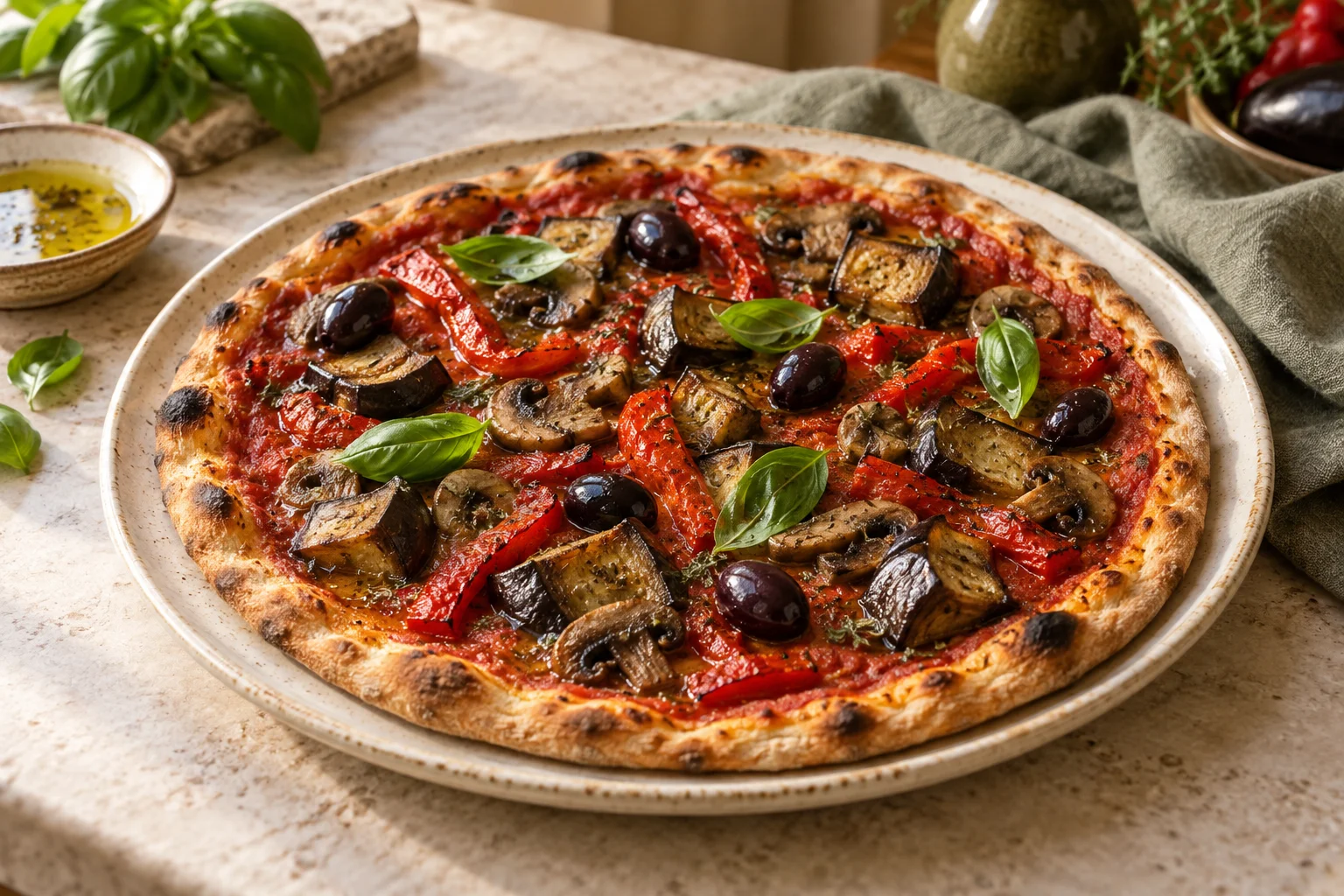
For our own topping example for two pizzas about 28 to 30 centimetres across, set out two fully proofed dough balls of roughly 250 grams each, 120 grams of fairly thick tomato sauce, 160 grams of cooked and drained vegetables, 20 grams of pitted olives and two teaspoons of olive oil. A mixture of aubergine, pepper and mushrooms works for the vegetables. Add a few basil leaves. The 160 grams explicitly refers to the prepared vegetables; the raw quantity needed depends on the cut and cooking losses. Prepare a little extra to serve alongside rather than relying on an exact raw-to-cooked conversion.
For each pizza, this provides 60 grams of sauce, 80 grams of vegetables, ten grams of olives and one teaspoon of oil. These amounts are a manageable starting point, rather than a rule for every dough. Spread the sauce, leaving the rim clear, then distribute the vegetables and olives with gaps between them. Drizzle the oil in small drops. If adding plant-based cheese, use a modest amount according to the product guidance and reduce the other toppings if needed. Before launching, check that the pizza moves freely on the peel. For this example, add the basil after baking.
Bake the base while watching the surface
For the example, you can preheat a conventional home oven with top and bottom heat to 250°C, provided the oven and accessories are suitable. Heat an approved pizza stone or baking steel according to its instructions. With an ordinary suitable metal baking tray, follow the handling method in your dough recipe. A thin pizza at this temperature often takes roughly eight to twelve minutes; start checking after about six minutes. The actual time depends particularly on the baking surface, dough thickness and toppings. It is ready when the base is baked through and the rim appropriately browned, rather than when a fixed number of minutes has elapsed.
A very hot pizza oven requires its own method. Do not transfer home-oven timings to an oven running several hundred degrees hotter. Delicate plant-based toppings may darken much faster there too. Use appropriate recipes and your appliance instructions. In a home oven, simply switching to the strongest top heat does little to solve a pale base: vegetables or cheese can darken while the underside still lacks heat. Assess the bottom and top of the first pizza together. For the next one, you can adjust the quantity of toppings or the baking position deliberately.
Prepare calmly for several guests
Prepare sauce, vegetables and dough as separate components. Cool cooked ingredients promptly and refrigerate them appropriately if they are not being used immediately; follow package instructions for bought products. Set out only the quantity needed at first and replenish it as required. This keeps the work surface manageable. Label similar bowls when serving vegan and other versions together. A separate spoon prevents cheese or another unwanted ingredient from accidentally entering the vegan sauce. Food allergies may require additional precautions beyond these arrangements, so do not treat separate spoons alone as an assurance of suitability.
Top only the pizza that is going into the oven next. Fully topped dough becomes soft during a long wait and can stick to its surface. For four pizzas following the example, you need 240 grams of sauce and 320 grams of prepared vegetables; the quantities scale easily. Oven capacity does not grow with them, however. With a single baking position, plan to bake in sequence and share finished pizzas at the table. Everyone can then eat warm slices while the next pizza cooks. A second peel is useful if the first has become hot through contact with the oven.
Solve common problems at their source
If the centre is soft, first look for excess liquid and a topping layer that is too thick. Were the mushrooms still wet, the sauce thin or the vegetables hot? Then check whether the base received enough heat from below. Where possible, change one of these factors next time so that you can recognise its effect. For a dry pizza, a little more sauce may help, provided the base was not already damp. Excessive baking time or very small, heavily roasted vegetable pieces can also dry out the topping. Extra oil alone will not correct every one of these causes.
If a cheese alternative fails to melt as expected, compare the usage instructions, amount and actual baking conditions. A different grate size or a product intended for pizza may be more useful than leaving an already baked pizza in the oven longer. If flavour is missing, first identify whether it needs salt, acidity, herbs or browned flavours. Add a little of the relevant ingredient. A pizza does not need every characteristic at maximum intensity. A well-baked dough and two or three compatible topping components already create a clear, appetising combination that you can adjust to your preferences next time.