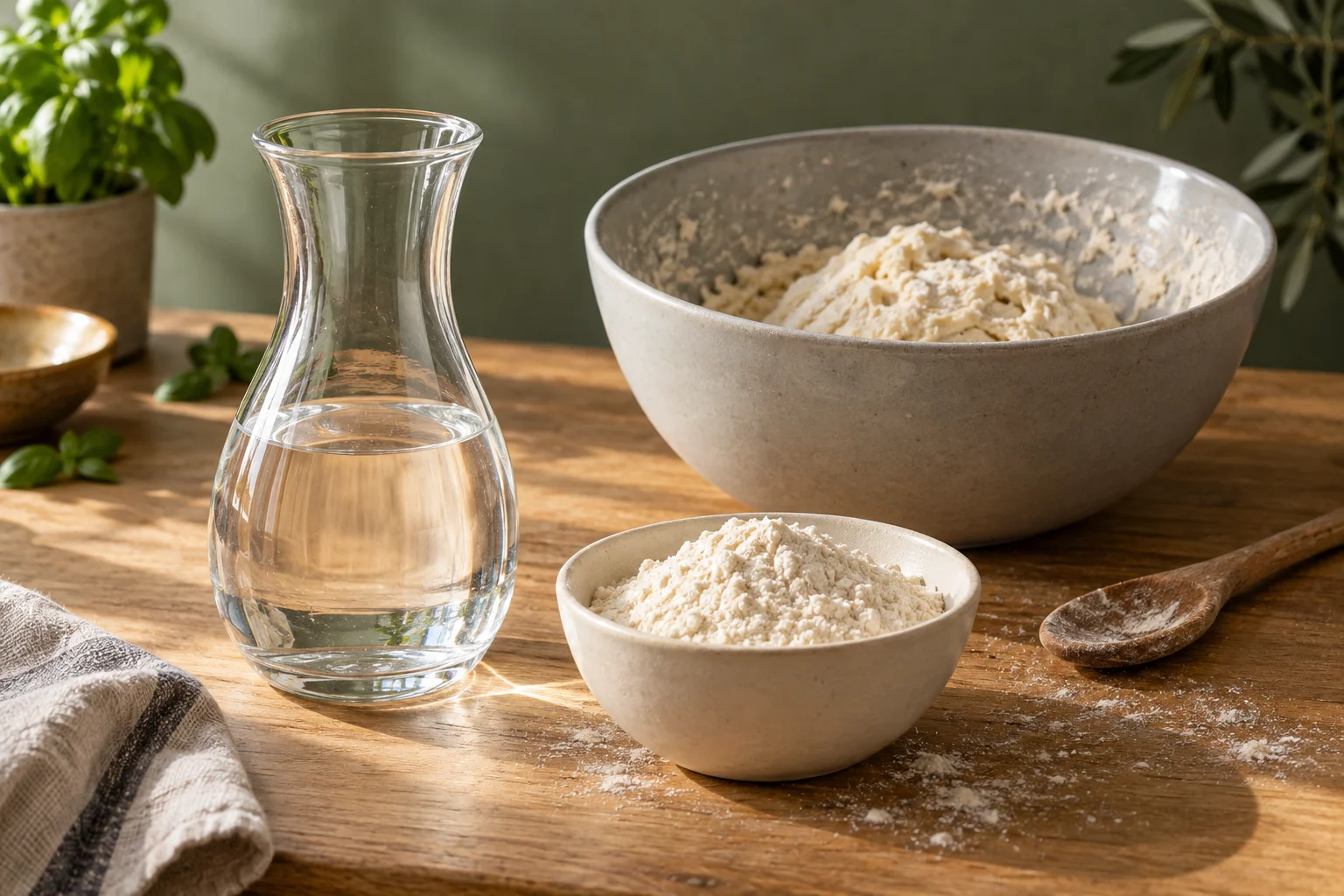
Start with a reliable measurement
Put a bowl on your scales, tare them and weigh the water in grams. This matches the flour measurements in a dough recipe directly and avoids estimating a level against a coarse measuring jug scale. For ordinary kitchen purposes, one millilitre of water weighs approximately one gram; using scales removes the need to make that conversion. Pour slowly as you approach the target. If you have put 345 grams into the bowl instead of 325, remove the extra twenty grams before mixing. Once the water has entered the flour, correcting that same mistake becomes less straightforward.
Keep all the recipe water in a separate container. If you need some to dissolve or mix an ingredient, take it from there. An extra glass used for preparing yeast can otherwise become an unnoticed second water addition. Record later additions as well. An instruction to add another splash is difficult to repeat after a successful batch. An addition of ten weighed grams is much easier to reproduce. Before starting, check the unit shown on the scales: an accidentally changed setting is not always obvious when the number on the display looks familiar.
Calculate hydration from all the flour
Hydration describes the weight of water relative to the weight of flour. Divide the water by the flour and multiply by one hundred. With 500 grams of flour and 325 grams of water, the result is 65 percent. This does not mean that 65 percent of the finished dough is water. Those two ingredients alone weigh 825 grams, before salt and yeast are added. The distinction explains why percentages in a dough formula cannot be read as though they describe the composition of a finished serving of food.
To find the water required for a chosen hydration, reverse the calculation. Multiplying 500 grams of flour by 0.62 gives 310 grams of water for 62 percent hydration. Using 800 grams of flour at the same ratio requires 496 grams of water. Moving from 62 to 65 percent with 500 grams of flour adds just fifteen grams of water. That is already a meaningful formula change, even though it looks small in a jug. Calculate the target before weighing. Our dough calculator helps scale quantities; you still need fermentation and baking instructions suited to the recipe you have chosen.
Include the water in poolish and sourdough
A preferment brings flour and water into the final dough. Both belong in the total calculation. Suppose your target is a dough containing 500 grams of flour and 325 grams of water overall. A poolish made with 100 grams of flour and 100 grams of water already supplies part of that total. The final mix therefore needs another 400 grams of flour and 225 grams of water. Adding the full 500 and 325 grams on top of the poolish would create a different formula: 600 grams of flour and 425 grams of water, or approximately 70.8 percent hydration rather than the intended 65 percent.
One hundred grams of sourdough starter containing equal weights of flour and water supplies fifty grams of each. For the same overall target, that leaves 450 grams of flour and 275 grams of water to add. This calculation applies only to that particular starter composition. A stiff starter contains less water and must be divided according to its actual formula. Write down the overall target separately from the quantities already present in the preferment. The calculation then remains understandable when you make a bigger batch or change the preferment proportion. These quantities alone do not tell you whether the preferment is ripe.
Separate oil from water
Oil is a liquid, but it does not count as water when calculating hydration for a simple pizza dough. A formula with 500 grams of flour, 325 grams of water and fifteen grams of oil still has 65 percent hydration, with an additional three percent oil. Adding the oil to the water would incorrectly produce a figure of 68 percent. Keeping the two separate is especially helpful when comparing recipes. A supple dough containing oil need not contain more water than an oil-free dough, even though the two may handle differently.
Milk, eggs and vegetable purées make the calculation more involved because they contain other components alongside water. Do not casually replace part of the water with the same weight of one of these ingredients and expect identical dough. Choose a recipe developed for that variation. When learning, it helps to keep the ingredient list straightforward: flour, water, salt and the specified yeast or a clearly defined preferment. An observed change is then easier to relate to an actual quantity you altered. Extra bench flour is also not mathematically invisible if you knead substantial amounts of it into the dough.
Choose an amount that suits the flour and pizza
A higher hydration percentage is not a quality ranking. What matters is whether the flour, method and intended pizza suit it. Dough that you can open evenly and launch reliably may be a better choice for your oven than a very wet dough with an impressive percentage. Start with the water proportion in your chosen recipe. Do not take only its flour quantity, increase the water spontaneously and assume that the fermentation schedule, mixing method and shaping instructions are all guaranteed to work unchanged.
Compare flours under similar conditions. A different product or the inclusion of wholemeal flour can change water absorption. Allow freshly mixed dough the rest specified in the recipe before judging how it handles. Dry patches immediately after the first stir are a different observation from fully hydrated dough that remains consistently stiff. Make later adjustments in small, recorded steps. With 500 grams of flour, five grams of water represent one hydration percentage point. Change that quantity first while keeping the other conditions as similar as possible. You will learn more than by changing flour, water, yeast and baking temperature simultaneously.
Use reserved water deliberately
Some methods call for adding part of the water during kneading. That portion belongs to the calculated total from the beginning. If the total is 325 grams, for example, you might weigh 300 grams for the initial mix and reserve twenty-five grams for a later addition, provided that this suits the chosen method. If the recipe also mentions water for preparing yeast, check explicitly whether that amount is already included in the total. Dividing the water is a mixing instruction, not an invitation to pour in another unmeasured glass.
Add reserved water in portions and let it incorporate instead of leaving an already cohesive dough floating in a large puddle. Follow the appliance limits and the intended mixing method. A domestic mixer does not need an arbitrarily high speed merely because the dough temporarily looks slippery. If you deliberately leave out part of the reserved water, record the amount actually used. Three hundred rather than 325 grams with 500 grams of flour gives 60 instead of 65 percent hydration. That may be a useful recipe adjustment, but it is no longer the composition you originally planned.
Distinguish water temperature from dough temperature
Water provides a practical way to influence temperature during mixing. Finished dough does not simply take on the temperature of the water: flour, room, bowl and warming during kneading also contribute. A recipe with a long cool fermentation may therefore need a different approach from dough intended for the same evening. Measure the water with a suitable thermometer and check the dough after kneading. Lukewarm describes a sensation, not an easily repeatable measurement. As the seasons change, two batches that feel similar at the start may have substantially different temperature conditions.
A simple approximation helps when mixing water at different temperatures. Two hundred grams at ten degrees and one hundred grams at forty degrees mathematically produce 300 grams at twenty degrees Celsius. The container and surroundings affect the actual result, so stir and measure it. Combine the water portions before adding yeast. This example is not an instruction to expose yeast directly to water at forty degrees. If a yeast product requires activation, follow its own directions. And water measured at twenty degrees still does not automatically produce finished dough at twenty degrees.
Put tap water, hardness and bottled water in perspective
Water of drinking quality is generally suitable for ordinary pizza dough. A special geographical origin or an expensive bottle is not a prerequisite. Water hardness mainly concerns calcium and magnesium; it is not the same thing as the total amount of all minerals. Your water supplier can provide information about your local tap water. Check the supply area for your actual address when the information covers several treatment works or different distribution zones. A general figure for a whole region may not describe the water reaching your kitchen.
Pronounced differences in water composition can affect dough handling. They do not, however, provide a reliable remote diagnosis of sticky dough or a disappointing rise. Check quantities, flour, temperature and time first. If those factors are repeatedly consistent and you want to compare water, prepare two small batches using the same water temperature. Record the products and quantities. One successful attempt with bottled water does not establish that hardness caused the earlier problem. There is consequently little reason to buy a filter solely because of a blanket recommendation to use soft pizza water.
Investigate the problem before pouring in more
Dough that springs back during stretching does not automatically need more water. It may still be tense after balling or cold inside. Very sticky dough can instead reflect a quantity error, excessive warming or fermentation that has progressed too far. Consider when the problem appeared. How did the dough feel directly after mixing, after resting and before baking? If the change developed only after several hours, the original water quantity alone does not explain the entire sequence. Adding water at that late stage may create another variable without addressing the cause.
For the next batch, a short record is enough: flour product, total flour, water actually used, water temperature, dough temperature after kneading and the times of shaping and baking. Add a concrete observation such as opens easily after resting or very sticky immediately after kneading. These notes give you a reason for making one particular adjustment. Water becomes a measured ingredient within your own method. You do not have to find a special source or immediately master the highest hydration to make pizza from dough that you can handle reliably.