What the sauce contributes to lasagne
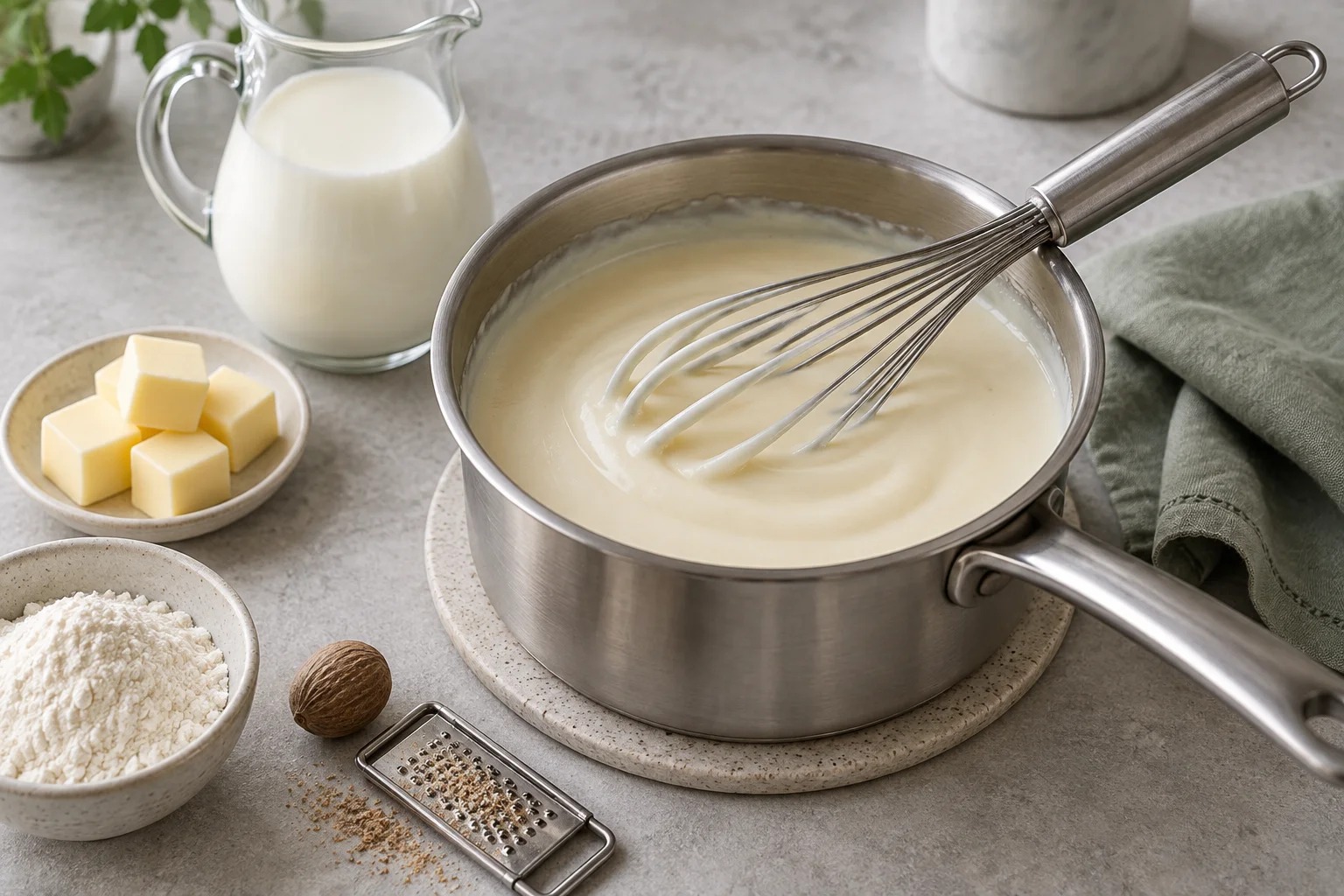
In its simplest form, béchamel consists of butter, flour and milk. The butter distributes the flour during cooking, the milk provides liquid, and the starch thickens the sauce as it heats. In lasagne, it adds a mild, creamy layer alongside the red sauce. It also helps cover the pasta sheets with moisture. Particularly with dried no-boil sheets, it therefore belongs in the recipe's overall liquid planning. Very firm béchamel is difficult to distribute, while a thin, barely thickened sauce can run away from between the layers.
Judge it for the purpose you are cooking it for. When warm, the sauce should fall from a spoon in a broad ribbon and spread with the back of the spoon. It does not need to hold a rigid mound. Cold béchamel feels considerably firmer than warm sauce, so do not decide how much extra milk to add solely from its condition straight out of the fridge. Decide early whether cheese will go into the sauce or separately into the lasagne. A substantial cheese addition later changes both seasoning and consistency. The basic white sauce initially needs no cheese at all.
A small starting batch with clear quantities
For a relatively spreadable béchamel to use in lasagne, start with 500 ml whole milk, 35 g butter and 35 g plain white wheat flour, such as German type 405. Add a small pinch of salt, some pepper and a little freshly grated nutmeg initially. Allow around 20 minutes for weighing, warming and cooking. This is a batch of sauce, not a complete lasagne for a guaranteed number of people. The amount required depends on the dish, number of layers, red sauce and pasta sheets. Follow your lasagne recipe for the total quantity and scale this batch if necessary.
For one and a half times the batch, use 750 ml milk and 52.5 g each of butter and flour. For half, use 250 ml milk and 17.5 g each. Weigh flour and butter rather than treating heaped spoonfuls as equivalent amounts. A litre of milk does not automatically produce exactly a litre of finished sauce after butter and flour are added; liquid also evaporates during cooking. If a recipe specifies a particular weight of finished béchamel, weigh it after cooking. Keep a small extra splash of milk available only for a possible consistency adjustment, rather than as an unplanned large addition.
Prepare the pan and ingredients before heating
Choose a saucepan in which the whisk can comfortably reach the base and lower edges. A very wide pan is unhelpful for this small batch because the shallow layer thickens quickly and can catch. Sufficient height, however, prevents milk from splashing over while you stir. Have a heatproof spoon or spatula ready to reach the corners of the pan as well. Coated pans need suitable utensils that will not scratch the surface. The whisk does not have to be particularly large; being able to control its movement matters more.
Weigh the flour into a small bowl and cut the butter into pieces. Warm the milk separately until hot, without letting it boil vigorously and spill over. The method described here uses warm milk in several additions. Other recipes use cold milk; do not switch between different methods midway through a batch because one is presented as the only correct approach. Have all the measured milk ready. Once the roux is on the hob, neither searching for nutmeg nor weighing the next ingredient should interrupt your stirring.
Keep the roux pale
Melt the butter over low to medium heat. It may foam lightly but should not turn dark. Add all the weighed flour and immediately stir it into the butter to form an even paste. Cook while stirring for about one to two minutes over gentle heat, until no dry pockets of flour remain visible. Keep the colour pale. A dark roux roasted for a long time is not the aim for béchamel. Briefly take the pan off the hob if the paste starts browning faster than you can move it evenly.
Sweep over the junction between the base and sides too. A small amount of flour often remains there and appears as a lump when milk is added later. The paste can hold together, but stirring should still move it readily. A strong burnt smell or dark particles are not desirable toasted notes in this white sauce. In that case, start again with a clean pan. Pouring milk over a burnt base simply distributes the flavour throughout the batch. Keeping the mixture pale is easier when you reduce the heat in time.
Work in the milk in stages
Take the pan briefly off the heat for the first addition. Add approximately 100 ml warm milk and stir thoroughly. The mixture may initially look firmer before becoming even again. The important point is to make it smooth now. Only then stir in the next approximately 100 ml. Add the remaining 300 ml in two further portions. Dividing it makes the process easier to control; you do not need to measure each addition to the exact millilitre. Together, they still make the measured 500 ml. Stir steadily and firmly enough to combine the mixture without splashing hot liquid out of the pan.
If small lumps appear during the first stage, pause before adding more milk. Press and work them out with the whisk while the mixture is still manageably thick. Adding a large amount of milk at once makes those pockets harder to reach. Return the pan to the hob and heat the fully combined sauce while stirring continuously. Avoid using a particularly high setting to catch up on supposedly lost minutes. The base can become much hotter than the sauce above it. Even heating and stirring right into the corners matter more than reaching a boil as quickly as possible.
Simmer, season and check consistency
Once the sauce comes to a gentle boil, reduce the heat and simmer for about five to ten minutes. Keep stirring so that nothing catches on the bottom. It thickens as it heats; do not remove it from the hob as soon as you see the first thickening. The flour and milk need the full cooking stage. The time is a guide for this batch, not an instruction to maintain vigorous bubbling. Small rising bubbles and sauce that remains easy to stir are sufficient. If it reduces heavily during this stage, lower the heat and adjust with a little milk as needed.
Season carefully towards the end with salt, pepper and nutmeg. Consider the ragù and cheese in the finished lasagne, which may already contribute substantial salt. Lift a spoon to check consistency: the béchamel should coat it while still flowing. For tasting, take a little sauce with a clean spoon and allow it to cool slightly. A raw, floury impression may mean that it needs to simmer gently for longer. Heavy seasoning will not solve that problem. Assess flavour and consistency separately, so that correcting one does not unnecessarily change the other.
Adjusting sauce that is too thick or too thin
For overly firm béchamel, stir in warm milk a tablespoon at a time while heating the sauce evenly again. Pause after each addition until it is fully incorporated. You can then see whether another spoonful is needed. A large unmeasured addition can turn an almost suitable sauce into one that is too thin. If the béchamel has only thickened through cooling, warm it while stirring first. Decide about additional liquid after that. Note substantial adjustments if you want to repeat the batch for the same lasagne in future.
For a thin sauce, first ask whether it has become sufficiently hot and simmered for several minutes. If not, complete that stage before doing anything else. If it remains too liquid afterwards, prepare a small additional roux separately, for example with 5 g each of butter and flour. Cook it pale, gradually stir in some warm sauce until smooth, and only then combine the two mixtures. Simmer the complete batch gently again for about five to ten minutes. Sprinkling raw flour straight over the finished sauce readily creates lumps and does not remove the need for further cooking.
Distinguish lumps from a scorched base
For small flour lumps, first take the pan off the heat and whisk the sauce thoroughly. If they remain, pass the still-pourable sauce through a fine heatproof sieve into a clean pan. Heat it again afterwards and continue cooking if the original cooking stage was incomplete. A sieve removes lumps; it does not cook any raw flour hidden inside them. Also check whether the remaining quantity still suits your lasagne. Straining out a large amount of paste can change the balance between milk and the flour that thickens it.
Burnt sauce is a different problem. Do not scrape dark residue vigorously off the bottom and stir it in. If the sauce already smells or tastes burnt, a fresh small batch is the better solution. Extra nutmeg, cheese or milk will not remove that flavour. Lower heat, a suitable pan and regular contact between the stirring utensil and the entire base help on the next attempt. A harmless skin on the surface, meanwhile, is not a scorched base. Remove it before continuing, or pass the sauce through a sieve if it will not stir back in smoothly.
Spread it warm and allocate the quantity sensibly
Béchamel is easiest to layer while it is warm and spreadable. Have the ragù, sheets, dish and cheese ready before it finishes cooking. Reserve some for the top rather than spreading very thick layers at the beginning. Connect small spoonfuls with the back of a spoon without completely displacing the red sauce underneath. Pay particular attention to the corners of the pasta sheets. Continuous moist coverage there is more useful than a large mound of sauce in the middle. An even layer also makes it easier to lay the next sheet flat.
If you want to add cheese to the sauce, choose a version designed for that and include it in the overall quantities. A rich cheese sauce behaves differently from this plain béchamel. Similarly, a plant drink or gluten-free starch will not deliver the same consistency without adjustment in every case. For such versions, use a recipe suited to the specific ingredients. Lactose-free cow's milk is not a substitute for someone with a milk-protein allergy. Milk, butter and wheat flour remain the starting ingredients for the basic sauce described here; their properties determine the method. Adapt a particular variation deliberately after that.
Preparing ahead and reheating
If you are not using the sauce immediately, transfer it to a clean, shallower container to cool quickly. Do not leave a large hot saucepan on the worktop for hours. To prevent a skin, you can place a covering suitable for the temperature and direct food contact against the surface, following the material's instructions. Refrigerate promptly and store covered. Keep the fridge no warmer than 7°C and preferably below 5°C, while following any stricter instructions for the ingredients used. A firm surface does not mean that the sauce has acquired a longer storage life.
To reheat, put the béchamel in a suitable saucepan and stir it smooth over moderate heat. Add only the milk needed for the desired spreadability. Heat thoroughly to at least 70°C for two minutes in every part; if unsure, check with a food thermometer and stir to distribute heat evenly. A small freshly cooked quantity is often easier to plan than a large indefinite supply. For the next batch, note the milk, butter and flour amounts and the consistency during layering. These details help you reproduce the sauce that fits your lasagne.