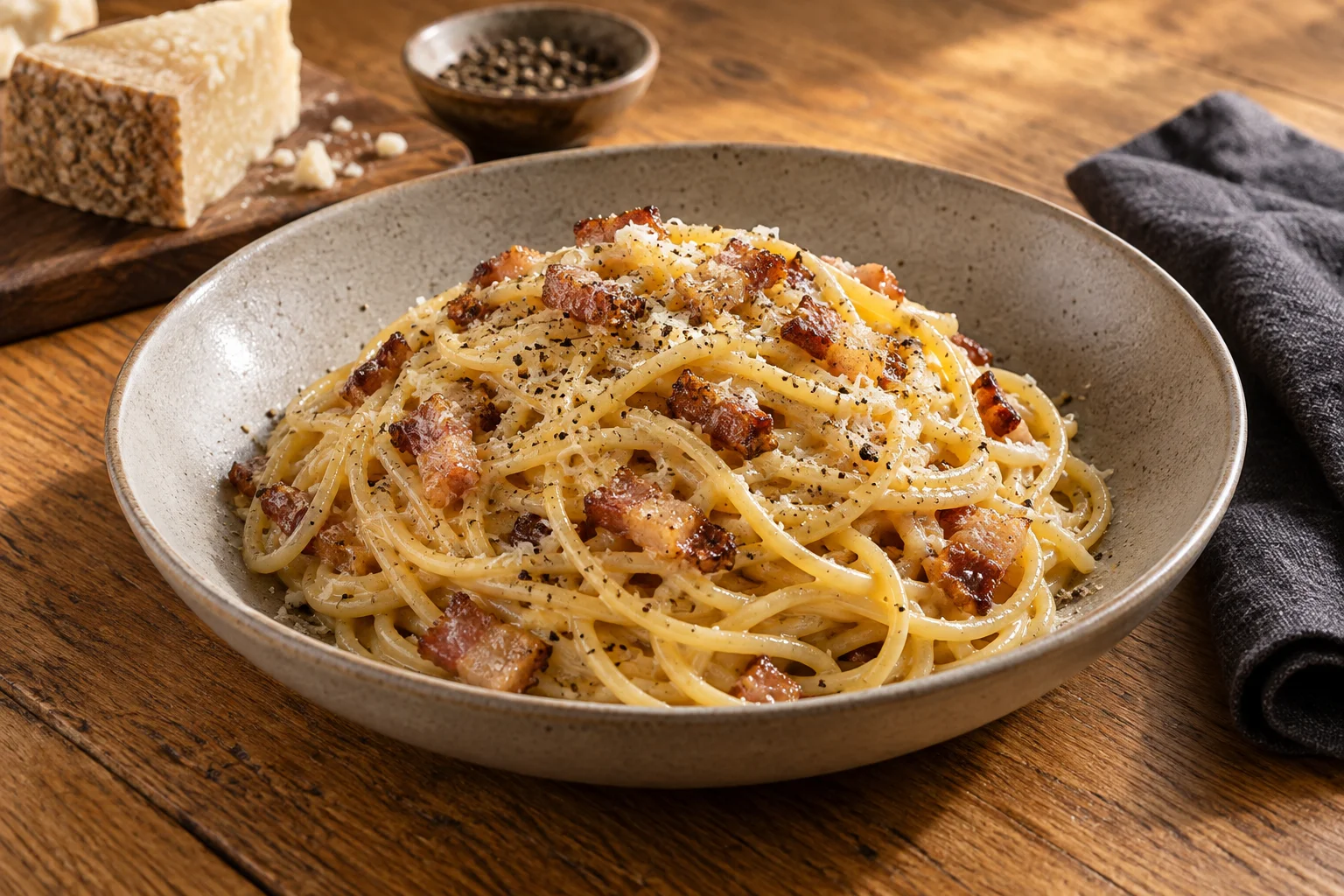
How the sauce comes together
A well combined carbonara coats the pasta with a thin, glossy layer. Egg yolk, finely grated cheese, a little rendered pork fat and starchy cooking water all contribute to that sauce. Mixing disperses the ingredients, while gentle warmth also changes the consistency of the yolk. Excessive heat produces firm pieces of egg. Too little liquid, however, can create a heavy, sticky mixture even before the egg has set. Those two problems need different corrections. Before applying more heat, it is therefore worth checking whether the sauce simply needs a little more water to loosen it.
The method below uses a metal bowl and, if needed, a gentle water bath. This separates the supply of heat from the hot base of the frying pan. Cream is unnecessary for this version: combining the existing ingredients produces the creamy texture. You do not need to stir in raw starch or toss the pasta in a large extra quantity of fat either. Have the cheese, yolk and cooking water ready before the spaghetti finishes cooking. Once you drain it, the remaining actions should follow one another without a lengthy interruption. Set the table before you reach that stage.
Ingredients and quantities for two
For two main courses, use 200 g dried spaghetti, 100 g guanciale with its hard rind removed, 60 g commercially pasteurised egg yolk, 40 g finely grated Pecorino Romano and half a level teaspoon of freshly ground black pepper. Choose a yolk product whose manufacturer states that it is suitable for dishes that will not be fully cooked; sweetened baking products are unsuitable here. Cook the pasta in roughly 2 litres of water, initially seasoned with 8 g salt. Later, reserve 200 ml of that cooking water. It is a reserve to draw from as needed, not an instruction to add it all.
The yolk quantity is a weight, rather than a fixed number of eggs. Weigh the cheese without its rind too. Guanciale and Pecorino already supply salt, so the cooking water starts with comparatively restrained seasoning. Allow around 30 minutes, or slightly longer on a first attempt. Gather a pasta pot, frying pan, sufficiently large heatproof metal bowl, tongs and fine grater. For the water bath, you also need a small saucepan on which the bowl sits securely without its base touching the water. A kitchen thermometer helps you warm the sauce gently and observe its changing temperature.
Choosing the egg yolk deliberately
Carbonara's creamy appearance does not demonstrate that ordinary raw egg has been adequately heated. Hot pasta can warm and thicken an egg mixture without delivering a reliable pathogen-reducing combination of temperature and time throughout it. This version therefore explicitly uses suitable pasteurised yolk. The later warming step adjusts texture; it is not a method for pasteurising raw eggs at home. A very fresh shell egg, a strongly coloured yolk or a thickened sauce does not remove that distinction. Do not silently substitute uncooked shell egg for the specified ingredient and assume that the procedure has the same properties.
Store the product according to its packaging and measure out the required 60 g when preparing the sauce. Follow its instructions after opening too: taking a small portion from a large carton does not restart its storage life. Use a clean bowl and clean utensils. Avoid leaving the egg mixture beside the cooker while unrelated jobs delay the meal. If an appropriate product is unavailable, choose a different sauce with a suitable complete recipe for that evening, such as a tomato sauce. That is easier than improvising a different egg treatment once the pasta is already cooking.
Rendering guanciale and measuring its fat
After removing the hard rind, cut the guanciale into pieces about 5 to 8 mm wide. You can brush away some of a thick outer pepper coating so that loose spice does not burn during frying. Put the pieces into the frying pan without additional oil and heat over medium to moderately low heat. Fat should render and the surfaces should develop colour over approximately 8 to 12 minutes. Move the pieces occasionally. The actual time depends on their size and your pan; dark, burnt edges are not the aim and can make the finished sauce taste bitter.
Lift the browned pieces out with a slotted spoon and move the pan away from the hot hob. Keep the rendered fat separately. Start the sauce with one tablespoon of that fat later, rather than automatically using everything left in the pan. Different pieces of guanciale can release substantially different amounts. Measuring the initial addition prevents a fattier packet from turning the meal unnecessarily oily. The prepared meat waits only while you finish cooking the pasta. Reserve a small amount to put on the plates if you like, and mix the remainder through the sauce towards the end.
Preparing cheese and collecting cooking water
Grate the Pecorino finely and freshly. Long, firm shavings distribute less readily than a light, fine grating, particularly at the gentle temperature used here. Mix the 60 g yolk, 40 g cheese and pepper in the metal bowl. A thick paste at this stage is normal. Use all the weighed cheese in this mixture; the quantities do not include an additional topping of cheese. For a milder flavour in a later batch, you could replace some of the Pecorino with Parmigiano. Bear in mind that changing the cheese also changes its saltiness and how it behaves in the sauce.
Cook the spaghetti in the prepared water until al dente, following its packet and stirring at the start. Shortly before draining, collect 200 ml cooking water in a heatproof container. Measure 20 ml from it into a separate small vessel and let that portion cool until warm rather than boiling hot. Stir those 20 ml into the yolk and cheese together with the one tablespoon of warm, rather than hot, guanciale fat. This loosens the base before it meets the pasta. Keep the remaining 180 ml of cooking water available for the adjustments that follow; it may not all be needed.
Combining pasta and sauce away from direct heat
Drain the cooked spaghetti without rinsing it under cold water. It does not need to sit drying in a colander for several minutes; some clinging cooking water is welcome. Transfer it to the prepared bowl and immediately mix it thoroughly with the sauce. Turn the strands with tongs and lift the lower ones through the mixture so that everything receives a coating. At first, the bowl stays on the worktop, away from an active hob. The hot base of the guanciale frying pan plays no part in this step. This removes one source of heat that can otherwise be difficult to judge.
If the sauce feels tight, add one tablespoon of warm cooking water and mix again. Repeat only until the strands move freely and shine evenly. A large splash is harder to correct afterwards. Look at the bottom of the bowl too: a little creamy sauce there is fine, whereas a clear layer of fat or a watery puddle suggests that the mixture needs attention. Add most of the guanciale now. If the texture is already pleasantly creamy and the food is warm, serve it straight away. There is no need to use a water bath as an extra compulsory step.
Gently thickening over a water bath if needed
If the mixture remains distinctly thin despite only a small addition of water, gentle warmth can help it thicken. Bring a little water in the small saucepan to a gentle simmer. Sit the matching metal bowl securely on top, keeping its base above the water. Hold it with a dry oven cloth and keep moving the pasta. Lift it away from the saucepan repeatedly to assess the texture. The sauce should gradually coat the strands without forming firm streaks of egg around the bowl. Vigorous boiling, an unstable bowl and handling hot metal with an unprotected hand are unsuitable for this method.
A sauce temperature around 60 to 65 °C can serve as a working guide while you stir. Measure in the moving sauce rather than against the metal base. This is a texture range, not proof of pasteurisation. Remove the bowl as soon as the sauce binds; you do not have to force it to reach a particular number when the texture is already right. If it thickens too far, add a little warm cooking water. Avoid holding the finished mixture over the water bath: heat continues to act while moisture is lost and the yolk becomes firmer. Serve directly after finishing the mixing.
Correcting common problems
A uniformly thick but smooth sauce usually needs liquid first. Stir in a tablespoon of warm cooking water and assess it again. Distinct, firm yellowish flakes instead suggest that egg has set. Remove the bowl from all heat immediately. More water may loosen the sauce surrounding those flakes, but cannot reliably turn them back into a smooth emulsion. Further heating makes the problem worse. Excessive salt also has limited last-minute fixes: adding more Pecorino to thicken a mixture adds salt at the same time. Restrained seasoning at the ingredient and cooking-water stages is easier than trying to correct the plated dish.
An oily layer is more likely when too much rendered fat goes into the bowl. Thorough mixing with a little warm cooking water may bring a still-loose sauce together, but that is not a guarantee for unlimited amounts of fat. Conversely, a watery sauce does not immediately need more cheese. First see whether further mixing and brief, gentle warmth will thicken it. Make small adjustments and change one thing at a time. Adding cheese, water and heat together makes it difficult to identify which action helped. It also makes your next attempt at the same portion size harder to plan consistently.
Scaling portions and planning variations
For four people, double the ingredients to 400 g dried pasta, 200 g guanciale, 120 g suitable pasteurised yolk and 80 g Pecorino. Adjust the pepper and the initial measured addition of rendered fat accordingly. A larger batch also needs more space for mixing. Two smaller bowls can be easier to handle than one overfilled bowl, especially over a water bath. The time needed to reach the desired consistency does not simply double. More hot pasta changes the way the mixture warms, while the clearance between the bowl base and the water remains an essential part of the setup.
Pancetta can be a deliberate alternative to guanciale, but its flavour differs and it may release less fat. Smoked bacon adds smoke flavour as well. In either case, do not automatically transfer all the frying fat into the sauce. A vegetarian version requires more thought than merely removing the meat and following the remaining instructions unchanged: the fat and seasoning base changes, and cheese may contain animal rennet. A separately balanced recipe suits that variation better. In the carbonara described here, guanciale, Pecorino, yolk and pepper remain the main flavours; neither garlic nor cream is added to the mixture.
Serving immediately and handling leftovers
Divide the finished pasta between two waiting plates, add the reserved guanciale and serve immediately. The sauce can look slightly looser in the bowl than you want it on the plate, because it firms as it cools. Plates taken straight from a very hot oven are unnecessary. If people are eating at different times, complete the final steps in separate portions. Leaving a fully mixed carbonara on the cooker for half an hour seldom preserves the intended texture, and unnecessarily extends the period during which the food remains outside refrigeration. Preparing for the actual serving time produces a more manageable result.
Plan this dish primarily for the current meal. If some remains, cool it promptly in shallow containers and refrigerate at no more than 7 °C, preferably below 5 °C; follow any stricter product instructions. When reheating, the food should reach at least 70 °C for two minutes throughout. The egg may become firmer and the sauce grainier during that process. Do not shorten the required reheating merely to preserve its original creaminess. A fresh batch for two is therefore generally a more suitable plan than cooking a large quantity of carbonara to provide several days of meals.