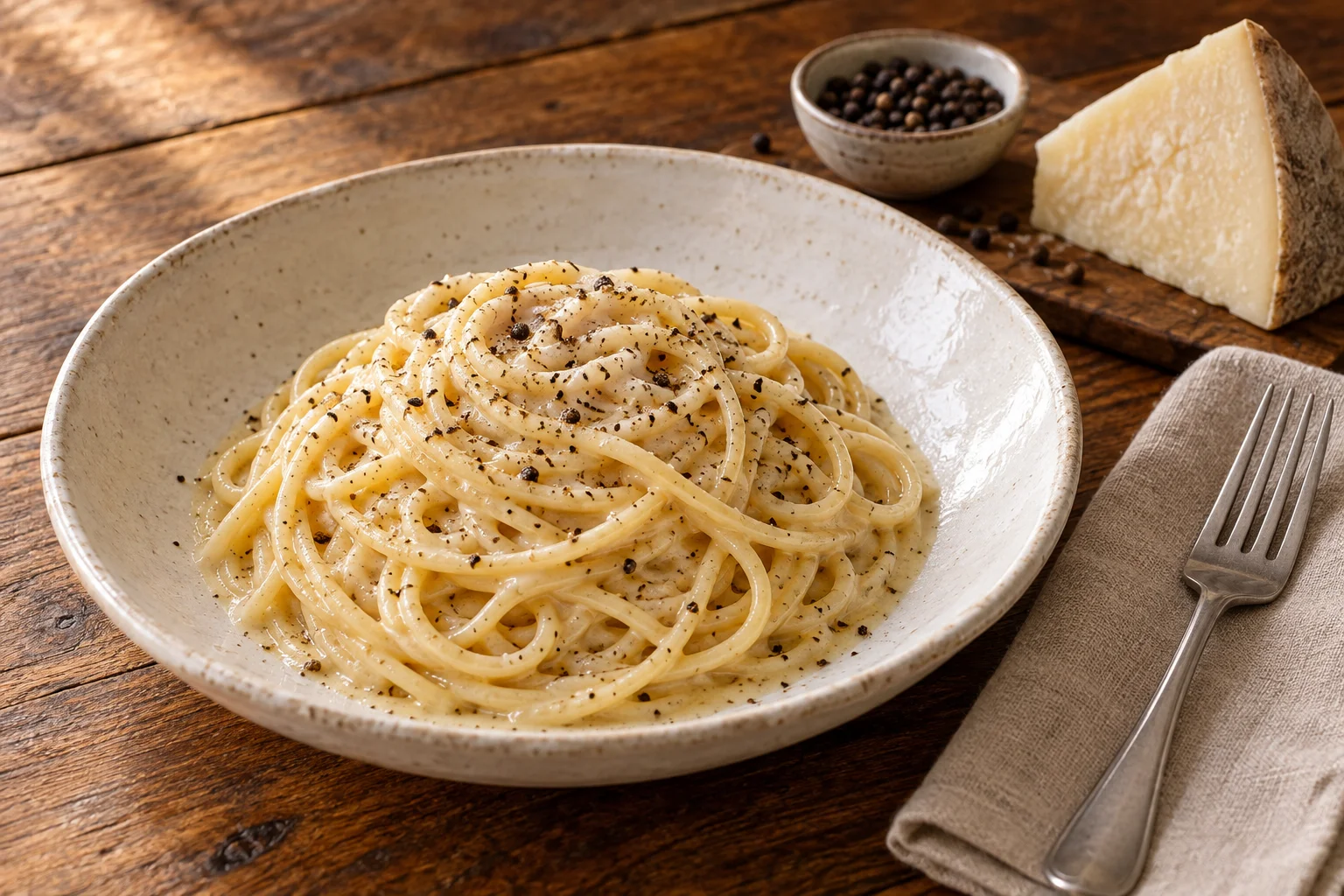
What makes the sauce creamy
Cacio e pepe brings together grated cheese and starchy cooking water. Black pepper supplies the seasoning, while the pasta contributes heat and further starch. That sounds like a dish in which everything can simply be thrown together. In practice, the final mixing stage largely determines whether you get a smooth coating or firm pieces of cheese sitting beside the strands. Plan that stage first: grate the cheese, prepare the pepper and put out the bowls before cooking the pasta. Once the spaghetti has drained, there should be no need to search for a grater or clear space for mixing.
This method uses a cheese paste and a large bowl away from the hob. The bowl makes heat easier to control than a heavy frying pan that has just been heated. Cream, butter and additional powdered starch are not part of this version. The sauce should coat the strands and remain slightly fluid at the bottom of the plate, without forming a watery puddle. It firms up as it stands. Have plates ready and serve as soon as mixing is complete. Keeping the finished dish warm for a long time is less suitable than a short, properly prepared finish.
Measure ingredients for two servings
For two main portions, use 200 g dried spaghetti, 80 g Pecorino Romano and one level teaspoon of black peppercorns. Allow approximately 1.5 litres of cooking water and start with about 6 g salt. This modest seasoning takes account of the salty cheese and the cooking water that will become part of the sauce. You can adjust the finished dish according to the cheese and your preference. The pasta quantity refers to dried spaghetti. Fresh tonnarelli contain a different amount of water and have a different cooking time, so the same weight would not provide an equivalent portion.
Grate all 80 g of cheese for the sauce. If you want extra cheese for serving, measure that separately so that the planned sauce quantity remains intact. Have a heatproof measuring jug ready to hold approximately 200 ml cooking water, collected towards the end of boiling. This is a reserve, not a quantity that must all go into the dish. Begin the cheese paste with 40 ml of it, then make small additions as needed. That gives you room to loosen a stiff mixture without later having to reduce a sauce that has become too thin.
Grate the cheese finely and choose it carefully
Pecorino Romano is a strongly flavoured hard sheep's milk cheese. Use a fine grater to produce small, loose particles. Long, coarse shreds need more moisture and mixing before they distribute evenly. Remove the hard rind before weighing the cheese. Prepare it alongside the other kitchen tasks; there is no reason to leave it unrefrigerated for hours. A large quantity straight from a very cold pack can cool the mixture more noticeably, but fine grating and controlled heat during the final combination matter more than achieving an exact starting temperature for the cheese itself.
Ready grated products vary in particle size and ingredients, so check whether you have bought pecorino or a cheese blend. Parmesan changes the flavour and salt level and can be used in a deliberate variation, rather than treated as an identical substitute. A meatless ingredient list also does not automatically make the dish vegetarian: Pecorino Romano is made using animal rennet. For a vegetarian version, choose a hard cheese specifically labelled as suitable and expect its melting behaviour to differ. The same mixing principles remain useful, although the water requirement may change. Adjust the seasoning after everything has been combined.
Prepare the pepper without burning it
Crush the peppercorns in a mortar or grind them coarsely. Very large fragments can be unpleasant to bite into, whereas a fine powder spreads its heat immediately throughout the dish. Small fragments with a little finer pepper work well among the long strands. Warm the crushed pepper briefly in a small dry frying pan over a low to medium heat, moving it around. As soon as its aroma becomes clear, take the pan off the hob and transfer the pepper to a small dish. It should not smoke or develop black, burnt residue.
This is a short task that can be completed before the pasta goes into its water. A very hot pan continues heating the pepper after the hob has been switched off, which is why the pepper is transferred out. Keep back a small pinch for serving and use the rest in the cheese paste. If you prefer to control the heat cautiously, start with less during mixing and add more at the table. Burnt pepper is a different issue and cannot reliably be balanced by extra cheese. Prepare a fresh small quantity before draining the pasta and beginning the more sensitive final stage.
Cook the pasta and reserve starchy water
Bring the measured water to the boil in a sufficiently large saucepan and add the salt. Put in the spaghetti and move it until all the strands are submerged. Stir several times at the beginning to stop strands sticking together or catching on the base. Although the water quantity is fairly modest, the pasta still needs space to move. Add hot water if the saucepan is unsuitable for that amount or the level falls markedly during cooking. A small departure from the initial quantity is less troublesome than pasta that has stuck together or cooked unevenly.
Use the packet time as a guide and check a strand towards the end. It should be cooked al dente because it will not continue boiling in the mixing bowl. During the final minutes, ladle approximately 200 ml of the now cloudy cooking water into the measuring jug. Transfer 40 ml to a small open container so this first portion can cool promptly. Do not pour away the remaining cooking water until the reserve is safely collected. After draining, leave the pasta unrinsed: extra water would make the sauce harder to measure and cool the strands unnecessarily.
Mix a smooth cheese paste
The water for the cheese paste should be warm rather than freshly boiling. In a small bowl, gradually stir the first 40 ml into the finely grated pecorino and prepared pepper. The mixture will initially be thick. Work it evenly with a spoon or small whisk, adding further slightly cooled pasta water a teaspoon at a time if necessary. Aim for a soft, spreadable paste with no dry pockets of cheese. It does not need to flow like a finished sauce yet, because the pasta and further moisture will join it during the final mixing stage.
Pouring boiling water directly over cheese increases the chance of firm clumps. Research into this kind of sauce also shows that stability depends on temperature, starch content and the balance between cheese and water. One temperature cannot therefore guarantee success with every product. For this method, use the small cooled portion of water and keep the mixture away from the hob. If the paste is merely stiff, more water and thorough stirring can help. If it already contains firm, stretchy lumps, further heating generally makes the problem worse rather than returning the cheese to a smooth consistency.
Combine the spaghetti away from the hob
Drain the cooked spaghetti and put it into a large bowl at room temperature. Separate and turn the strands briefly with tongs, allowing the strongest heat to escape for roughly half a minute to a minute. That is a guide for this small batch, not a guaranteed cooling time for every bowl. The strands should remain warm, but should not carry freshly boiling liquid directly into the cheese paste. Avoid a serving bowl that has been heated strongly beforehand. Its stored heat would replace the direct hob heat that this method deliberately keeps out of the final stage.
Add the cheese paste in two or three portions and turn the spaghetti thoroughly, repeatedly drawing the strands through the mixture at the bottom. If they are difficult to move, add a tablespoon of warm, non-boiling pasta water and mix again. Repeat only until the sauce coats evenly and the strands separate easily. There is no need to use all 200 ml of the reserve. Small additions are particularly useful just before serving. One large ladleful can turn a nearly finished sauce into a thin liquid that is difficult to thicken again without exposing the cheese to excessive heat.
Distinguish stiffness, thinness and clumps
A stiff sauce is initially a moisture problem. If the cheese is evenly distributed but the strands cling together and look dry when turned, add warm cooking water a tablespoon at a time. After each addition, watch for the pasta regaining its sheen and separating more easily. Extra oil is not an equivalent correction because it does not replace the water needed by the mixture. If prolonged adjustments allow the food to cool, resist bringing the entire cheese mixture back to a vigorous boil. A smaller batch and fully prepared ingredients are more useful next time than an especially hot finish.
For a thin sauce, first check whether liquid really remains pooled beneath the pasta or begins to thicken after a little mixing. The strands continue absorbing moisture, and cooling also makes the mixture firmer. More cheese can thicken it, but also adds salt, so make any addition finely grated and modest. Large rubbery lumps are a different problem from a sauce that simply lacks body. They often cannot be stirred completely smooth again. Sprinkling raw starch over the dish or boiling the sauce hard is not a suitable repair for this method. A cooler final mixing stage is the useful adjustment for the next preparation.
Plate promptly and plan larger quantities
Divide the pasta immediately between two prepared plates, including the still supple sauce at the bottom of the bowl. Finish with the reserved pinch of pepper. Only now taste whether more salt is actually needed. With 80 g cheese already included, a heavy extra layer is often unnecessary and draws additional moisture from the surface. The intended result is apparent when you lift a forkful: the strands turn around the fork, remain evenly coated and do not sit as a dry, rigid block on the plate. A little fluidity in the sauce is welcome during plating.
For four servings, the ingredient quantities can be doubled mathematically, but the larger mass of pasta retains more heat. A very full bowl is also harder to mix quickly. If you have limited experience with the method, two small batches finished in succession are easier to control than one large batch. Grate all the cheese beforehand and divide it into the planned quantities, and prepare the pepper as well. Mix each cheese paste using freshly collected cooking water. Arrange the meal so that everyone is already at the table when you finish the final portion; immediate serving suits this dish best.
Prepare ahead and handle leftovers sensibly
Useful preparation centres on the dry ingredients and equipment. Cheese can be grated before cooking and kept covered in the refrigerator; pepper can be measured and crushed. Put the jug, tongs, small bowl and large mixing bowl within reach. Holding the finished sauce warm would prolong the stage most sensitive to heat and water loss. If you need a meal that can be prepared earlier and reheated later, ragù or an oven pasta designed for that purpose is simpler to organise. Cacio e pepe is particularly well suited to small quantities cooked shortly before they are eaten.
If portions are left over, cool them promptly in a shallow container and refrigerate covered at no more than 7°C, preferably below 5°C. When reheating, sufficient heat takes priority over preserving the original creaminess: every part should reach at least 70°C for two minutes. This can change the cheese sauce and soften the pasta. Reheat only the portion needed and keep the remainder cold. For a second meal with the same freshly made texture, the better approach is another small batch using newly cooked spaghetti, prepared cheese and pepper, rather than expecting stored sauce to behave exactly as it did the first time.