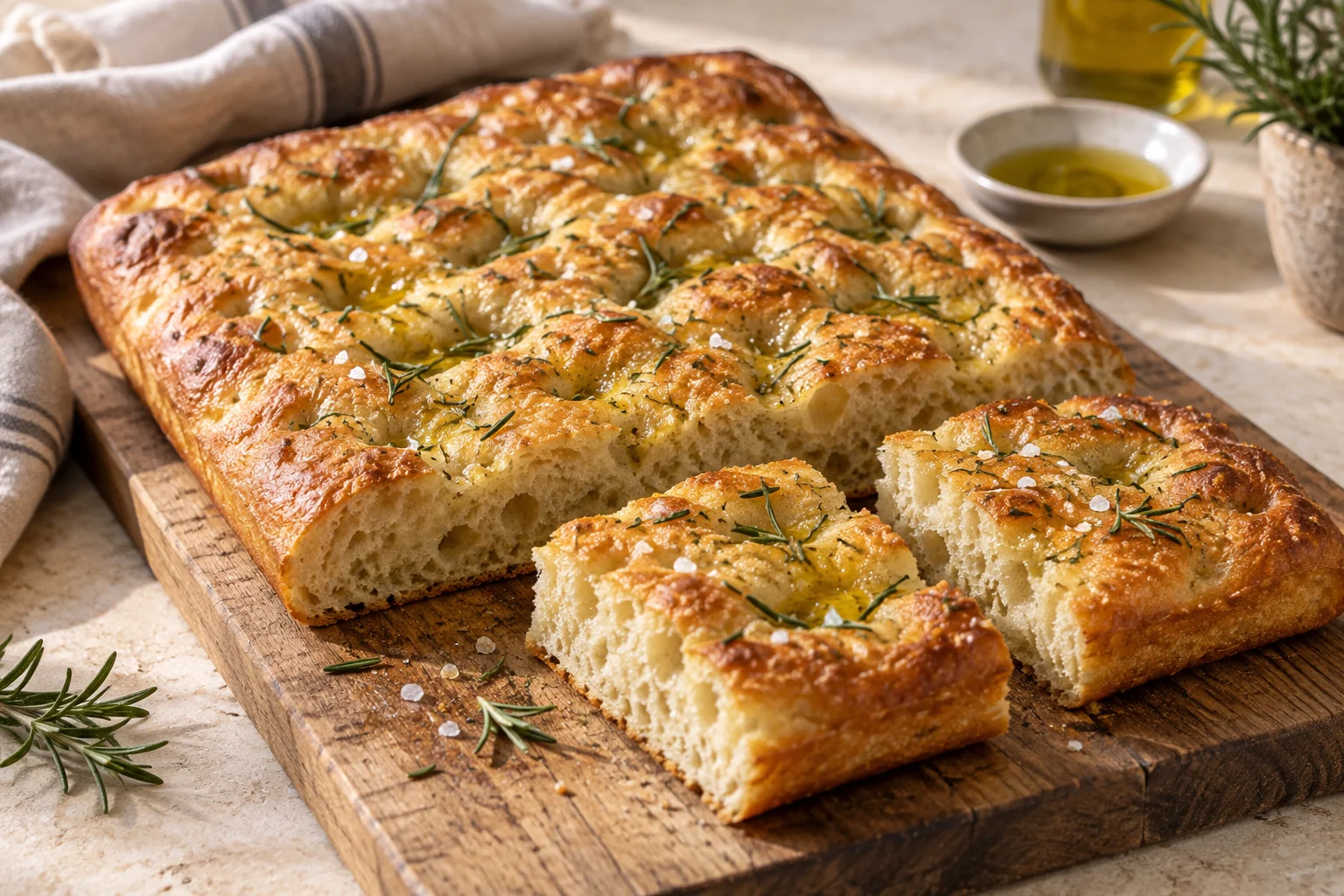
The recipe
Ingredients
- 500 g strong white wheat flour, such as a suitable German Type 550
- 350 g water, approximately room temperature
- 4 g instant yeast
- 10 g fine salt for the dough
- 60 g olive oil, divided into 20 g for dough, 20 g for pan and 20 g for surface
- 1 tsp fresh rosemary needles, finely chopped
- Approximately ¼ tsp coarse salt for the surface
Method
- Mix flour, instant yeast according to its packet, water and 10 g salt. Work in 20 g oil and knead by hand for a few minutes to make a cohesive soft dough. Cover.
- Let rise at approximately 22 to 24°C for about 90 to 120 minutes, until noticeably increased in volume. After 30 and 60 minutes, gently fold the edges towards the middle, covering again afterwards.
- Spread 20 g oil in a metal pan approximately 20 by 30 cm. Transfer the dough gently and ease it out. If it contracts, rest covered for 10 minutes, then gently press towards the corners again.
- Proof covered in the pan for approximately 45 to 75 minutes in total, until visibly airy. Towards the end, preheat the oven to 220°C with conventional top and bottom heat.
- Press dimples into the dough with oiled fingertips. Mix rosemary with the final 20 g oil, distribute over the surface and sprinkle with a little coarse salt.
- Bake on a middle-to-lower shelf for approximately 25 to 30 minutes until golden, checking from minute 22. The underside should be baked and the centre no longer doughy. Extend by a few minutes if needed.
- Release from the pan and cool on a wire rack for at least 15 minutes before cutting.
Choose the pan and keep the dough soft
For this quantity, use a metal pan approximately 20 by 30 cm with sides at least four centimetres high. A substantially larger pan produces a thinner bread and changes the baking time. The dough contains 500 g strong white wheat flour and 350 g water, giving 70 percent hydration. It remains soft and slightly sticky. Avoid adding flour until it feels like a firm pizza dough. A scraper and slightly damp hands make handling easier.
Divide the total 60 g olive oil into three amounts: 20 g for the dough, 20 g for the pan and 20 g for the surface. Oil does not count towards the water quantity. Use four grams of instant yeast according to its packet instructions. The timing below assumes a kitchen around 22 to 24°C. Cooler conditions extend fermentation; in a warmer room, check earlier. Visible aeration and a soft, airy feel matter more than an exact time on the clock.
Spread it in the pan without pressing out the air
After the first rise, transfer the dough gently into the oiled pan. It does not need to reach every corner immediately. Ease it out slightly, then rest covered for ten minutes before gently helping it spread again. This pause forms part of the subsequent pan proof. Before baking, the dough should be noticeably more aerated and wobble slightly when the pan is moved gently. Do not then pull it vigorously in every direction again.
Use oiled fingertips to make evenly distributed dimples without flattening the whole dough. Mix finely chopped rosemary with the remaining surface oil and distribute over the top. Small pools of oil in the dimples are welcome. Add only a little coarse salt because the dough already contains ten grams. Release the baked focaccia from the pan and let steam escape on a wire rack. Leaving it in the tray traps steam and softens the underside more quickly.