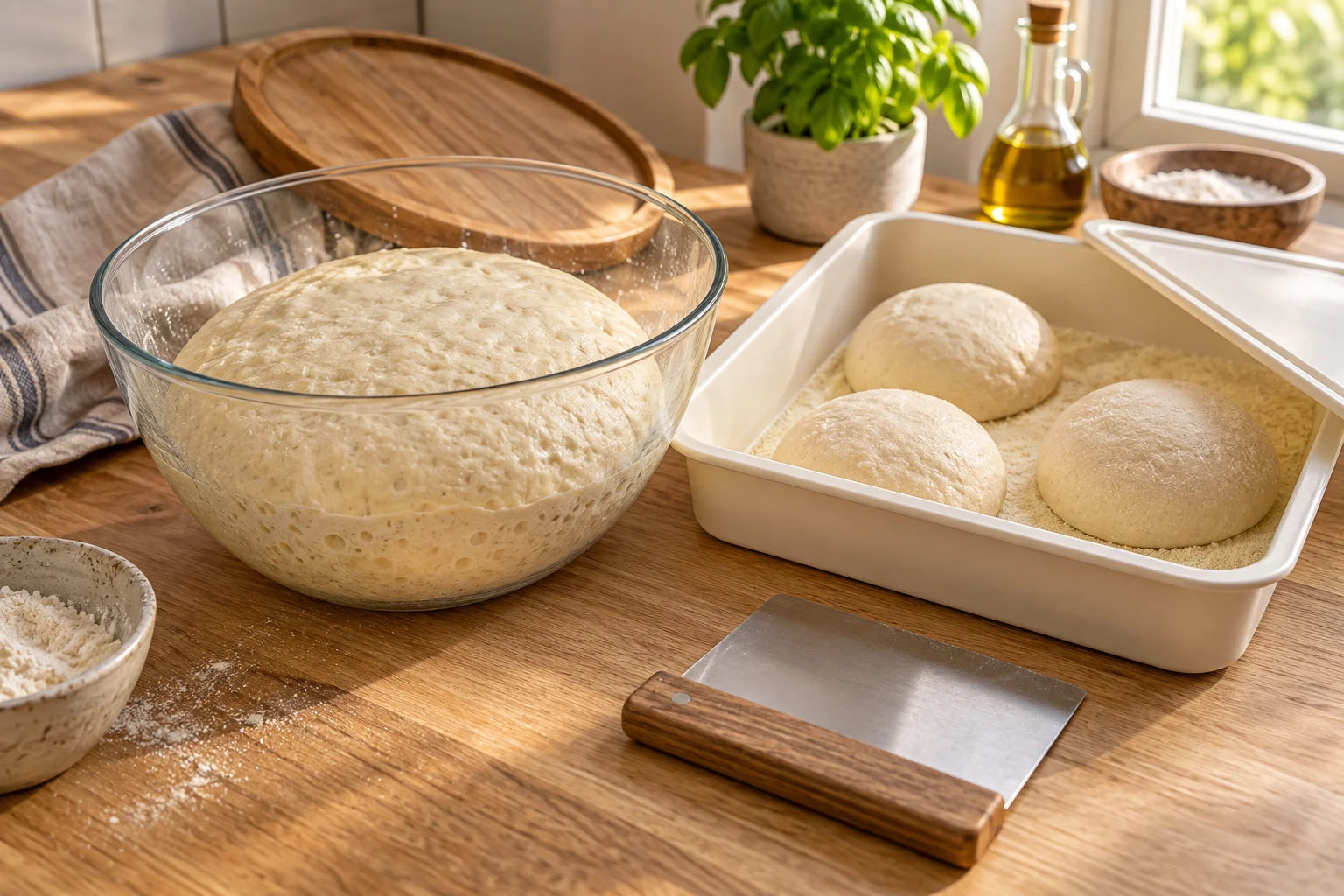
Two stages in one continuous fermentation
Bulk fermentation is the rest of the combined dough after mixing and kneading. The whole batch initially stays in one bowl or box. Dividing and balling then creates individual portions, whose further rise is called the final proof. Yeast remains active during both stages; cutting the dough does not start a new biological clock. The terms mainly describe the form in which the dough rests and what you intend to do next. For pizza, the final proof ends before the ball is opened into a base. This differs from bread, which often completes its rise already shaped as the finished loaf.
Not every pizza recipe needs a long bulk fermentation. Some methods divide early and allow most of the fermentation to happen in individual balls. Others keep the batch together for longer and portion it later. Either approach can work when yeast quantity, temperature and timing are compatible. Start by following one complete recipe. Combining two time estimates from unrelated recipes does not necessarily create a suitable schedule. What matters is having dough balls that are sufficiently aerated and relaxed at baking time and can be opened without major tears.
Work backwards from the first pizza
Begin with the time you want to bake the first pizza. Allow beforehand for thoroughly preheating the baking surface, preparing toppings and opening the first portion. The final proof needs to be sufficiently advanced by then, which determines when you should divide. For example, suppose your chosen room-temperature recipe specifies approximately two hours of final proof and three hours of bulk fermentation. For a first pizza at 7 pm, portioning would fall around 5 pm and the end of kneading around 2 pm. This illustrates scheduling; it is not a complete dough recipe on its own.
The dough may progress differently if your kitchen is warmer or cooler than expected. Check in good time rather than waiting until 6:55 pm. For the first batch, record the starting time, temperature after kneading, dividing time and condition at baking. These four details tell you more than a list of fridge hours without any temperature context. When making several pizzas, account for the final baking time too: four portions finish one after another in a domestic oven. Arrange the dough so later portions do not wait uncovered on the counter for a long time.
Observe bulk fermentation in a suitable container
Place the kneaded dough in a clean container with enough room and cover it. The cover protects against a dry skin but should not stick to the rising dough. A transparent container with relatively straight sides makes changes in volume easier to compare. Mark the starting height on the outside with removable tape. In a strongly flared bowl, twice the height does not mean twice the volume, so the mark provides only a rough reference. Leave sufficient headroom to prevent the dough growing against the lid.
Consider several signs during bulk fermentation: the dough gains volume, its surface becomes more cohesive and small gas bubbles appear at the sides. How far it should rise depends on the recipe and the stages still to come. A universal rule requiring it to double would be particularly unhelpful before a long remaining fermentation. Do not end the stage simply because one large bubble appears somewhere. Assess the whole mass and remember whether a warm final proof or extended refrigeration follows. When considerable fermentation remains, there is little benefit in pushing the dough to its furthest possible rise already.
Fold when the dough needs support
A soft wheat dough can benefit from a fold early in bulk fermentation. Gently lift one edge and lay it over the middle, repeating from several sides. The dough should stretch without tearing. Let it rest again afterwards. Slightly damp hands often make the surface easier to handle. Use only a little water so handling does not become an unintended change to the formula. Folding organises the dough and can help it hold together, but it replaces neither suitable flour nor sufficient fermentation time.
A firm dough that has already been kneaded well does not need repeated folding at fixed intervals regardless of its condition. Check whether it is spreading loosely or already holding its shape. If you fold, record when and allow time afterwards for relaxation. Vigorous handling late in fermentation, immediately before dividing or baking, expels gas and tightens the dough again. Its effect differs from early support. With a recipe that works well, follow the stated folding schedule first. Add extra rounds only when you can identify a specific reason in the dough itself.
Dividing and balling change how the dough handles
At the end of bulk fermentation, cut the required number of portions. A scale helps the resulting pizzas have similar size and thickness. If the finished batch weighs 1,000 g, for example, four equal portions weigh 250 g each. This uses the complete dough weight, not one kilogram of flour. Avoid pulling long pieces away from the main mass. A dough scraper makes a more controlled cut. Put small weight corrections on the underside before forming each portion into a ball with a smooth upper surface and a closed seam.
Balling creates surface tension. This helps the portion keep an organised shape but also makes it less extensible immediately afterwards. That is precisely why a rest follows. A freshly tightened ball often does not yet open comfortably into a pizza base, even if the original batch had already risen considerably. Place it seam-side down in the prepared container and cover. The final proof now allows both further aeration and relaxation. Do not ball it again every time you inspect it, because that repeatedly interrupts the practical benefit of this rest.
Judge the final proof by aeration and extensibility
A proofing dough ball becomes visibly more aerated and spreads a little. Its surface should remain reasonably intact. When gently lifted, it no longer feels like a tightly stretched ball, but it should still hold together. The exact shape depends on water content, flour and container: a softer dough spreads more widely than a firm one. Width alone therefore proves neither good fermentation nor overproofing. Where possible, compare the same dough in the same box with the previous batch and account for its temperature.
A gentle finger-poke check can provide another clue, but it is not the sole deciding factor for pizza. Cold, soft or recently re-balled dough responds differently from warm, firm dough. Avoid repeatedly pressing deep holes into it. Its behaviour during careful opening is more useful: if a small disc immediately springs back strongly, cover it again and allow extra rest. If it stretches thin and develops holes with almost no resistance, further pulling is unlikely to help. Keep that base smaller and top it lightly. Readiness is a useful balance of aeration, strength and extensibility.
Refrigeration can come before or after dividing
Depending on the recipe, you can chill the combined mass and divide later, or refrigerate the shaped balls. The practical differences are storage space and the work still required. One large bowl means fewer separate containers, but the middle of the mass cools more slowly than small portions. Pre-portioned balls can be removed individually later. They need enough separation or their own containers, however. If you ball the dough late, still allow for relaxation afterwards; the time already spent in the fridge does not automatically replace that stage.
Cooling slows fermentation but does not stop it instantly. A large warm batch remains active while its centre gradually cools. After removal, the centre also warms more slowly than the surface. The appropriate time outside the fridge therefore depends on portion size, actual fridge temperature and the kitchen conditions. Keep the dough covered and assess it early enough to adjust. A cold batch does not become more predictable simply by adding extra yeast. Use a recipe intended for the refrigerated schedule you want, then change one influencing factor at a time in later batches.
Handle dough that develops too early or too late
If the dough becomes markedly airy and soft earlier than expected, first consider whether you can bake sooner. Alternatively, a cooler place can slow its further development. Remember that cooling takes time. Refrigeration cannot make severely overproofed dough young again. It may be sticky on removal, collapse or tear under gentle tension. A less ambitious size and an oiled tray may make it easier to handle, provided the dough otherwise appears normal. An extra fold immediately before baking does not reliably restore structure that has already been lost.
If the batch remains dense and barely aerated, it may need more time or a less cool environment. Also check that the yeast was used according to its packet and that ingredients were weighed correctly. Do not simply place the bowl on a hot radiator. Strong local heat can dry the outside while creating very different conditions inside. For the current batch, controlled waiting is usually easier to understand than kneading in more yeast afterwards. For the next batch, correct the underlying cause, such as a low initial dough temperature or an unrealistically short overall schedule.
Build a repeatable sequence for several pizzas
For the first run, use a manageable quantity and one complete basic recipe. Keep all portions the same size. Note when the balls opened comfortably and how the final portion behaved compared with the first. If the first pizzas worked well but the last ball became very soft, the entire formula is not necessarily wrong. Your baking sequence may simply take longer than expected. Next time, keep later portions cool for longer and bring them out in stages instead of placing every ball in the warmest part of the kitchen at once.
When assessing the result, separate three questions: was the dough sufficiently aerated, did it stretch appropriately and was the baking surface ready? A pale underside alone does not establish that the final proof was wrong. Equally, a tight ball may simply have been shaped again very recently. Making these distinctions helps you adjust more precisely. Initially keep the flour, water quantity and yeast type unchanged, and modify only the stage that actually caused difficulty. Bulk fermentation and final proof then become manageable steps for planning your baking time.