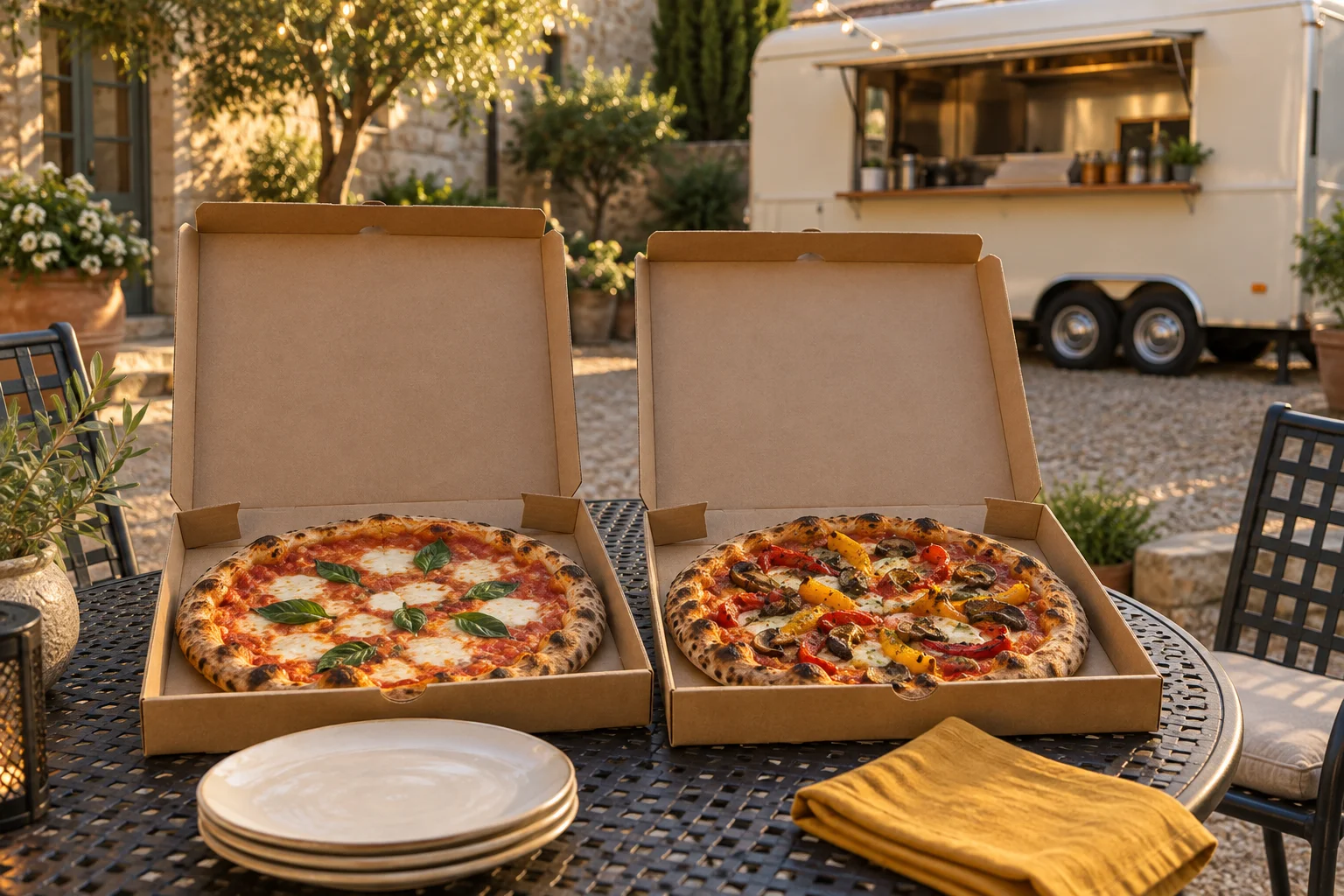
Start with how your guests will eat
Begin with the occasion. Will a small group sit down to dinner together, will people arrive over several hours, or is there a short shared break? This matters more than an initial preference for a truck or pizza boxes on a table. Delivery may suit a manageable gathering with a clear mealtime. A mobile caterer may be appealing when cooking at the venue and several serving rounds are part of the celebration. These are possible uses, not promises about every business. What matters is whether the particular supplier can provide your quantity within the available time and at the actual location. Let that practical question shape the first enquiry.
Write a short common brief containing the date, exact address, expected number of people eating, start and end of service, and the role of the food. Explain whether pizza is the main course or whether pasta, starters and dessert will also be offered. Someone trying several dishes does not automatically need a full main portion of each one. Mention guests with specific requirements early so that both options address the same task. This shared starting point makes the responses comparable. Otherwise, two offers carrying the same guest count can describe very different meals and leave you with different amounts of work during your own celebration.
Understand what a truck needs on site
A food truck needs more than a vacant parking space. Dimensions, access, ground conditions, working space and service must suit the actual vehicle or installation. Some businesses arrive with a trailer, others with a stand or a small mobile oven. These formats need different footprints and routes. Giro di Pizza, for example, describes different space requirements for its pizza mobile and its Ape. Those details apply to the named installations; they do not confirm what another vehicle needs. Ask about the complete working area, including open hatches, supports, preparation space and the intended queue. The vehicle must also be able to leave after the celebration, when parked cars or event equipment may have changed the access route.
Confirm power, water and other supplies against the specific equipment. One supplier may offer a largely self-contained installation, while another needs connections at the venue. A photograph of an oven cannot reliably establish this. The venue must also permit the intended use. A sufficiently large courtyard does not automatically allow cooking or blocking an access route. Discuss a suitable bad-weather arrangement and an eating area that will actually be available to guests. An improvised cover does not make every appliance suitable for every weather condition. An oven designed for outdoor use should therefore not be moved into a garage as a spontaneous fallback when the forecast changes.
Identify what delivery leaves with the host
Food-only delivery does not require a permanent cooking position at the venue. It still needs an accessible handover point, an available contact and a prepared route to the serving area. Establish whether handover takes place at the entrance or whether the agreed service includes carrying the order into the room. Mention stairs, locked entrances and long internal routes in the enquiry. At an office or hired hall, the street address alone may not identify the right entrance. There is little benefit in redirecting a driver after arrival when the detail could have been supplied earlier. A clear handover makes the intended meal start more realistic and avoids leaving food unattended while someone searches for the host.
With a food-only delivery, the host often handles distribution after handover. Who sorts the boxes, keeps specially agreed portions identifiable, puts out plates and explains the varieties? Who manages used crockery and the remaining packaging? A delivery business may offer additional services, but they need to form part of the actual order. A business accepting ordinary orders also does not prove it can handle every large event at your chosen time. Smiley's currently presents pizza, pasta and other dishes for ordering on its website. Availability, the responsible branch and the scale of a larger gathering must still be confirmed with the specific business rather than inferred from a general ordering page.
Plan the meal start and service together
For a food truck, distinguish arrival, setup, operational readiness and the first serving. MM Pizza mit Amore describes roughly an hour for its own setup before the first pizza. This is one supplier's example, not a standard setup time for all pizza mobiles. Ask your chosen business when it needs access and when guests can actually collect their first portion. A truck arriving punctually is not necessarily ready to serve immediately. Equally, prepared food does not need to sit on a buffet early just because setup is complete. The transition to serving should follow the agreed mealtime and the actual state of the food, equipment and serving area.
For delivery, the confirmed arrival window must allow for handover and your subsequent distribution. Do not infer a guaranteed large delivery to the exact minute from the availability of ordinary online ordering. A hypothetical example illustrates demand: if 60 guests should receive a first portion within 15 minutes, that requires four first portions per minute. This describes your requirement, not a measured output from a truck or delivery business. At a long open reception, the same head count can create a different task. Discuss peaks, queues and repeated rounds for both options. A suitable offer explains the intended process instead of relying solely on a general number of guests it claims to serve.
Assess quality through the menu and journey
Pizza baked on site can travel a short distance from oven to serving point. That does not mean every pizza is eaten immediately or that every truck delivers the same result. Toppings, baking, distribution and waiting time need to work together. If guests should eat simultaneously after a speech, a process that continuously bakes individual pizzas may need a different arrangement from an open buffet. Ask about the intended sequence and the distribution of varieties. An attractive oven scene can contribute to the atmosphere, but it does not demonstrate performance under your event's conditions. Use the specific answers and a suitable menu to judge whether the proposed service makes sense.
For delivered food, preparation, transport and the journey inside the building form one sequence. Discuss which dishes the supplier recommends for that arrangement and whether any components should arrive separately. Crisp pizza and a pasta dish do not respond identically to transport and waiting, but this does not establish one universal winner at every distance. Boxes that feel warm or a closed transport container do not prove suitable temperature control throughout. Longer holding needs an appropriate process and, where necessary, suitable equipment. Unknown storage times do not become harmless because the host reheats the food later. Organise serving to avoid unnecessary waiting in the first place, and do not treat the packaging as evidence of the food's complete history.
Compare service and your own work
Describe the necessary tasks individually: preparing or delivering the food, cutting, serving, taking plates to tables, replenishing crockery, handling drinks and clearing the area. Not every food truck includes all these activities. Table service may be an additional option. MM Pizza mit Amore, for instance, specifies extra staff for this; it does not establish a general staffing rule for other businesses. Conversely, an agreed setup or service package can extend a delivery order. The labels food truck and delivery therefore do not tell you enough about how much time you will have to enjoy the occasion. Only the actual division of work answers that question.
Assign the remaining tasks to people who will genuinely be available. A host welcoming guests and giving a speech cannot automatically check and distribute a large order at the same time. At a small private gathering, unpacking together may fit the occasion well. Decide deliberately which help is welcome and realistic. Include the period after the meal: collection crates, clear work surfaces, packaging and later pickup do not disappear with the last portion. An agreed responsibility prevents the work from quietly falling to whoever happens to remain in the room. Less work for you comes from suitable services and a practical division of tasks, not simply from the type of vehicle used by the supplier.
Compare complete costs for the same scope
Use complete offers for the same meal and the same tasks. Mobile catering may involve travel, setup, staff and minimum orders. Delivery may involve a delivery charge, additional equipment or agreed service. The actual quotation determines which items are charged. A low amount per portion is not yet the full event cost. Ask about the unit, included duration and any explicitly additional charges. For your comparison, use confirmed final amounts without inventing an unknown tax treatment yourself. Keep unresolved costs visible as questions until the supplier answers them. This is more useful than entering zero for something simply because an early message did not mention it.
A hypothetical example shows why equal scope matters. Suppose a fully specified mobile offer costs €1,350. In the same example, delivery costs €900, required service adds €250 and crockery adds €100. Under exactly those assumptions, the delivery arrangement totals €1,250 and is €100 lower. These are invented figures, not researched market prices. Crockery already available at the venue must not be counted again as necessary hire, and a refundable security deposit is not a final consumed cost. Check that every required service is included before treating the difference as meaningful. You can then weigh the remaining price difference against the aspects of the service and atmosphere that actually matter to your group.
Include special portions, weather and changes
For guests with allergies or other agreed requirements, either option needs clear information about ingredients, preparation and handover. A vegan pizza is not automatically suitable for a person with a wheat allergy. At a truck, the actual working method must fit the requirement; with delivery, the correct portion must reach the correct person. Discuss ingredient changes before making a firm promise, and do not guess from similar-looking boxes. If a business cannot provide the necessary preparation, arrange an appropriate alternative early. A general menu label cannot replace this conversation, and simply removing a topping does not establish that the remaining food meets an allergy requirement.
Also establish what happens if attendance falls, the date changes or the weather deteriorates. A truck may depend on a confirmed suitable alternative position. Delivery still needs an accessible handover point and somewhere for guests to eat. Neither format creates an automatic right to free changes. Deadlines, additional travel and possible charges depend on your agreement. Replacement food or a different delivery time must suit both the guests and the programme. An alternative that a supplier can technically offer is of little help if it arrives after the venue closes. Keep the important decisions in one current version of the order so that the team is not relying on an earlier assumption.
Choose the arrangement that fits the occasion
Delivery can work well when a particular business can provide your quantity at the agreed time, the eating area is ready and the remaining work suits your group. A food truck can be a good fit when the site is appropriate, cooking at the venue is wanted and the offered service covers your timing needs. Neither option wins independently of the occasion. Start with essential conditions such as available space, actual supplies, suitable food and a workable meal start. Only then use preferences about atmosphere or serving style to choose between feasible offers. This order keeps an appealing photograph or a headline price from outweighing a condition the event cannot meet.
Finally, ask the selected supplier for a complete current order covering menu, quantity, location, times, services and total cost. Add what you will provide and who can be reached on the day. Delivery needs the handover point and distribution arrangements; a mobile installation also needs access and site conditions. One current agreement is more useful than several messages containing conflicting quantities. Your search for a caterer or pizzeria becomes more focused because you know which questions need answers and what makes an offer suitable. The chosen food arrangement can then support your celebration, rather than forcing you to redesign the event around details discovered after booking.