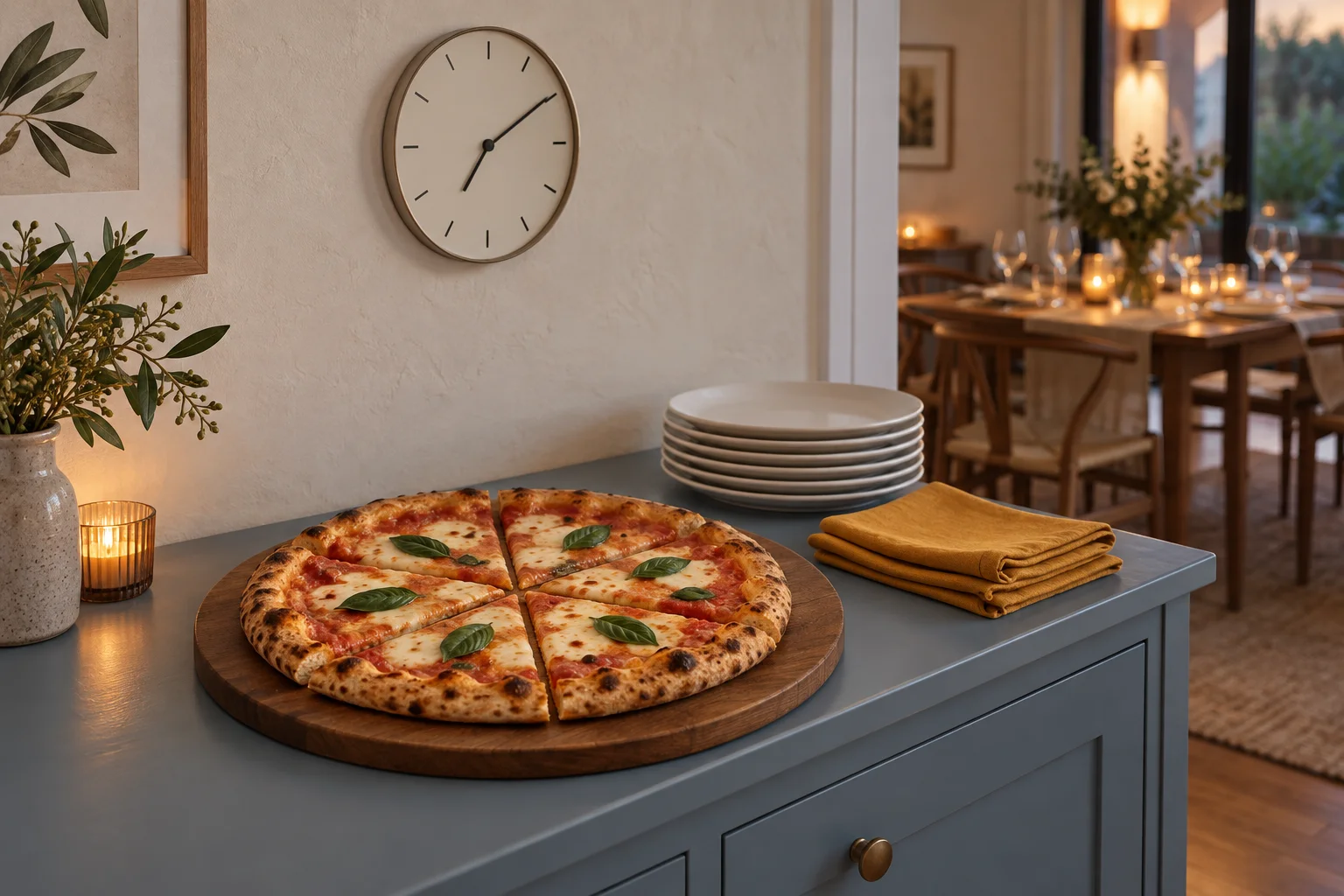
Establish when guests should start eating
First write down when the first guests should actually receive a portion. This is a different time from the start of the celebration or the caterer's arrival. A reception at 5 pm might begin with drinks, while pizza is planned for 6 pm. If the invitation simply says from 5 pm, communicate the meal time clearly as well. Guests expecting an immediate meal will plan their day differently from those expecting a longer reception. Include the other end of the window: how late can arriving guests eat, when does the next activity begin and when does the venue close? These points give the supplier a job to plan around.
Distinguish a shared meal from open service. At a seated meal, tables should start reasonably close together. At a pizza buffet, guests can collect small slices gradually. During a short conference break, however, feeding the whole group within the available time is critical. Explain that pattern before selecting a duration. Two hours of attendance do not automatically solve a twenty-minute peak in demand. Starters and the main course also need to connect. If antipasti accompany the reception, establish whether they form part of the meal or are only a small extra. This affects how urgently the first pizza is needed and what guests are expecting when they arrive.
Work backwards from service to arrival
Ask for the time needed by the setup you are actually booking. This may include entry, positioning, unloading, connecting supplies, setting out the workspace and preparing the equipment. The sequence matters more than a generic number of minutes. MM Pizza mit Amore, for example, describes roughly 60 minutes of setup before the first pizza can be served on its offer page. That information belongs to this supplier and does not replace confirmation for your booking. A different vehicle, larger installation or longer route between parking and service may require a different plan. Record the confirmed steps and ask which can happen together and which must wait for something else.
Consider a freely assumed example: first service is planned for 6 pm. The caterer confirms that this setup needs 90 minutes from usable access to operational readiness. You also agree on a fifteen-minute time allowance. Access is therefore needed at 4:15 pm; after 90 minutes, preparation would finish at 5:45 pm, leaving the allowance until 6 pm. These times explain the calculation and are not a general recommendation for an oven or vehicle. The allowance does not mean that cooked food should stand without appropriate control. The supplier coordinates actual cooking with the intended meal time. If a necessary connection only becomes available at 5 pm, the original timing assumption is already unmet.
Secure access before the vehicle arrives
Schedule the venue's tasks before arrival. In this example, a responsible person could open the agreed entrance, clear the pitch and make the confirmed connections accessible at 4 pm. That quarter-hour is another planning assumption; the real lead time depends on the site. A locked barrier, occupied setup area or unreachable caretaker cannot be compensated for by faster baking. Give the caterer the correct entrance and a reachable contact. A postal address alone may lead to the wrong access point at a courtyard, exhibition site or large company premises. Also establish where delivery vehicles may stop and when they must leave, particularly where other activities share the same entrance.
Where several suppliers use the venue in sequence, coordinate shared bottlenecks. Decoration, drinks delivery and the food truck should not block the same narrow courtyard simultaneously. Agree which work must finish before setup and what can continue alongside it. This includes when tables reach their final positions and cable routes are properly installed. Do not treat improvised last-minute alterations as the normal solution. A confirmed pitch needs the agreed space, including unfolded parts and working routes. Even a delivery without on-site vehicle operation needs a specific handover: who receives the food at the vehicle and who takes it along which route to the prepared serving table?
Include a short handover before service
Before guests approach the food, the host and responsible service person should share the same current information. A brief handover is enough if the details were settled beforehand. Confirm expected guests, the sequence of dishes, the serving location and individually agreed portions. Establish who remains available for questions while the host gives a speech or welcomes people. One known contact makes decisions easier while other helpers carry on with their tasks. New requests affecting quantity, preparation or price should reach that responsible person. They should not arrive at the kitchen as contradictory instructions from several guests. Make the authority clear without turning a simple handover into a lengthy meeting.
Readiness must match the next action. An installation can be operational while the buffet remains incomplete because plates, cutlery or menu information are missing. Conversely, nobody should put prepared food out early merely to make the table look decorated. Agree who authorises the first service and how everyone knows it has started. A short announcement is usually clearer than a buffet quietly opening beside an ongoing speech. For a multilingual audience, the location, sequence and special handovers should also be understandable. A clear announcement will often be enough; each guest does not need a complicated instruction sheet. Share only the information that helps people receive their meal.
Match replenishment to demand
During service, total quantity is only part of the picture. Suppose 60 people should receive their agreed first portion within fifteen minutes. Average demand is four portions per minute. That figure describes the requirement and does not prove the caterer can deliver it. Discuss how the first wave will be served with the proposed menu: freshly in sequence, through coordinated serving rounds or from professionally prepared provision. Whole individually ordered pizzas create a different process from small slices of several varieties. Payment may also affect the handover if guests buy their own food. Baking time alone therefore cannot tell you when the last person will actually receive a portion.
At an open celebration, you can identify several eating phases without assigning every pizza a precise time. A first busy period may follow the welcome, with another after a game or scheduled activity. Tell the caterer about those planned transitions. If the menu includes pasta and pizza, coordinate their service so one group is not already eating dessert while another waits for its main course. Replenish according to observed demand and the agreed package. The same reserve should not appear simultaneously as additional guests, extra portions and a blanket safety percentage. Record what quantity is already included and the latest point at which changes are possible. This keeps the schedule connected to the actual food order.
Plan appropriate temperature control for the food
A timetable must consider how food is treated during transport, preparation for service and serving. With a delivery-only arrangement, agree more than an arrival time: in what condition does the food arrive, who takes responsibility and how will it be kept suitably hot or cold until eaten? A warm cardboard box exterior provides no reliable evidence of the temperature of all the food inside. Fresh pizza handed out immediately and a pasta dish held for longer create different requirements. Discuss them with the responsible supplier. The planned gap between arrival and eating must not become an overlooked storage period simply because it looks like spare time in the schedule.
For private use afterwards, Germany's BfR gives clear foundations: cool cooked food promptly, divide larger quantities among several shallow containers and bring it below 7 °C within a few hours. The refrigerator should be no warmer than 7 °C, preferably below 5 °C. Do not wait for food to cool completely on the worktop before arranging refrigeration. These measures cannot retrospectively make leftovers with unknown or unsuitable storage histories safe. Decide before the evening whether suitable containers, cooling capacity and a responsible recipient are available at all. If they are not, blanket takeaway of leftovers is not a useful fixed item in the programme. Food left on guests' plates does not return to the shared supply.
Agree what happens if the timing changes
Set a simple route for reporting delays. If the caterer will arrive late, the contact needs a new realistic estimate for setup and first service. If your welcome overruns, tell the supplier in time whether the kitchen should adjust its sequence. Not every delay can be absorbed by serving later: staffing, hire duration, another booking or the venue's closing time may impose limits. Agree in advance who can approve a paid extension and under which stated conditions it is possible. An impromptu promise from a helper without that responsibility should not become the basis for an additional hour. Everyone involved should know where to direct that decision.
Record a fallback that fits the event. An announced short gap between the reception and main course might, for example, be covered by starters already included in the agreement. This is not a recommendation to buy unplanned food without known ingredient information. For weather problems, use the previously confirmed alternative setup or an adjusted service. An arbitrary gazebo does not make equipment weatherproof, and an oven intended for outdoor use cannot simply be moved into a room. If safe operation is impossible, service must pause or change in line with the actual arrangement. A time printed on a schedule is not a reason to ignore unsuitable conditions at the venue.
Separate the final portion from departure
Several different times occur at the end of service. The last order may precede the end of staffed service so there is time to prepare and hand it over. Depending on the package, returns, cleaning, dismantling, equipment cooling and loading then follow. Ask for the actual departure time of the specific setup. If the venue must be locked at 10 pm, food service cannot run until exactly 10 pm without further arrangements. Collection the following day is only an option if agreed and allowed by the venue. Record who remains available until the final necessary access, including any later collection of hired materials or equipment.
Agree the handover of crockery and leftovers as well. Used plates need a designated return area while clean supplies remain protected. Who counts hired items, gathers the required crates and checks the condition of the pitch? Any leftover food must be assessed against its actual history, including temperature control and clean handling. Handover to a private recipient has to fit that history. Allow sufficient time for these tasks without inventing a universal number of minutes. Discovering only after the caterer leaves that return crates are still needed creates avoidable improvisation. A short closing check gives the parties a shared understanding of what is complete and what remains to be collected.
Share a plan people can read on the day
Bring the final schedule together on one clear page. Each entry needs a time or recognisable event, a specific task, a responsible person and any necessary condition. In the example, these include access from 4:15 pm, confirmed preparation until 5:45 pm and first service at 6 pm, followed by the actually agreed last order and departure. Separate confirmed times from unresolved assumptions. A plan full of apparently precise minutes that nobody has committed to is less useful than a few reliable milestones. When a major time changes, check the dependent steps too. Otherwise one corrected line can leave the rest of the timetable describing an arrangement that no longer works.
Give the current version to the caterer, venue and participating helpers, including the reachable day contact and their stand-in. Guests need only the information relevant to them: when food is served, where to collect it and when the final portion is available. Technical setup times belong in the organisers' coordination. After the celebration, briefly note when the first and last portions were actually handed out and where people waited. This gives a later booking a basis in your own experience. The next schedule can then follow observed demand and confirmed services, instead of repeating the same unclear timing assumptions from one event to another.