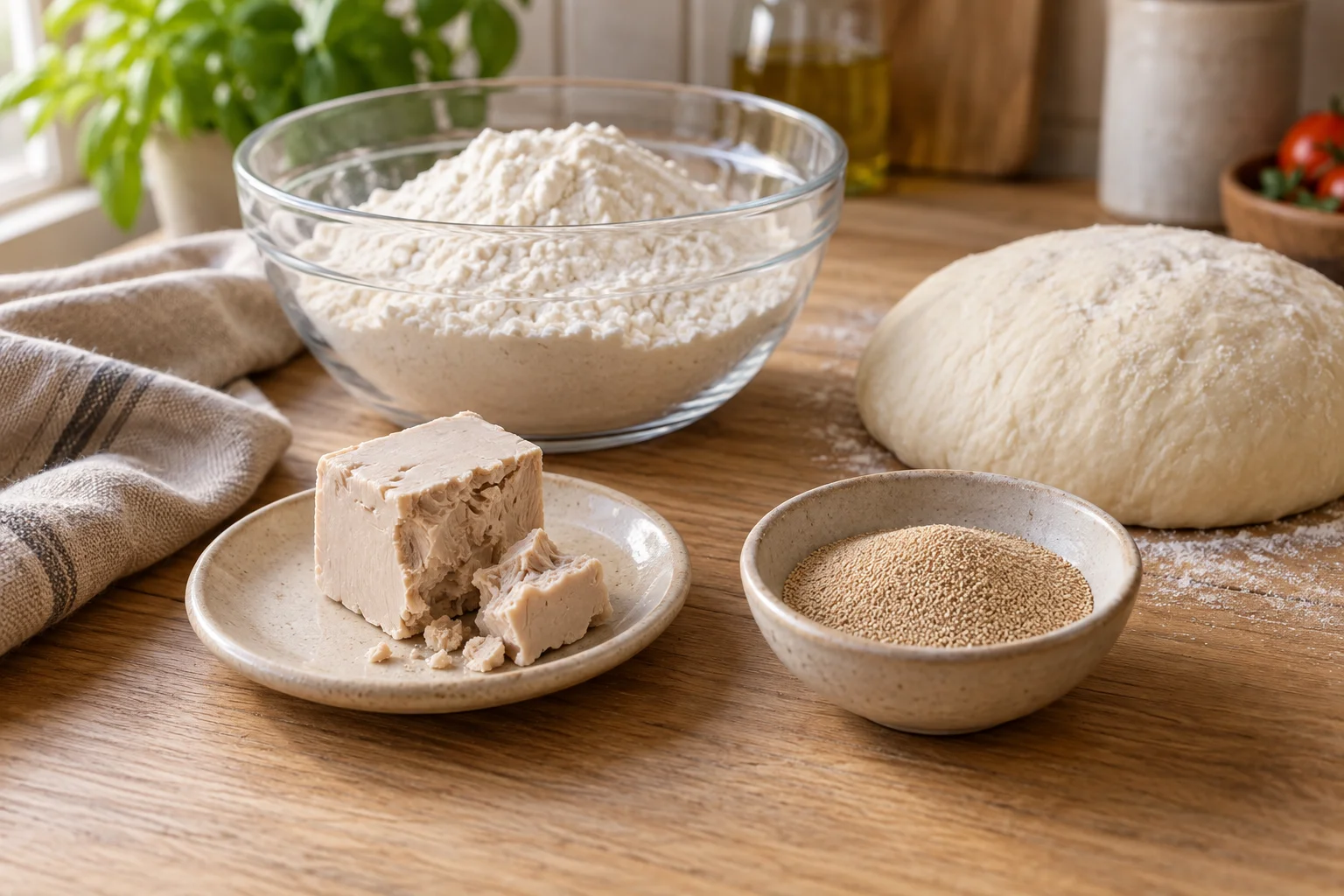
Use three to one as a guide
For ordinary fresh yeast and instant dried yeast, roughly three to one is a common starting point: three grams of fresh yeast corresponds to around one gram of instant yeast. Nine grams fresh therefore becomes about three grams instant; 1.5 grams instant becomes about 4.5 grams fresh.
The manufacturer’s instructions take priority. This calculation replaces the quantity already specified in a recipe; it does not determine how much yeast a new dough needs. If a long fermentation recipe calls for only one gram of fresh yeast, a whole seven-gram sachet of dried yeast is far too much.
Dried yeast is not one uniform product
Depending on the packet, instant yeast can be mixed directly with flour. Active dry yeast may have different dosage and dissolving instructions. Do not apply the three-to-one guide blindly to every international recipe or product.
Fast baking mixtures that also contain baking powder are not an identical substitute either. Read the complete product description. If dissolving is required, take that water from the total in the recipe and follow the stated temperature. Extra water would otherwise alter the dough’s hydration.
Weigh small amounts and store them correctly
Long fermentation recipes often use less than a gram. A standard kitchen scale displaying whole grams may be too coarse for this. Use a sufficiently precise scale or a carefully calculated distribution method such as the one in our yeast dosage guide. A knife tip is not a reliable unit of weight.
Fresh yeast needs refrigeration and should be used according to its packaging. Store dried yeast as instructed and protect opened packets from moisture. Record the opening date if useful. A mathematically correct amount helps little if poor storage has reduced the yeast’s raising power.
Judge the dough as it develops
For the first substitution, keep flour, water, temperature and schedule as consistent as possible. Watch the increase in volume and how the dough feels before shaping. A converted weight does not guarantee identical fermentation times to the minute across every product.
Slow dough does not necessarily mean the yeast type is wrong. Check the actual dough temperature and how long it has fermented too. For the next batch, record the product, weight and process. You can then make a useful adjustment without changing several possible causes at once.