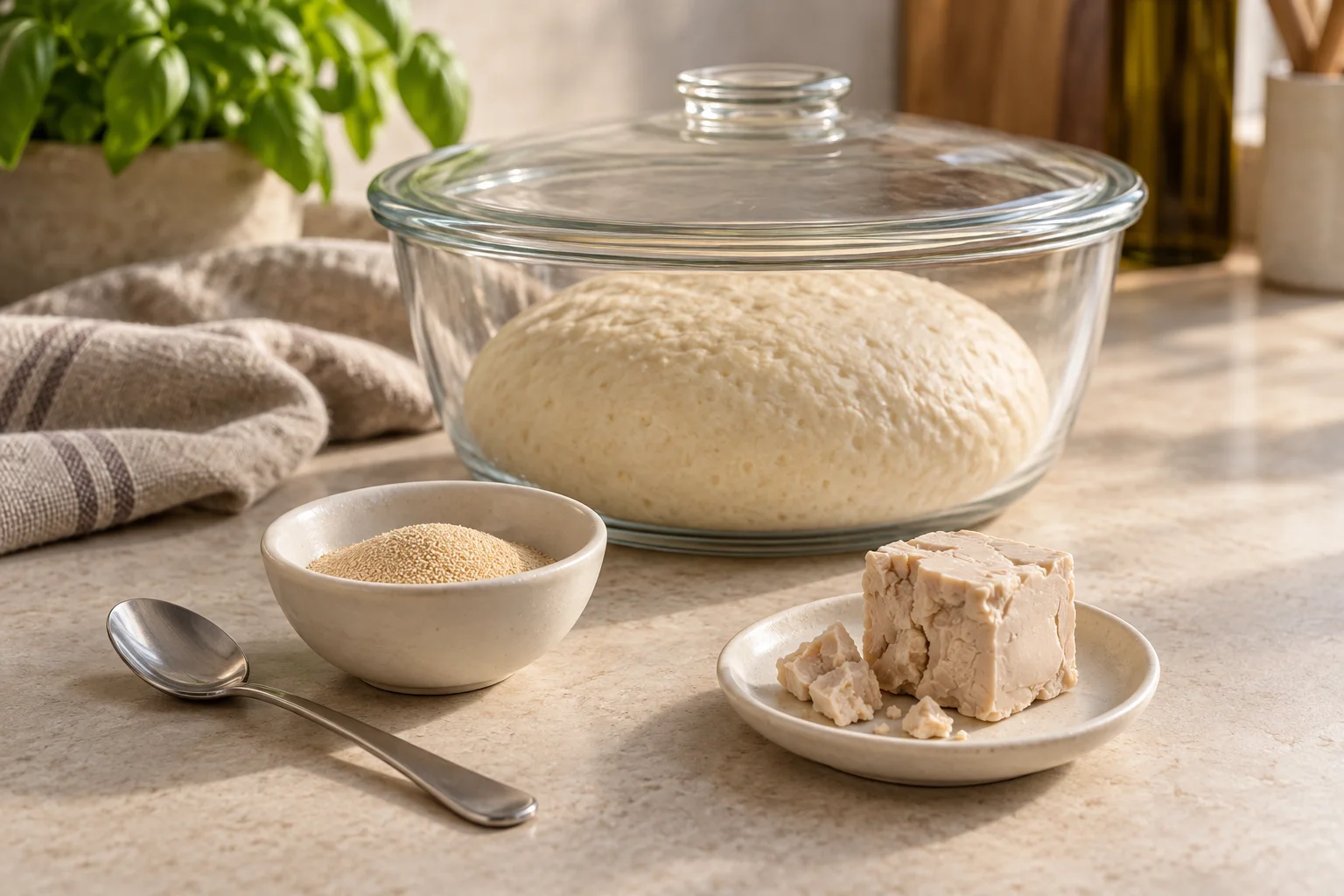
Yeast quantity belongs to a schedule
The right quantity of yeast for pizza dough cannot be determined from flour weight alone. What matters is when the pizza needs to enter the oven and which temperatures the dough will experience beforehand. A batch for the same afternoon has different conditions from dough spending two days in the fridge. Yeast produces gas to aerate the dough, while the dough's structure must be able to retain it. More yeast therefore does not automatically create a higher or better rim. Dough that becomes ready too early may already be losing strength when you shape it.
Begin with a complete recipe whose timing suits your intended meal. Record mixing, the first rise, dividing, any cold storage and the final rest before baking. Only then consider changing the yeast quantity. The guidance on a yeast packet is not a universal dose for every pizza dough. It may relate to another bake and a much shorter process. If your recipe calls for only a small part of the packet, that is not necessarily a mistake. Do not add the remainder to the bowl merely as a precaution.
Distinguish fresh yeast from dried yeast
Fresh baker's yeast contains substantially more water than dried yeast. Ten grams of fresh yeast should therefore not be replaced with ten grams of dry yeast. A common starting conversion is roughly three parts fresh yeast to one part instant yeast. Thus 6 g fresh yeast becomes approximately 2 g instant, while 1.5 g instant corresponds to around 4.5 g fresh. Give priority to the specific manufacturer's conversion. These figures describe a substitution ratio, not a recommendation for a particular flour weight or fermentation period. Write down the yeast type alongside its weight.
English-language recipes also distinguish active dry yeast from instant yeast. They are not necessarily handled identically in every method. Some manufacturers permit substitution at the same weight while noting that active dry yeast starts more slowly. Whether it should first be stirred into water also depends on the product. Read its packet instructions rather than applying a single rule to all dried yeast. Extra-fast baking mixes containing additional raising agents are another product again. They should not be substituted unnoticed for pure baker's yeast in a carefully timed dough.
Compare yeast as a percentage of flour
A percentage puts different recipes on a common basis. Divide yeast weight by total flour weight and multiply by one hundred. With 500 g flour, 5 g yeast represents one percent, 2.5 g represents half a percent, and 0.5 g represents one tenth of a percent. The arithmetic works for any yeast type, but the effect is comparable only when the type is the same. Two recipes both listing 0.5 percent yeast may therefore have quite different doses if one means fresh yeast and the other means instant.
When enlarging an otherwise unchanged recipe, scale all the ingredients together initially. Increasing flour from 500 g to 750 g gives a factor of 1.5, so 2 g instant yeast becomes 3 g. A batch containing 325 g water and 12.5 g salt would correspondingly need 487.5 g water and 18.75 g salt. Do not also multiply the rising times by 1.5. However, a larger undivided mass may cool differently from the smaller original batch. For several pizzas, appropriately timed portions in separate containers are often easier to plan than one very large warm bowl of dough.
Check temperature before adding more yeast
If a recipe works in a kitchen at 24°C and yours is only 18°C, that already helps explain slower progress. The temperature inside the dough after mixing is more informative still. Cold flour, refrigerated water and a cold bowl can produce a cool initial dough even when the room feels comfortable. Conversely, extended machine kneading warms the mixture. For recurring timing problems, measure inside the dough with a clean probe thermometer. An infrared thermometer measures the surface and does not reliably answer the same question about the temperature at the centre.
Avoid trying to catch up every delay with a particularly hot proving location. The temperature should suit the chosen recipe and remain reasonably steady. A spot on a hot radiator or beside a running oven may heat the outside much more than the centre. When adjusting the next batch, choose initially between allowing more time, providing a more suitable environment or changing the yeast quantity. If you change everything simultaneously, it becomes difficult to know which intervention actually improved the timing. A small deliberate adjustment is easier to repeat.
Do not count fridge hours as warm hours
Cold fermentation slows yeast activity rather than stopping it completely like a switch. Freshly mixed warm dough also needs time to cool internally. The fridge's numbered setting is less useful here than a measured temperature at the actual storage position. A container near the door may experience different conditions from one farther back. Leave enough room for expansion and keep the portions covered. Their surfaces should not dry out while the dough matures slowly in preparation for the next day's bake. Consider container size and placement before the bowl is already full.
Look at the entire sequence: warm time before refrigeration, cold storage and the final rest before baking. Dough spending 24 hours in the fridge followed by four warm hours does not have the same conditions as a batch kept cold for all 28 hours. A calculator can help with planning, but it cannot replace those inputs. Check which yeast type and temperatures it assumes. When using a suitable cold-fermentation recipe, begin with its dose. Carrying over the unchanged yeast quantity from a quick afternoon dough may provide too much for the longer process.
Measure small quantities reproducibly
A suitable precision scale is useful for quantities below one gram. A kitchen scale displaying whole grams cannot reliably measure a requirement of 0.2 g. A pea-sized piece of fresh yeast is not a fixed unit either: its shape, density and size vary. Place the scale on a level surface, use a small clean container and tare it. Add the yeast carefully and wait for the reading to settle. A display with many decimal places is helpful only if the scale is actually suitable for measuring within that small range.
For fresh yeast, an immediately used suspension provides another option. For example, thoroughly stir 1 g fresh yeast into 9 g water taken from the recipe. The resulting 10 g mixture contains ten percent yeast by weight. If you stir again and immediately weigh out 2 g of it, that portion contains approximately 0.2 g fresh yeast and 1.8 g water. Deduct the 1.8 g from the remaining recipe water. This still requires reasonably reliable measurement of 1 g and 2 g. It cannot make a coarse scale arbitrarily precise, and the remainder should not be saved as stock.
Include salt, sugar and preferments in the calculation
Salt seasons dough and also influences fermentation. If you substantially change its percentage, the same yeast dose is no longer working under exactly the same conditions. That does not mean yeast can never contact salt during ordinary mixing. A suitable formula and even distribution are what matter. Avoid putting concentrated salt onto wet yeast and leaving them together unmixed for a long period. In a normal dough, the ingredients are incorporated promptly. An unexpectedly slow batch has not automatically failed merely because it contains salt, so assess the rest of the process too.
An ordinary pizza dough does not inherently need added sugar for the yeast to work. Use sugar when the chosen recipe calls for it instead of trying to compensate for an uncertain yeast quantity. With poolish or biga, distinguish yeast in the preferment from any additional yeast in the final dough. An example containing 500 g total flour, 0.2 g instant yeast in the poolish and 0.8 g in the final mix contains 1 g altogether, or 0.2 percent. Adding a whole packet during the final mix would change that planned fermentation substantially.
Recognise readiness and manage the current batch
Ready pizza dough offers more evidence than an expired timer. It has increased in volume, looks aerated and becomes easier to open after its intended final proof. A tight cold ball that springs back strongly may first need more time to warm and relax. Soft dough with large bubbles and little support may instead be far advanced. Consider temperature, volume and handling together. A single finger indentation is not an infallible readiness test, particularly with very soft or cold dough. The condition should make sense in the context of the whole method.
If the dough is ready too early, you can move it somewhere cooler in its intended container and bake sooner if the schedule allows. Cooling does not reach the centre instantly. If it remains clearly underproofed, allow more time under suitable conditions. Kneading dry yeast into a finished dough is difficult to distribute evenly and is not a simple correction. Adjust the starting dose for the next batch instead. Specific observations, such as very expanded balls two hours before the planned bake, are more useful than simply describing the dough as difficult to handle.
Set your dose through small, recorded adjustments
For a repeatable process, record six things: flour weight, yeast type and grams, dough temperature after mixing, temperatures during fermentation, the timing of each stage and the condition when shaping. If the same formula repeatedly matures too early, moderately reduce the yeast on the next comparable batch or shorten the warm stage. An example reduction from 2 g to 1.5 g instant yeast is 25 percent less. It does not automatically imply a rise that takes 25 percent longer. Development still depends on all the other conditions involved in the process.
Check the yeast itself too. Dry yeast left open for a long time can lose raising power; follow the manufacturer's storage instructions and use period. If its activity is uncertain, use the manufacturer's specified activity check before making a large batch. Simply doubling the quantity from a poorly stored packet does not produce reliable planning. Fresh, appropriately stored yeast and a recorded method make the dose easier to assess. The aim is dough that is ready and manageable during your baking window, rather than achieving the smallest possible yeast number for its own sake.