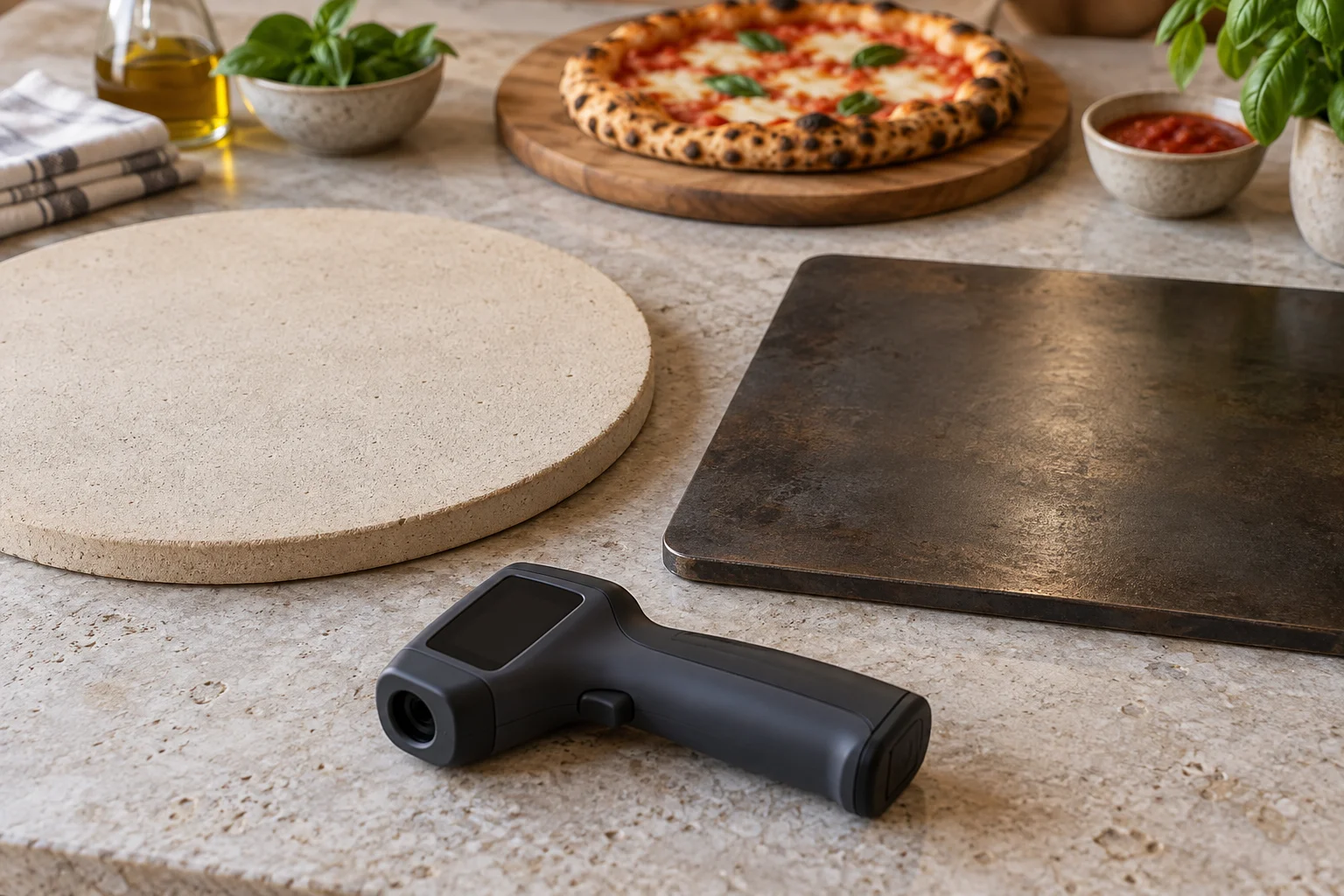
The surface is part of the measurement
Emissivity is neither a temperature nor a percentage of heating power. It describes how strongly a surface emits thermal radiation within the relevant range. The thermometer uses that information in its calculation. The material setting therefore matters even when the distance and aiming point are correct.
A matte stone surface behaves differently from bare shiny metal. With metal, surface condition, oxidation and coatings can change the measurement too. A table entry for “steel” does not automatically suit every baking steel. Fluke explicitly notes that its material tables require consideration of the actual surface and conditions.
Follow the specified setting rather than assuming 0.95
Start with the thermometer instructions. Some instruments have a fixed setting; others allow emissivity to be changed. A device preset for certain baking stones is not automatically configured for every pan. Ooni, for example, describes its digital model as preset for its own cordierite stones and adjustable for other surfaces.
Use the specified value for the particular combination of instrument and surface. A value of 0.95 is commonly encountered, but it is not a universal guarantee of a valid reading. Do not keep adjusting the setting until the display matches your hoped-for baking temperature. Without a suitable reference, that merely adjusts the reading to your expectation.
Be especially cautious with shiny metal
Shiny metal can strongly reflect radiation from its surroundings. Hot oven components can then affect the measurement, and the displayed value may not represent the steel's actual temperature. A stable number is not proof of a correct number. Simply averaging several such readings does not remove a systematic error either.
If readings appear implausible, clarify the measuring method with the instrument or oven manufacturer. Industrial advice about applying measuring tape or paint is not an instruction to treat cooking surfaces that way. Do not improvise with adhesive strips or coatings on a hot food-contact surface. An alternative contact measurement also needs a suitable probe rated for the temperature involved.
Keep the conditions comparable
Measure at a defined cooking position and respect the permitted distance. The complete measuring spot must fall within the intended surface. On instruments that have one, the laser is an aiming aid; it does not make the measuring spot arbitrarily small. Never direct it at eyes or people, and keep the instrument itself away from heat beyond its operating limits.
Compare readings together with the surface, setting and measuring position. A stone reading describes neither the air temperature nor the internal temperature of food. For the next bake, a suitable, repeatable measurement at the right position is more helpful than an especially high isolated reading beside a flame or heating element.