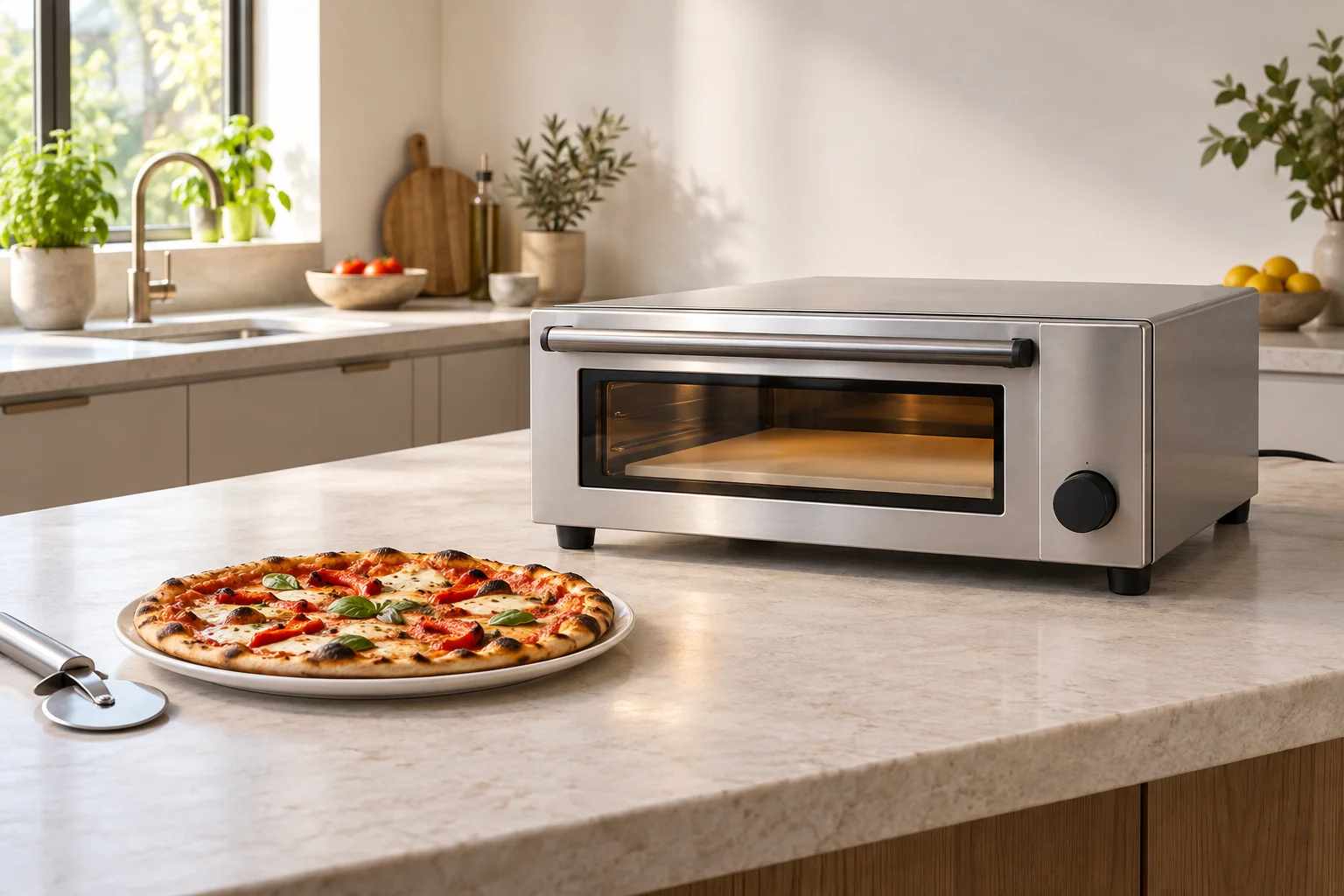
What pizza do you actually want to bake regularly?
Start with the food you intend to make. A specialist high-temperature oven can be interesting for a thin pizza with an airy rim and a short bake. For tray pizza, thicker bases or a large family bake, other dimensions and settings may matter more. Write down two or three dishes you would genuinely make regularly. Then check whether the candidate offers the area, height, temperature controls and permitted pans they need. A shallow chamber may be excellent for round pizza while excluding your favourite baking dish. A high temperature claim does not answer that question. Even an appliance with several programmes is versatile for you only if your intended dishes actually fit.
Include your existing oven in the decision. If you mainly bake large trays for several people, it may already be the more practical option. A separate countertop oven may change the available temperatures, baking area or independent heat controls, depending on the model. Compare those specific capabilities with what your current setup lacks. Wanting to serve smaller pizzas in succession at the table is a useful requirement. Assuming that more degrees must always be better is not. Knowing your usual dough and intended portion size lets you assess specifications more accurately and avoid a large appliance whose special functions see little everyday use.
Choose a model explicitly approved for indoor use
Electric power alone does not make an oven a kitchen appliance. Its manual must expressly permit indoor operation. Ooni describes the Volt 2 as an indoor-only oven, for example, and the Sage Pizzaiolo manual also specifies indoor use. Other electric pizza ovens are outdoor appliances. Check the exact model name and the version intended for your market. A related product name or a video of an older oven can lead to incorrect assumptions. Opening a window does not turn an outdoor gas, wood or pellet oven into a suitable kitchen appliance. For this purpose, choose an electric oven designed for indoor use and follow its installation requirements.
The manual should be available before purchase. Find the sections covering installation, power supply, accessories, first use, cleaning and shutdown. This sounds more involved than it is: those sections answer the questions that otherwise produce surprises after delivery. A product photograph in a decorated kitchen does not establish that your cabinet clearance or worktop is suitable. If the retailer’s wording and manual conflict, do not simply choose the more convenient interpretation. Ask the manufacturer using the exact model number. Until the question is resolved, the disputed location is not a firm basis for a purchase. For an appliance intended to stay in one place, clarifying this is more valuable than gaining another convenience programme.
Measure the worktop including the required clearances
For a realistic space comparison, you need the external dimensions, minimum clearances and room with the door open. The Ooni Volt 2 manual, for example, requires at least 10 cm on every side and 15 cm above it. Those figures apply to that model, not to pizza ovens universally. Transfer your candidate’s requirements to the actual worktop. An overhead cupboard, a power strip behind the oven and a wall at the side may each matter. Measure the space in front as well: an open door and a peel need room while you are handling hot food. The oven door is not an extra work surface.
A simple template matching the external dimensions makes the difference between catalogue measurements and a real kitchen visible. Lay it on the cold, empty worktop and mark the required clear spaces. Put a normal chopping board and plate beside it so the rest of the cooking routine is represented too. Can you remove a pizza without first moving the coffee machine? Is the route to the sink clear? Will the cable stay away from hot areas? Remove the template before operating any appliance. If only the casing fits, the location is not fully planned. A freestanding island may offer more room, but still needs an appropriate surface, power supply and safe cable route.
Consider the surface, weight and connection together
The work surface must be level, stable, able to carry the load and suitable for heat according to the appliance instructions. Do not judge a material by appearance alone. Finishes, joints, adhesives and the structure underneath can all affect its suitability. Resolve uncertainties with the surface manufacturer. An arbitrary board or thin decorative mat is not established heat protection. Do not simply put the oven on an existing hob to save worktop space if its instructions do not provide for that arrangement. All its feet should stand fully on the intended surface. An overhanging section or unstable side table does not become reliably suitable through careful handling.
For the electrical connection, the regional voltage, rated power and manufacturer’s requirements matter. The European Ooni Volt 2, for example, is specified at 1600 watts. That figure does not describe the combined demand of your kitchen. A kettle, another oven and other appliances may share the circuit. If the existing supply is unclear, have it checked by a qualified professional. Where possible, plan a suitable socket within direct reach. Extensions or adapters are options only under the relevant instructions; contradictory guidance needs resolving before use. Keep the cable away from hot surfaces, trapped positions and hanging routes where someone might pull it. A suitable connection belongs in the location decision, not as an afterthought during unpacking.
Check baking space and accessories against your recipes
Distinguish the stone’s dimensions, the advertised pizza diameter and the opening. A round pizza needs some additional room for launching and, where required, turning. For a pan, external dimensions including the rim and handles matter, as does its height with dough and toppings. Measure an existing favourite pan fully rather than relying on its nominal size. Check whether the manufacturer permits that material and accessory at the intended setting. A pan that fits inside the chamber is not necessarily suitable for its highest temperature. Coatings, handles and lids can have lower limits. Those accessory limits still apply inside a powerful oven.
Do not add an extra stone or steel on your own initiative to increase bottom heat. This changes the space, weight and heating behaviour, while the manual may permit only particular components. For the Volt 2, Ooni explicitly specifies compatible Ooni pizza stones 10 mm thick. Other models may have different requirements. Check consumables too: baking paper does not automatically belong in a high-temperature oven just because it works in a conventional one. The Ooni model mentioned here does not allow it directly on the stone. A suitable peel, appropriate oven gloves and a secure place for hot food are usually more useful than several unchecked accessories whose combination ultimately does not suit the appliance.
Assess temperature and browning separately
The highest setting is a capability, not a daily obligation. Models differ in how they control temperature and heat from above. Start with a complete recipe and the corresponding manufacturer’s guidance. Then assess the base, rim and toppings separately. A dark base beneath pale toppings is a different observation from a pale base under dried-out ingredients. Each raises different questions: was the stone preheated appropriately, were the toppings too wet or thick, and was the upper heat chosen sensibly? One overall response such as adding another two minutes can make the already dark part worse. Learn the adjustments available on your particular appliance.
Keep the first pizzas reasonably comparable. Use the same recipe, similar dough weights and simple toppings instead of immediately switching between thin pizza, filled calzone and thick pan pizza. Note the setting, preheating routine, approximate bake time and observations of each part. Change one point deliberately on the next attempt. The displayed chamber reading is not automatically the temperature of every part of the stone. A suitable infrared thermometer can add surface readings, but it cannot meaningfully measure the stone through the closed glass door. Follow the relevant instructions for measurement and door handling. You are looking for an understandable setting for your dough; a single high number cannot replace that relationship.
Plan for steam, smells and the working routine
An electric oven still produces heat, steam and cooking smells. Wet toppings release water, cheese can drip and excess flour can darken on hot surfaces. These effects matter when planning a kitchen setup even though no cooking fuel is being burned. Keep the appliance’s ventilation paths clear and use the ventilation available in your kitchen without changing the required installation conditions. A built-in filter is not a promise of completely odour-free cooking. Do not disable smoke alarms. If unusually heavy smoke or a fault occurs, end operation according to the manual and resolve the cause rather than simply launching another pizza.
A calm routine starts before preheating. Prepare toppings, drain wet ingredients appropriately and keep perishable foods refrigerated until needed. Clear enough space to shape the dough and lay out your tools. Top each pizza shortly before launching so it does not unnecessarily stick to the peel. Keep door openings as short as safe handling and the instructions allow; repeated opening merely to look makes a consistent routine harder. Move the finished pizza to its prepared landing area. If several people are helping, put one person in charge of the oven and another in charge of cutting or serving. This keeps hands, plates and the peel from competing for the same confined working space.
Include preheating and cooling in the time commitment
Do not compare appliances solely by an advertised baking time. Heating up, several batches, any required recovery of the baking surface and finishing the session all belong to the evening. A target-temperature indicator must also be interpreted alongside the prescribed preheating routine. Do not plan to return the oven to a cupboard immediately after the last pizza. The casing and stone can remain hot for a long time. A separate oven is therefore especially convenient when its suitable position can remain clear during cooling. Before buying, consider whether you need that surface for something else straight after the meal. In daily use, this may matter more than a few minutes’ difference in preheating.
Pay particular attention to shutdown. For the Volt 2, Ooni requires at least 30 minutes in the specified standby cooling sequence before switching off the rear power switch or unplugging. The oven must cool completely before cleaning or moving, which can take longer. For the Sage Pizzaiolo, the fan should stop after switching off before the plug is removed. These examples show why finishing the meal and immediately pulling the plug is not a universal instruction. Follow the sequence for your appliance. Do not carry away or cover a hot oven. Once it is cool, use its designated lifting points; a door handle is not automatically a carrying handle.
Compare overall costs and everyday handling
Alongside the purchase price, include the accessories you actually need and check what is supplied. A peel, suitable pan, gloves and any necessary surface protection can change the comparison. Rated power is not measured electricity consumption. As a calculation, 1.6 kilowatts drawn continuously at full power for half an hour would equal 0.8 kilowatt-hours. A real evening includes control cycles, preheating and pauses of different lengths. To calculate cost, you need actual consumption and your own electricity tariff. An exact cost per pizza without that basis says little. Assess the specifications, purchase and intended use together instead of treating one figure as the whole decision.
Finally, read the cleaning instructions and check the planned storage space. The stone, casing, filter and pans may need different treatment; one dishwasher-safe accessory says nothing about the rest. Clean only after complete cooling and disconnection as instructed. If you must lift the oven from a deep cupboard every time, weight and safe lifting points become especially relevant. A permanently suitable position can make regular use easier, provided all required clearances remain unobstructed. Your choice is well prepared when you can describe the route from recipe through setup and cooking to cleaning without improvised intermediate steps. You can then choose an appliance for your kitchen and meals rather than reorganising the kitchen around a specification sheet afterwards.