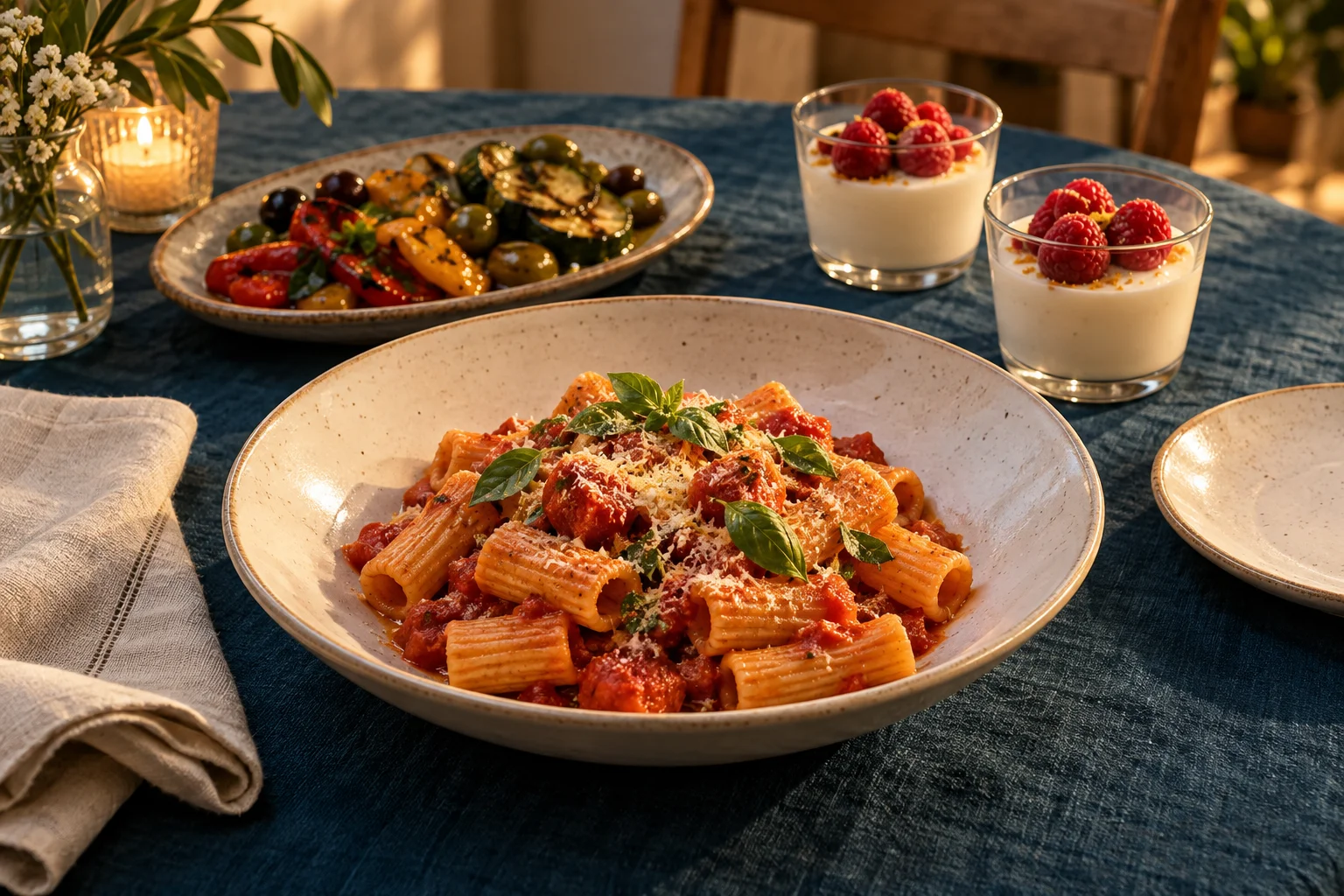
Give the evening a clear centrepiece
First decide which dish should take centre stage. You might want to serve a good pasta dish, share several pizzas or bring a prepared pasta bake to the table. The other courses support that choice. If the main dish is rich, a small vegetable starter can provide a suitable opening. With a simple tomato pasta, another part of the meal might carry a stronger flavour. Plan around taste, appetite and the occasion. A relaxed evening with friends does not automatically need the same sequence as a long formal dinner. The number of recipes is not a reliable measure of how well the menu will suit the people eating it.
Write down the guest count and roughly how much time you have for the meal. Ask in advance about vegetarian, plant-based or individually suitable food. You can then consider the selection together instead of finding a separate last-minute alternative for every course. Include space at the beginning of the plan: how many people can sit together, what crockery is available and where can food be plated? Answering these questions before selecting three elaborate dishes makes the menu easier to organise. In particular, a requirement agreed with a guest must remain accounted for throughout the evening rather than being solved for the main course and forgotten when dessert arrives.
Use course names as a guide
Italian menus and recipe collections use terms such as antipasti, primi, secondi, contorni and dolci. Antipasti are starters, primi can include a pasta course, secondi are a further main course, contorni are side dishes and dolci are sweet dishes. Eataly, for example, organises recipes around these categories. The terms help you navigate a menu; they do not oblige you to fill every category at a private dinner. Pasta can be the centre of your meal without another substantial main course following it. Choose a sequence that suits what you actually want to serve rather than adding dishes simply to complete a list of names.
Decide whether guests will receive individually plated courses or share bowls and platters. Individual plates make exact portioning easier but need space and timely plating. Shared dishes can support a sociable meal, provided there is accessible table space and suitable serving equipment. Guests with individual ingredient requirements still need clearly allocated portions. An Italian name on a menu does not establish what the dish contains. Add an understandable description of the food you are serving. This makes choosing easier and helps people ask a specific question without having to translate the whole menu. A clear description is useful even when the recipe name is familiar to most of the group.
Build variety through flavour and texture
Consider the meal as a whole. If the starter already contains plenty of bread and cheese, the next course need not be particularly heavy and cheesy too. Tomato, browned vegetables, fresh herbs and a creamy component can create different accents. You do not necessarily need many extra ingredients to achieve this. One ingredient can appear more than once where it has a useful role. Roasted peppers as a starter and a few strips on a pizza are possible, for example. The dishes should nevertheless feel like distinct parts of the meal rather than the same mixture presented differently. Decide what gives each course its character.
Plan texture as deliberately as seasoning. A small crisp or fresh opening can contrast with a soft pasta bake. After several savoury components, fruit or a small prepared dessert can finish the meal. These are flavour suggestions, not nutritional or medical classifications. Heat, garlic and very salty ingredients should also suit the group. Offer finishing additions separately where that fits the dish and the agreed requirements. This allows a shared base without seasoning every portion equally strongly. Remember that adding cheese or pesto changes the actual ingredients of the dish. A separate serving bowl can offer a choice, but it cannot establish suitability for a particular allergy on its own.
Choose between three possible sequences
One option is a pasta menu with prepared vegetables as a small opening, freshly finished pasta al pomodoro and a simple suitable dessert. Its advantage is a clear warm centrepiece: the pasta is cooked for its intended course and combined with a prepared sauce. A second option centres on rigatoni al forno. A small fresh starter could precede it, with fruit or a prepared dessert afterwards. Here, the actual oven schedule and the state of the dish determine the timing. A large baking dish does not automatically finish as quickly as a smaller recipe quantity. The choice is partly about the food and partly about which preparation pattern suits your kitchen.
For a pizza evening, put out a small starter and then serve several pizzas in shared rounds. An uncomplicated finish keeps work manageable after the last bake. If you specifically want both pizza and pasta in the same menu, give each a clear role: small pizza slices as an opening, for example, followed by an appropriately adjusted pasta quantity. This does not automatically imply two full main portions per person. These sequences are suggestions for your own event, not a claim that one fixed Italian tradition governs every meal. Choose a starting point and adapt it to your preferences, kitchen and available time rather than trying to combine all three approaches.
Calculate quantities across the complete meal
Decide portion sizes alongside the course sequence. Dry pasta for a smaller course within a larger menu may differ from the amount used when pasta is the only main dish. Recipe quantities provide a starting point but must fit the occasion. Use clear units throughout. Dry pasta weight, cooked weight, finished sauce and the number of plates are different measures. Fresh filled pasta cannot simply be judged by the same number as dried spaghetti. For each component, ask which people and which part of the meal it is intended for. This helps prevent every course from being planned as a separate full dinner with its own hidden extra allowance.
A hypothetical quantity example illustrates the calculation. If you choose 80 grams of dry pasta for each of six people in a particular course, the total is 480 grams. This assumed allowance is not a universal serving recommendation. A recipe written for four people scales mathematically to six by multiplying by 6 divided by 4, or 1.5. An ingredient weighing 400 grams would become 600 grams. Baking time, pot size and seasoning do not automatically increase by the same factor, however. Check whether the method still works at the larger quantity. Include any reserve explicitly once and remember that the courses already work together to make up the meal.
Build the work plan backwards from serving
Start with the warm main course and work backwards. What must happen immediately beforehand, what can already be prepared and which appliances will be needed together? For freshly cooked pasta, boiling water, ready sauce and plating may need to follow closely. A pasta bake needs its intended oven space and cooking time appropriate to the recipe. Pizza adds preheating and possibly several baking rounds. Plan these tasks around the actual recipes. One general preparation time for an Italian menu would be of little use because the final steps differ between dishes. The plan should tell you when your attention is needed, rather than simply listing a total cooking duration.
Set out the tasks to complete before guests arrive: lay the table, make the required plates and serving utensils available, store prepared ingredients appropriately and place drinks within reach. Depending on the recipe, dessert can be prepared earlier but will then need the right refrigeration or storage space. A sauce can often be made ahead; cooling and reheating must fit its actual preparation. Try to avoid choosing several dishes that all need the same pan or the same clear worktop at the last moment. A useful amount of advance preparation lets you remain at the table between courses instead of replacing one urgent kitchen task with another throughout the evening.
Finish the warm course at the right moment
Match the next cooking action to what is happening at the table. Pasta need not already be drained and waiting while guests are still enjoying the starter. At the same time, have the water ready early enough to avoid an unnecessary gap. A brief agreement with a helper can be sufficient: who clears the first plates, who prepares the serving bowl and who brings the next course? With shared pizzas, the baking rhythm forms part of the meal itself. Explain that more varieties will follow so guests understand the sequence and do not mistake the first round for the entire selection. Clear expectations make a modest kitchen's pace easier to enjoy.
Choose service that fits the quantity and kitchen. Plating six small dishes at once may be harder on a narrow counter than serving one shared bowl with plates already on the table. Personally agreed dishes still need an identifiable handover. Avoid leaving finished food waiting for a long time without appropriate temperature control merely to make every course appear ready in advance. A closed pot or attractive baking dish says nothing on its own about the temperature actually maintained. If the schedule changes, adjust the steps that have not yet been completed. Leaving finished dishes to wait indefinitely is not a reliable substitute for arranging preparation in a suitable sequence.
Bring shopping, ingredient information and crockery together
Combine the ingredients for all dishes into one shopping list. This reveals which products appear several times and which small quantity serves only one finishing detail. Check existing supplies before buying another pack. Pack size does not automatically equal the right recipe quantity. For a vegetarian or plant-based menu, the actual composition of cheese, pesto, stock and purchased sauces matters. Agreed allergy requirements additionally need suitable preparation and handover. Keep product information accessible so that you can answer specific ingredient questions rather than relying on a dish's name. A familiar recipe may still vary according to the particular product used or a change made while cooking.
Count plates, bowls and cutlery across the whole sequence. If dishes will be washed between courses, there must be real time and suitable facilities for that task. A small stack of plates does not suffice merely because only one course is on the table at once. Establish an orderly place for used crockery and keep it separate from clean supplies and ready food. Serving platters also occupy space after they have been cleared. These small preparations prevent a thoughtful menu from becoming a search for bowls, utensils and empty surfaces during the meal. They also make it easier for a helper to contribute without repeatedly asking where everything belongs.
Include the finish and suitable leftovers
After the warm course, the evening can become simpler. A suitable prepared dessert or fruit can be served with little final work. Arrange coffee or other drinks so that preparation does not block the only remaining clear surface. Desserts with ingredients requiring refrigeration still need appropriate storage until they are served. Use ingredients and methods that fit the guests' agreed requirements. A dessert containing gelatine, for example, is not vegetarian merely because it is sweet. Accurately describing the actual dish and knowing its ingredients is enough for the menu itself; there is no need to turn the card into a lengthy explanation of the entire preparation process.
Suitable remaining cooked food needs appropriate containers and cooling space in good time. Germany's BfR household guidance recommends dividing larger quantities among several shallow containers and cooling promptly to below 7 °C within a few hours. The refrigerator should be no warmer than 7 °C, preferably below 5 °C. Do not wait for complete cooling on the worktop before arranging refrigeration. Later reheating does not undo an unsuitable storage history, and plate leftovers do not return to the shared supply. Afterwards, note which sequence and quantities felt right for your group. That practical feedback is more useful for the next menu than adding another course for which neither time nor appetite was available.