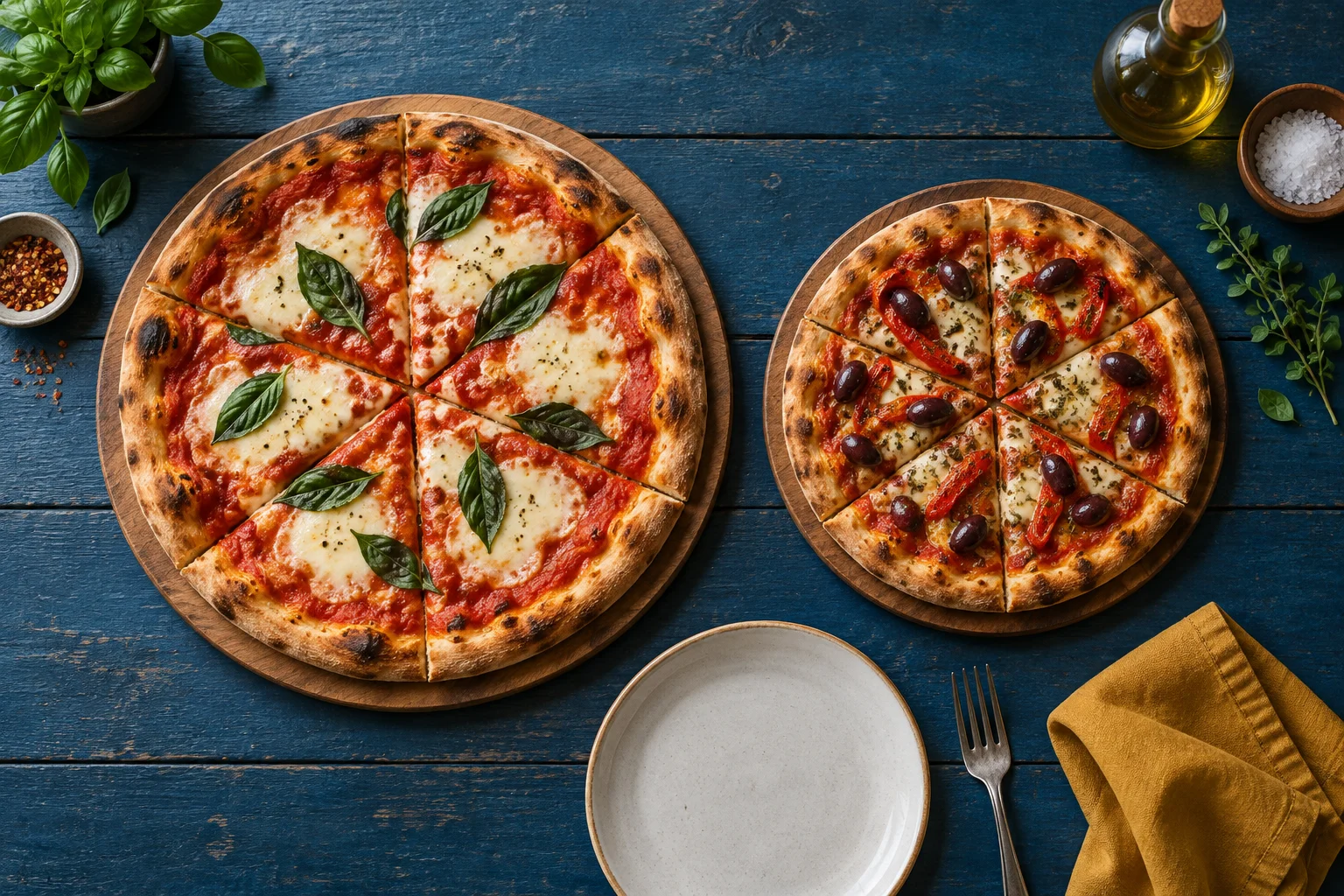
Define what one pizza means in your plan
A pizza is not a standard portion. A thin 28-centimetre pizza, a large pizza with a generous cheese crust and a thick slice of tray pizza differ considerably. Start with the recipe you intend to use: what size and shape does it produce, how much does each dough ball weigh and how substantial are the toppings? These details underpin the calculations that follow. For individual pizzas, one pizza from your chosen recipe can serve as a reference unit. For tray pizza, a whole tray is initially a clear unit; decide how you intend to cut it into pieces as well.
Record the role pizza plays in the meal. Is it the only main course, does it follow a substantial starter, or will you offer it alongside pasta and salads? A small green salad is not equivalent to a second filling main dish. Timing and a long celebration with several eating periods also affect the plan. This does not produce a universal number of grams per person, but it gives your particular gathering an understandable starting point. Germany's Federal Centre for Nutrition, the BZfE, emphasises that individual amounts and appetite vary. Its food pyramid does not provide a fixed pizza count to apply unchanged to every adult or child.
Combine the headcount with portion preferences
First establish who will actually eat. At a small private gathering, you can ask whether someone would like a little, approximately one of your planned pizzas or somewhat more. Guests do not need to specify exact gram weights. Simply describe the pizza's size and style and any other food. Count children as individuals with their own preferences. Assuming every child needs half an adult portion does not suit every age or appetite. Accompanying adults can help estimate for younger children. Small initial portions with the opportunity for seconds are often more practical than placing a large portion on the plate at the outset.
Here is a deliberately simplified example: eight adults each request approximately one of the planned pizzas. After discussing the children's needs, you allow two more pizzas between four children. The starting quantity is therefore ten pizzas. That result comes from the assumed requests, rather than a nutritional rule for twelve people. If the children would like three pizzas between them, or several adults prefer smaller portions, change the relevant line. Record particular variations separately so an agreed vegan or other special portion remains available. It is not automatically an addition to the overall headcount; it replaces that person's ordinary portion within the calculation.
Compare slices and diameters correctly
When sharing pizzas, a consistent number of cuts helps. Cutting each equally sized pizza into eight slices gives 80 slices from ten pizzas. That describes serving output, rather than how many slices each person should eat. An eighth of a large pizza is more than an eighth of a small one. Avoid adding up slices indiscriminately when offering very different diameters. Either bake reasonably similar sizes or plan each size separately. The same applies to rectangular trays: twelve small pieces and twelve large ones are only comparable when the underlying area and thickness are approximately the same.
For round pizzas of similar thickness, area provides a useful conversion. It grows with the square of diameter. A 36-centimetre pizza therefore has 36² divided by 30², or 1.44 times the area of a 30-centimetre pizza. Its area is 44 percent greater, although the diameter increases by only 20 percent. Ten 30-centimetre pizzas are approximately equivalent in area to seven 36-centimetre pizzas: seven times 1.44 equals 10.08. This is a geometric approximation, not a promise of equal fullness. The proportion of crust, thickness and toppings may differ. For a comparable base, a 250-gram dough ball would scale to 360 grams using that area factor; whether the larger pizza suits your recipe and oven is a separate consideration.
Choose one deliberate reserve
A reserve can be useful when appetite is hard to estimate or another guest might join at short notice. Make it explicit and suited to your circumstances. In the ten-pizza example, you could prepare one additional pizza, bringing the planned total to eleven. Here that represents ten percent, but it is not a general rule. A confirmed small group with another main course may need less; uncertain attendance requires a different assumption. Be clear whether the reserve covers extra guests, greater appetite or both. Confirmed guests arriving later belong in the starting quantity, rather than being hidden inside an undefined buffer.
Continue calculating from those eleven pizzas. If you then generously increase dough, sauce and cheese separately, the reserve grows unnoticed. Package sizes may create additional leftovers anyway. Keep some supplies unused and appropriately refrigerated instead of immediately topping every reserve dough ball. That leaves the decision open until the later rounds. A reserve need not include every specialist variation on the menu either. Think about which compatible ingredients cover the requests that are actually likely. An agreed dietary portion still needs its own suitable supply, however: an ordinary cheese pizza cannot replace a promised vegan portion, for example.
Convert the pizza count into dough
Multiply the number of pizzas by the dough-ball weight specified in your recipe. Eleven balls weighing 250 grams each require 2750 grams of finished dough. That total already includes water, flour, salt and any other recipe ingredients; it is not the flour quantity. If your recipe makes four such balls, the scaling factor is eleven divided by four, or 2.75. Multiply the ingredients accordingly or use a suitable dough calculator. The resulting total should match the intended number and weight of portions. Small ingredients such as yeast need a scale capable of usefully measuring their amount; repeated weighing cannot make a coarse display increment finer.
A larger quantity also changes working conditions. Check your mixer's permitted dough load and divide production into suitable batches where needed. Bowls, proofing boxes and the refrigerator must accommodate the dough and room for expansion. More dough in one large container does not automatically reach the desired temperature as quickly as a small batch. Use a fermentation plan suited to your conditions. Yeast quantity and fermentation time are especially connected: a different schedule cannot be derived solely from the factor 2.75. If the schedule remains the same, start by scaling the recipe quantities. If temperature or fermentation changes, adjust the dough process accordingly, rather than adding extra yeast by instinct.
Calculate sauce and cheese from recipe portions
Base toppings on the variations you actually plan to make. As a worked example, suppose your selected recipe uses 60 grams of sauce and 70 grams of drained mozzarella per pizza, and all eleven pizzas receive those toppings. You would need 660 grams of sauce and 770 grams of drained cheese. These numbers demonstrate multiplication; they are not universal topping quantities for every diameter or style. A large tray pizza needs a different reference, while a white pizza does not consume tomato sauce according to the same calculation. Divide the pizza count between variations first, then add together shared ingredients for shopping.
Distinguish usable quantity from sales weight. For mozzarella packed in liquid, this calculation uses drained weight; for olives or artichokes, use the drained amount intended for topping too. If a package contains, for example, 125 grams drained, six packages provide 750 grams, slightly less than the assumed 770-gram requirement. Seven provide 875 grams, leaving 105 grams extra. That surplus results from rounding up to whole packages and already exists. You do not need to distribute all of it over the pizzas. For a reduced tomato sauce, the tomatoes purchased and the finished sauce are different quantities; use the yield of your chosen recipe instead of treating raw and finished weights as identical.
Plan specific toppings and other dishes separately
Not every guest eats every topping. If only three of the eleven pizzas receive mushrooms, calculate mushrooms for those three pizzas. Apply the same approach to ham, artichokes or a finishing ingredient added after baking. For precooked ingredients, establish whether the recipe specifies raw or finished weight. Mushrooms lose water during cooking, so a finished quantity cannot be treated as an identical shopping weight without an appropriate recipe allowance. A small table listing each variation, its pizza count, ingredients and usable weights is sufficient. It keeps shopping understandable and prevents every opened package from being mentally allocated to the entire group.
If you also serve pasta, plan its portions as a separate part of the meal. Do not automatically add a full pizza meal and a full pasta meal for every guest when people are only meant to try some of each. Instead, discuss how many want mainly pizza, mainly pasta or smaller amounts of both. Include dessert as another planned offering without deriving a fixed pizza reduction from it. Dietary requests depend on ingredients and actual preparation: cheese made with animal rennet may not suit vegetarian guests, and separate ingredients alone cannot ensure protection from allergen contact. An agreed portion must contain appropriate ingredients and be practical to prepare as arranged.
Match the quantity to the oven and serving plan
Enough dough does not necessarily mean everyone can eat on time. Compare the pizza count with the number of baking cycles and the intended duration of the meal. When sharing, the first pizza can circulate immediately while others follow. If everyone expects a whole pizza simultaneously, an oven holding one pizza per cycle imposes a tighter constraint. The real sequence includes preparation, baking, removal and, where necessary, recovery of the baking surface. Do not calculate from an advertised baking time alone. A suitable tray pizza or a wider serving window may work more comfortably than numerous large individual pizzas in quick succession.
Top reserve pizzas once the need becomes clearer. After several rounds, ask who still wants to eat and allocate the remaining dough accordingly. Keep refrigerated supplies stored appropriately instead of putting everything on the table in advance. Replenish perishable toppings in small clean containers; do not repeatedly add fresh supplies to leftovers that have stood out for a long time. The BfR recommends a refrigerator temperature no higher than 7°C, preferably below 5°C, for perishable food. Temperature control therefore belongs in quantity planning: a shopping list that overfills the refrigerator or cannot be chilled adequately does not become workable merely because its calculated pizza count is correct.
Assess leftovers and improve the next plan
At the end, distinguish what remains: unopened supplies, prepared ingredients, fermented dough balls or baked pizza. They have different options for further use and storage. For recipe leftovers, ingredients, previous standing time and temperature history matter; a fresh universal storage period does not begin when the party ends. Promptly cool cooked pizza you intend to keep in suitable shallow containers, bringing it below 7°C within a few hours. Divide larger amounts. Do not wait for a whole stack to cool completely at room temperature first. When reheating thoroughly later, the BfR recommends at least 70°C for two minutes throughout the food.
A few details help with the next comparable gathering: how many people actually ate, which pizza style you served, how many pizzas were consumed and what other food was available. Note unusual circumstances, such as several late guests or a substantial starter. Preparing eleven pizzas and eating nine does not automatically mean two pizzas' worth of unnecessary purchases: some ingredients may remain unopened, while a popular variation might have run out early. Adjust the starting quantity and distribution of toppings first. A small, understandable calculation based on portion preferences, recipe quantities and a deliberately chosen reserve will serve the next invitation better than a rigid number of pizzas per person.