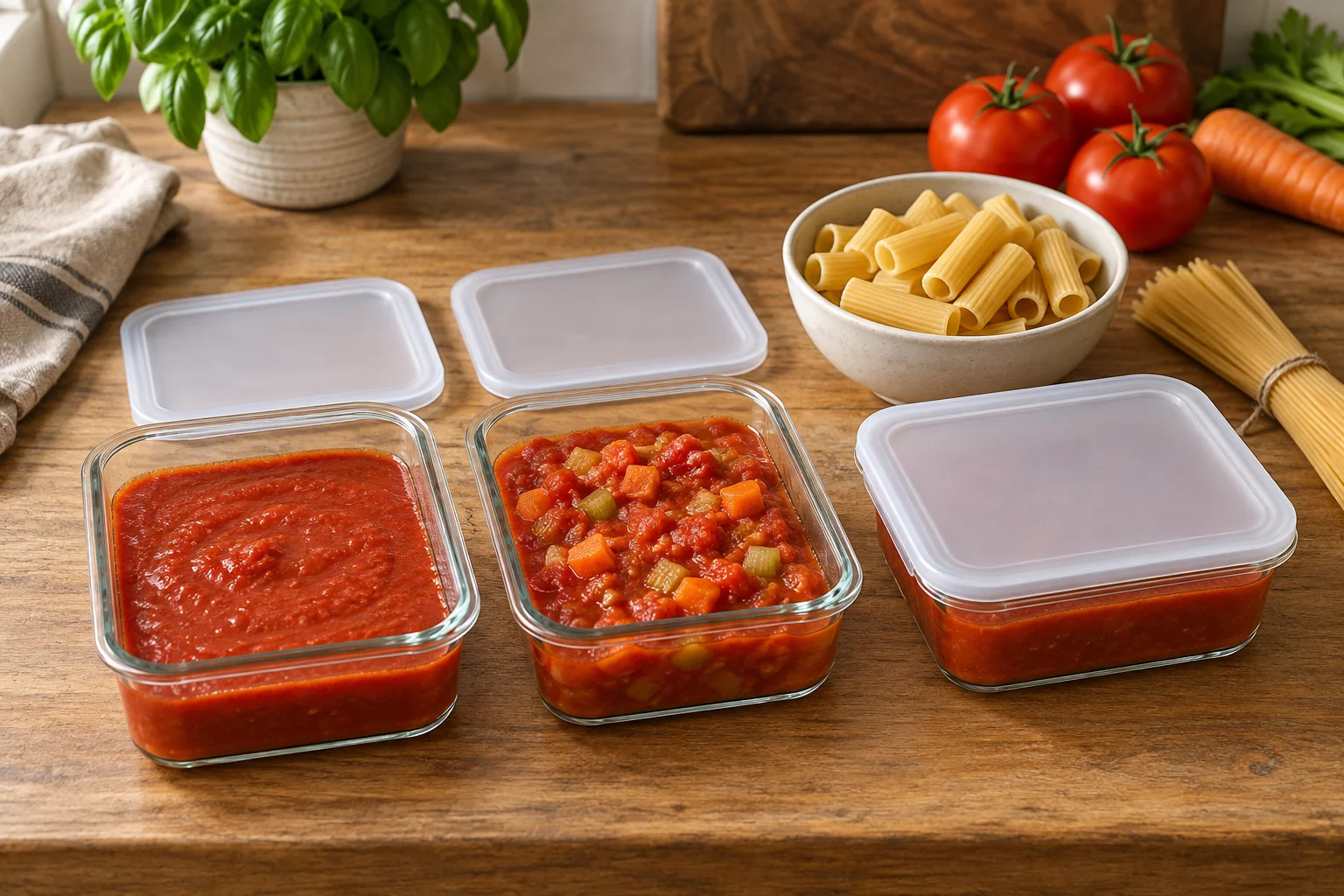
Start with the evenings you will actually eat at home
First mark the evenings when you genuinely expect to eat at home. A plan for Monday, Thursday and Saturday has different requirements from three consecutive days. You do not need a supply of cooked noodles waiting throughout the gaps; you need appropriately stored sauces and dried pasta in the cupboard. Our example allows for two people at each dinner. Monday is spaghetti with tomato sauce, Thursday is tagliatelle with ragù, and Saturday is penne with tomato sauce and freshly fried mushrooms. The other days remain available for different meals, appointments or spontaneous decisions.
Also decide how much time you really have on each evening. A sauce from the freezer helps only when you have allowed for thawing. Fresh mushrooms need some pan time on Saturday; a simpler garnish may suit a particularly tight schedule. Write one preparation action beside each meal: cook the sauces on Sunday, move Thursday’s portion to the refrigerator on Wednesday, and do the same for Saturday’s portion on Friday. Cook the dried noodles freshly each evening according to their package. You then avoid having to manage the texture of all the week’s cooked pasta in advance or refrigerate several complete meals at once.
Calculate quantities for three meals
Our own shopping starting point is 100 g of dried pasta per person for a main meal. That means 200 g for two people and 600 g across three evenings. You could divide this into 200 g spaghetti, 200 g dried tagliatelle and 200 g penne. Equal dry weights do not mean equal cooking times. Check each package separately. Fresh tagliatelle already contains more water and cannot simply replace the same weight of dried pasta in this calculation. If you want to make fresh pasta, use the serving quantities of the actual recipe and adjust that evening’s plan accordingly.
The sauce plan uses two recipe batches, each making four main-meal servings: four portions of tomato sauce and four of ragù. That gives eight sauce portions, of which six are needed this week. Two portions of ragù remain as an extra frozen reserve for a later dinner. Divide each finished sauce into two equal units, each intended for two people. Divide the actual cooked result rather than assuming a final weight before evaporation. If your selected tomato sauce recipe serves two, double its ingredients to serve four. Likewise, read the actual serving count for the ragù rather than judging it from the size of the pot.
Combine the recipes into one shopping list
Choose a complete method for each sauce, such as our basic vegan tomato sauce and ragù Bolognese. Transfer their ingredients to one list, applying the required multiplier. Onions, garlic and tomato products may occur in both batches; add their quantities before shopping. Passata and tomato purée remain separate items because they perform different jobs. Nor can the meat in a ragù be replaced with the same weight of dried lentils. For a plant-based week, choose a complete lentil recipe with its own liquid quantity and cooking sequence instead, and plan four portions of that sauce.
Add the total 600 g of dried pasta for the three evenings and any fresh garnishes. For our Saturday dinner, 250 g of fresh button mushrooms and one tablespoon of oil provide a suitable addition for two people. Allow separately for cheese, herbs or a side salad as wanted, without treating these as extra sauce portions. Compare the list with what you already have. Weigh an opened pasta packet and assess an opened dairy product by its actual storage history. Note when refrigerated ingredients will be used. You can buy mushrooms and delicate herbs closer to Saturday rather than assembling everything on Sunday.
Work in a useful order on preparation day
First make room for cooling and storing the finished food. A large pot of sauce is poorly planned if there is nowhere to portion it afterwards. Set out clean shallow food-safe containers, matching lids, a ladle and something for writing labels. Check that the refrigerator and freezer can accommodate the intended quantities. Start with the sauce that takes longer. A ragù may simmer gently for several hours, while a simple tomato sauce can be started much later. The quicker sauce does not need to sit hot on the hob throughout the entire ragù cooking time.
Wash vegetables and herbs, weigh ingredients for the two recipes separately and keep their seasonings separate initially. This avoids accidentally adding a doubled quantity of salt to one batch. When handling raw meat, keep boards and tools separate from ready-to-eat ingredients or clean them thoroughly between uses; include your hands and work surfaces. Finish each batch according to its complete recipe. Half-cooked vegetables or meat do not become a finished sauce simply because they are described as meal preparation. Fresh herbs intended for serving are added on the actual eating day. This keeps preparation day manageable and the garnish fresh.
Allocate, chill and freeze the sauces
Divide the finished tomato sauce into two equal units for two people: one for Monday and one for Saturday. Halve the ragù in the same way: one half for Thursday and one as a reserve. Split larger hot quantities between several shallow containers for prompt cooling; a two-person unit may occupy two smaller boxes if necessary. Do not leave sauces standing in a large pot for hours. After prompt cooling, refrigerate them covered at no more than 7°C, preferably below 5°C. The Monday sauce stays there only until the next meal. Freeze the other three units in portions promptly after they have cooled.
Label each container with its contents, preparation and freezing dates, and “serves two”. Identify Thursday, Saturday or reserve in the weekly plan. Use freezer-safe containers and allow the expansion space specified by their manufacturer; a screw-top jar filled to the rim is not a sensible default. Arrange later portions so that each can be removed separately. This plan does not promise a particular number of months of storage for every sauce. Ingredients, packaging and appliance conditions still matter. Include the reserve first when making your next plan so that it does not disappear behind newer supplies. Freezing will not restore food that was poorly stored beforehand.
Cook with little preparation on Monday and Thursday
On Monday, have the chilled tomato sauce ready and bring water to the boil for 200 g of dried spaghetti. Reheat the sauce evenly in a separate saucepan or frying pan; if it has become very thick, add a little water. During reheating, every part of the prepared sauce must reach at least 70°C for two minutes. Cook the pasta according to its package and combine it with the hot sauce. Add washed, dried basil leaves and any chosen cheese when serving. One of the two tomato units is now used; the other remains frozen until its scheduled thawing day.
On Wednesday, move the ragù portion marked for Thursday into the refrigerator to thaw. A shallow container is easier to plan around than a large block; check in good time that it has thawed throughout. On Thursday, reheat the ragù thoroughly and cook 200 g of dried tagliatelle according to their own package timing. Here too, adequate heat throughout matters rather than bubbling at the edges alone. If the sauce needs more liquid, add it sparingly and adjust seasoning at the end. You do not heat your entire stock for this dinner. The second ragù unit stays untouched in the freezer as the basis of another meal.
Make a different dinner from the same tomato sauce on Saturday
Move Saturday’s tomato unit into the refrigerator on Friday to thaw. On Saturday, clean 250 g of fresh button mushrooms, remove damaged areas and cut into slices about 5 mm thick. Heat one tablespoon of oil in a sufficiently wide pan and fry over medium to moderately high heat until the mushrooms are cooked, their released water has evaporated and some surfaces are browning. Around eight to ten minutes is a guide; with a small pan, work in two batches and divide the oil between them. A crowded deep mound of mushrooms steams in its own liquid and follows a different cooking pattern.
Add the thawed tomato sauce to the cooked mushrooms and heat the mixture adequately throughout. Meanwhile, cook 200 g of dried penne and combine everything at the end. The mushrooms change flavour and texture without requiring a third base sauce. Finish with salt and pepper. To keep the meal vegan, choose a suitable garnish without dairy cheese and check the pasta ingredients too. The quantities for this mushroom addition belong only to Saturday; they are not divided between both tomato units on Sunday. You retain the option of changing the second tomato dinner at short notice if your plans or available ingredients change.
Adjust for appointments and extra people
If Thursday’s dinner is cancelled, an unopened ragù portion that is still completely frozen can remain in the freezer and be assigned a new date. If it has already thawed in the refrigerator, arrange to use it promptly rather than repeatedly postponing it. A quick look at the following day’s actual plans before thawing therefore helps. An unexpected extra guest is not automatically covered by the unchanged two-person portion. Using the same planning quantity, three people need 300 g of dried pasta and a correspondingly larger amount of sauce. Use another frozen unit only when its thawing and thorough heating fit the time available.
For an evening with four people, the same calculation gives 400 g of dried pasta and four sauce portions. You can allocate both two-person units of the same sauce, but the other planned dinner then needs a replacement. Freshly opened passata, a quick sauce or a different meal is easier to manage than an unnoticed gap in your supplies. Record what you actually take out. A simple note on the refrigerator is enough: dish, number of portions and storage location. You do not need an elaborate inventory of every noodle, just enough information to know that the dinner you are relying on is really available.
Include leftovers and the next shopping trip
Weigh dried pasta before cooking and serve according to actual appetite. If some remains, cool it promptly in a suitable shallow portion and label it. Two to three days in the refrigerator is a general framework for fully cooked meals, rather than a guarantee; dishes with raw components should be used by the following day at the latest. For this plan, assigning a leftover to the next meal is usually simpler. A portion already mixed with fresh rocket is handled differently from a separate frozen sauce. Transport meals already chilled with ice packs and refrigerate them again on arrival.
At the end of the week, check which quantities suited you. If 100 g of dried pasta per person regularly proved too much, reduce the starting amount for your next plan and adjust the sauce allocation accordingly. If the reserve was eaten, remove it from your inventory. If it remains frozen, the next week can begin with less preparation. The actual portion still available matters more than the original shopping list. This small feedback step makes the plan more useful in daily life: you buy more purposefully, cook the noodles freshly and use prepared sauces on the days when they save you work.