Describe the kind of club event
Start with who is invited and when food will be served. A closed summer gathering for registered members is easier to predict than an open tournament with changing teams and spectators. The headcount may include parents, volunteers, coaches and people who only visit briefly. Not every visitor will automatically buy pizza. Other food stalls, packed meals and the programme influence demand. Describe the actual event to the caterer and distinguish confirmed participants from uncertain visitor forecasts. A previous event can offer guidance when its purpose, weather, duration and other food options were genuinely comparable.
Establish what the club wants to achieve too: invite members to a shared meal, feed volunteers or provide an additional sales stand for visitors. This determines who places the order and who pays. For a shared club meal, the club might pay the agreed invoice; at a sales stand, the caterer might sell individual portions directly to guests. A combination is possible but needs clear arrangements. If volunteers receive meal vouchers while others pay individually, both sides should understand exactly what a voucher covers. Settle this before comparing individual prices so the quotations describe comparable services.
Choose whole pizzas, slices or a buffet
Whole individual pizzas provide a clearly defined portion and allow personal orders. They involve taking orders, possibly collecting payment and waiting for cooking to finish. Slices from prepared varieties can be served more quickly when enough fresh pizza follows and portions are clearly described. A buffet may better suit a shared meal with agreed staffing and replenishment. None of these formats is automatically included in every catering offer. Providers such as DasPizzaMobil advertise buffet formats as a possible service; that establishes neither a standard package nor unlimited provision at any time. Ask for the intended arrangement to be confirmed specifically.
Consider where guests will eat. Someone standing briefly beside the pitch between matches needs a different arrangement from a group at set tables in the clubhouse. Slice size, plates, napkins and any cutlery matter. Define a portion in the quotation, such as a whole pizza of a stated size or a specified number of comparable slices. A voucher simply marked pizza leaves that unresolved. For a buffet, establish whether the caterer cuts, replenishes and supervises serving, or only supplies the food. This avoids club volunteers unexpectedly taking on work for which neither time nor materials were allocated.
Break demand into serving windows
Map expected demand against the programme. Teams might eat after their matches, families around lunchtime and volunteers before or after their shifts. A shared activity or prize-giving can bring many people to the counter together. An hourly average conceals those peaks. Here is a hypothetical calculation: 160 agreed portions over four hours average 40 portions per hour. If 80 of them are needed in a single 20-minute break, that window requires an average of four portions per minute. These figures describe demand, rather than promised output from a particular caterer or oven.
Include those windows in the enquiry and ask how the provider would accommodate them. Baking is only part of the work: cutting, ordering, payment and handing over food matter too. An earlier start, staggered groups or an agreed limited selection for the main break might work. An additional oven alone cannot fix slow payment collection. Demand remains uncertain at an open event. Agree the deadline for changing quantities and what happens if substantially more or fewer visitors attend. Any reserve should be a specific additional quantity or agreed service rather than an allowance hidden repeatedly within different items.
Agree the menu and particular portions in advance
A manageable menu simplifies serving, especially when many guests order within a short period. Choose varieties suited to the audience and sufficiently different from one another. A simple tomato-and-cheese pizza and a suitable vegetable option can form the basis, with other choices reflecting actual preferences. Vegetarian or vegan options should not be improvised on the day by removing ingredients from a finished pizza. Ask for dough, toppings and finishing ingredients to be described together. Animal rennet in cheese or egg in dough may matter to the promised dietary description.
Allergies and intolerances also depend on actual preparation. Ask what separated processes the caterer can provide at the particular stand instead of inferring unrestricted suitability from a menu name. A gluten-free dough option does not establish protection from flour contact during shared preparation, for example. Agreed special portions need suitable quantities and a clear handover arrangement. Someone at the stand should be able to answer ingredient questions. Make the caterer's information available in the intended form and do not change the menu independently of it. Sauces or cheese added at short notice also change the ingredients in the food actually served.
Confirm the location and vehicle access
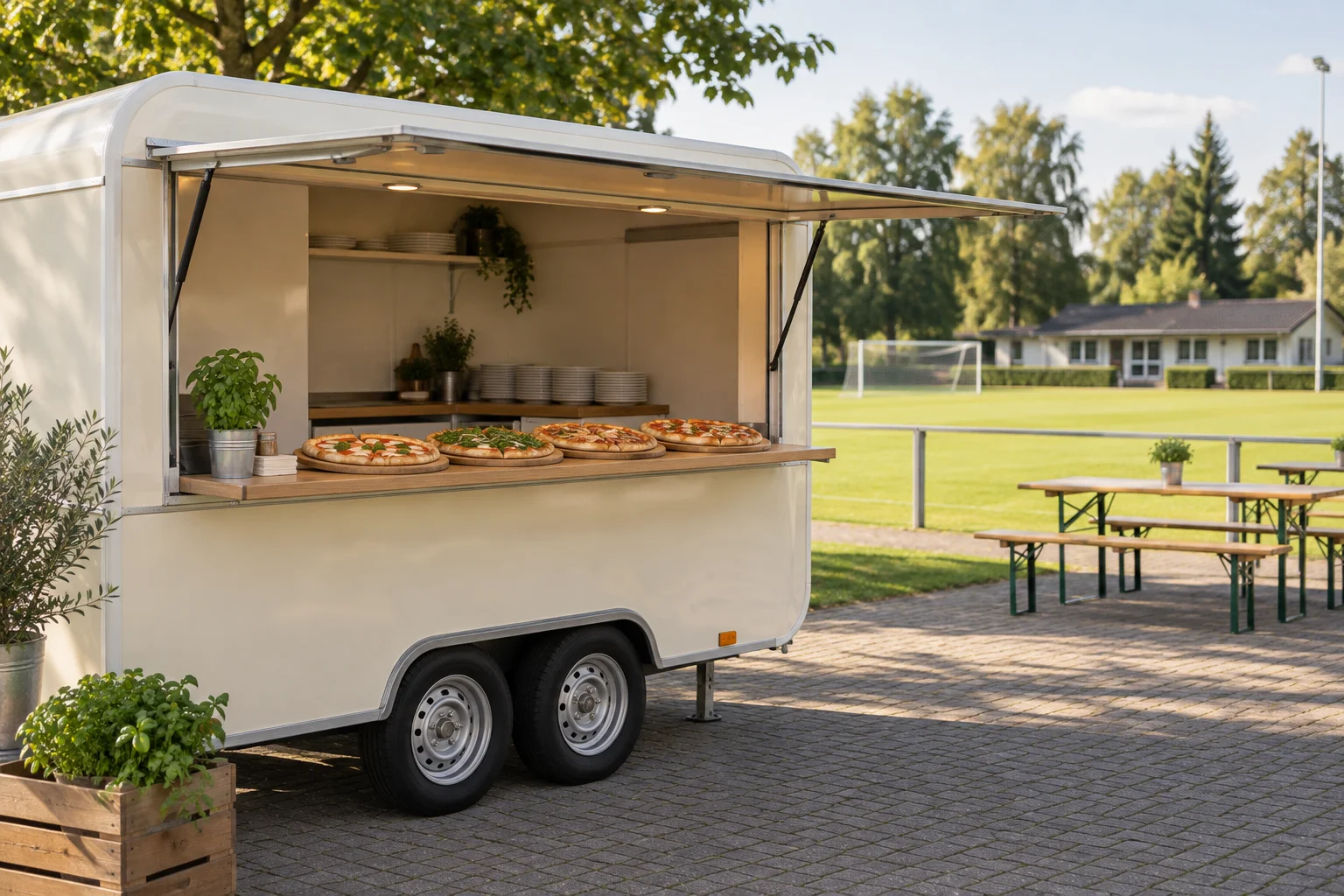
Agree the pitch with the venue operator and caterer. Required space extends beyond a trailer or vehicle's footprint: open hatches, working space, stabilisers, a towing vehicle and the queue may need additional room. Obtain dimensions and conditions for the actual setup being supplied. Check access width and height, bends, load-bearing ground and manoeuvring room. A level paved area is easier to assess than grass whose suitability may change after rain. A previous successful visit by a passenger car does not establish access for a larger catering trailer.
Schedule arrival and collection so vehicles can preferably enter before crowds build and leave during an appropriate clear window. Keep emergency routes, entrances, playing areas and pedestrian paths clear. Avoid positions where dust, smoke or waste from neighbouring activities could affect food. Weather protection, appliance placement and fire precautions depend on the actual setup and should be agreed with the responsible parties. An ordinary club marquee is not automatically a suitable cover for every oven. Photographs and a simple drawing of the actual site help this discussion; fill in important missing measurements before treating the location as confirmed.
Allocate electricity, water and waste arrangements
Ask about connection type, electrical demand and the number of connections required. The actual installation matters, including refrigeration and other appliances. Saying that a socket is available does not answer those questions. The venue operator and, where necessary, a suitably qualified person should establish whether the supply is appropriate. Agree who provides suitable cables, protected routing and connection. Improvised adapters or repeatedly linked distribution strips cannot replace an appropriate supply. Some providers bring parts of the infrastructure themselves, while others need particular connections on site. This is a matter for the quotation, rather than an inherent feature of anything called a food truck.
Food preparation and necessary cleaning require a suitable supply of drinking-quality water and an agreed wastewater arrangement. Establish whether the caterer brings appropriate fresh- and wastewater tanks or requires connections, and who provides them. Handwashing, refrigeration and the necessary work surfaces must function within the intended process too. Agree responsibility for food waste, packaging and used dishes. Reusable crockery also needs a return route and appropriate cleaning. Visitor waste containers should be accessible without affecting food service. Organise disposal with the venue operator and provider in line with local requirements; the nearest drain or any existing bin is not an agreed plan.
Compare prices for the same service
Request a quotation that identifies the quantity or charging model, food, serving period and additional services. These may include travel, setup, staff, crockery, extensions and dismantling. Check which items are included in the stated amount and whether prices include applicable VAT. The amount actually payable matters for your decision, rather than an isolated price per pizza. Quotations with different portion sizes, service periods or staffing are not directly comparable. Record the deadline for confirming final quantities and the conditions for changes or cancellation as well.
Where guests buy directly, an agreed minimum sales guarantee may create a cost for the club. In an explicitly hypothetical example, suppose a contract guarantees €1000 in sales revenue but only €800 is taken. Under that particular agreed arrangement, the club might need to cover the €200 difference. If a separate fixed €150 travel charge also applies, club costs would total €350 in this example. These figures are neither market prices nor a general contractual rule. Other offers charge differently. Clarify which sales count, how they are evidenced and what additional charges apply. For a shared club meal, establish who approves the invoice and which budget has been agreed internally.
Keep responsibilities clear on the day
Name an accessible club contact for arrival, placement and agreed decisions. They need not coordinate every pizza but should have access to keys, the event schedule and relevant volunteers. Decide who opens serving, who communicates programme changes and who may actually order a chargeable extension. This prevents contradictory instructions from different committee or team members. Club volunteers can direct guests, organise vouchers or collect dishes where those tasks have been agreed. Handling open food requires suitable instruction, equipment and hygiene; it should not casually become an extra duty during a cash-handling shift.
Before the event, agree with the caterer, venue operator and responsible authority which local requirements apply. A club event is not exempt from all food rules merely because volunteers organise it. Guidance from the German state of Baden-Württemberg explains that possible exceptions depend on the activity's nature, scale, regularity and organisation and require assessment of the specific situation. That cannot be treated as a general exemption for a commercial caterer. Clear allocation of responsibilities for safe food, necessary information and appropriate operating conditions matters. The local food authority can address unresolved questions about the particular event. Arrange this early rather than attempting it while opening the stand in front of waiting guests.
Agree closing, handover and the review afterwards
Distinguish the end of food service, dismantling and departure. A caterer serving the final portion at 6 pm will not necessarily be fully packed up at 6 pm. Confirm the time needed for each stage and coordinate it with use of the venue. If food remains, establish beforehand whether any can be handed over and under what genuinely suitable storage conditions. Leftovers do not automatically become club supplies. Food requiring refrigeration needs a traceable temperature history after the event too. Used plate leftovers must not be collected and served again. Clean return of equipment and agreed waste disposal also belong in the closing arrangements.
Compare the plan with what happened: how many portions were served, when demand peaked, where queues formed and which varieties were popular. Where a sales agreement applies, reconcile the agreed records together. Note unusual circumstances such as rain, delayed matches or teams withdrawing so next year's plan does not copy the figures uncritically. Better planning might mean another serving window or clearer vouchers rather than automatically more food. Describing the date, guest groups, demand windows, preferred format, site conditions and charging model together enables a caterer to provide a much more suitable quotation for the club event.