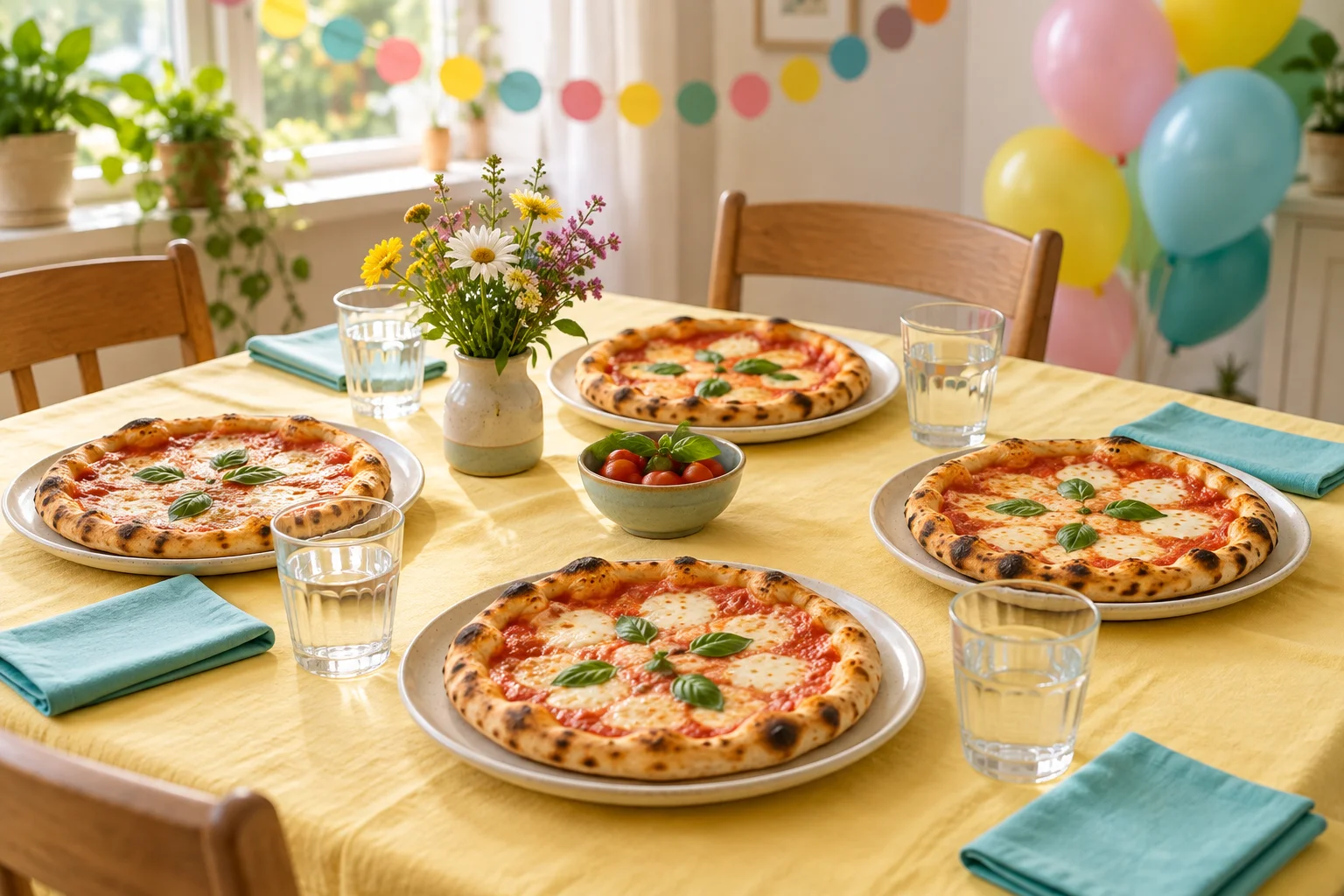
Decide how much the children will do
Making an individually topped pizza does not require mixing the entire dough during the party. Prepare dough balls according to a suitable recipe and let the children shape and top them later. That keeps the shared activity manageable: each pizza receives its own shape and preferred toppings. If shaping would be too demanding for the group, an adult can prepare the bases. Topping alone still offers plenty of choices. Ask the birthday child beforehand whether this shared preparation would be enjoyable, or whether they would prefer ready-made pizza after the games.
Match the activity to age, experience and group size. Children who enjoy cooking need different support from a group handling dough for the first time. Younger siblings can have a simpler task or stay with a supervising adult away from the work surface. Everyone need not do the same thing simultaneously. Some can set the table, choose toppings or make place cards beforehand. Germany's Federal Centre for Nutrition, the BZfE, recommends involving children in food decisions and preparation in ways suited to their abilities. That does not mean a child must operate knives, ovens or hot baking pans independently. Choose a task they understand and can undertake with appropriate support.
Coordinate the invitation and mealtime with parents
Explain in the invitation whether children will top pizzas together and approximately when they will eat. Parents can then decide whether another meal is needed beforehand. Leave sufficient time between eating and collection too. A pizza leaving the oven shortly before the party ends allows little time for appropriate cooling and a calm meal. Discuss allergies, intolerances and agreed dietary preferences with parents before shopping. Asking the child at a busy birthday table is not a reliable substitute. Be specific about the ingredients and preparation arrangements your kitchen can actually provide.
Include agreed portions in the plan. A pizza without visible cheese is not automatically suitable for every milk allergy when work surfaces and utensils are shared, for example. Equally, a wheat-free base alone does not answer every question about gluten or flour contact. If a separately prepared meal is more appropriate, agree this in advance so the child remains naturally included at the table. There is no need for a public explanation of their diet. Establish which adults will eat as well. Two accompanying parents staying for the meal affect the total even if only children were originally counted in the invitation.
Plan small initial portions and seconds
Choose a recipe size that works on your trays or in your oven. Small individual pizzas give each child their own result, while tray pizza requires fewer separate shaping steps. Quantity depends on appetite, other food and the course of the party. Children do not automatically need half an adult pizza. Cake beforehand and more food later create a different situation from pizza as the only substantial meal. Discuss an initial estimate with parents and arrange for children to start with a smaller portion and have more if wanted.
Here is a dough calculation only: six small pizzas using a chosen recipe portion of 150 grams each need 900 grams of dough. Two further 250-gram dough balls for accompanying adults add 500 grams, making 1400 grams of finished dough altogether. These are assumed recipe sizes, not age-based nutritional recommendations. Add a reserve explicitly rather than generously rounding up every ingredient afterwards. Derive sauce and toppings from the actual pizzas planned. Keep suitable supplies separate so additional portions can be made according to demand. No child needs to finish a large pizza simply because it was topped and placed on their plate at the start.
Prepare dough and toppings before guests arrive
Choose a recipe whose schedule fits the celebration and prepare its dough balls accordingly. Refrigerated fermentation, room temperature and the necessary dough relaxation depend on that recipe. Children should not have to wait through a lengthy fermentation after only just mixing flour and water together. Suitable ready-made dough can also fit the schedule; follow the package's preparation and storage instructions. Divide it so the activity does not begin with one large sticky mass on the shared work surface. Keep portions not yet needed appropriately covered and stored. The birthday need not become an exercise in several different dough processes at once.
A simple sauce, suitable cheese and a few prepared vegetable toppings provide enough choice. Wash and cut ingredients appropriately for the children's ages and the recipe. Adults should sufficiently precook toppings that require it and cool them safely if preparing ahead. Adding raw meat or raw eggs as hands-on ingredients makes the activity unnecessarily demanding. Very wet ingredients also need their intended preparation so the small pizzas do not sit beneath a watery layer. Put manageable amounts in clean bowls for the first round. Keep remaining perishable supplies refrigerated and replenish them in fresh clean containers rather than repeatedly adding them to older leftovers.
Separate the cold workspace from the hot area
Children need a stable work surface they can reach comfortably. Position bowls and spoons so nobody has to reach across someone else's pizza. Include a place for washing hands with soap and drying them cleanly. Wash hands before starting and again after contact with flour and raw dough before eating or touching ready-to-eat food. Keep flour and dough on their designated surfaces and clean those thoroughly afterwards. Separate cooked pizza, drinking glasses and clean eating utensils from the dough workspace. A glass on a flour-covered board can quickly become another obstacle.
An adult remains responsible for the oven area, including loading, unloading, hot trays, peels and safe resting surfaces. Someone helping six children with toppings cannot simultaneously watch every movement beside an open oven door. Where needed, divide those jobs between two adults or work with smaller groups in turn. A clear route from oven to resting surface avoids carrying hot pizza through children at play. Use only baking surfaces and tools suitable for the appliance. For children, the arrangement is straightforward: participate at the cold workspace, then receive the finished pizza at the eating table once it has cooled appropriately.
Offer a few clear topping choices
Briefly demonstrate on one prepared base how to spread a thin layer of sauce and leave the intended rim. A short explanation at the shared workspace is enough; several completed demonstration pizzas are unnecessary. Then give children real choices within the prepared selection. Someone who wants only tomato and cheese need not add vegetables to earn approval for their pizza. The BZfE emphasises accepting a child's refusal of food. You can offer and describe an ingredient without making tasting it a condition for the rest of the meal or a reward.
Let children arrange suitable toppings in patterns, stripes or small areas. A heavily piled pizza does bake differently from a lightly topped base, however. Help with quantity without correcting every shape. Raw dough must not be tasted, even when it contains no egg. Germany's Federal Institute for Risk Assessment, the BfR, points out that flour itself can contain pathogens; ready-made dough sold for baking is not automatically safe to eat raw either. If someone wants food during preparation, offer suitable ready-to-eat items at the separate eating place with clean hands. That makes the rule understandable without turning the whole shared activity into a hygiene lecture.
Keep track of pizzas and use the waiting time
If each child is to keep their own pizza, choose a simple way to identify it after baking. You might assign each child a position on a tray and record the arrangement outside the oven. Do not bake loose paper notes, toys or unverified decorative picks with the pizzas. A topping pattern can provide another clue, but it cannot replace reliable separation where dietary requirements demand it. Give small pizzas enough room and bake them according to the recipe. Bases of very different thicknesses with varying topping amounts may finish at different times. The adult operating the oven needs to account for those differences.
Plan something for the baking period that leaves the oven route clear. Children can wash hands, finish setting the table, distribute place cards or begin a quiet game with a supervising adult. Explain whether everyone will eat together or separate rounds will come to the table in turn. If the oven holds only a few pizzas per cycle, this decision matters more than a schedule specifying every minute. Baking time depends on the recipe and oven conditions; a clock alone cannot assess differently shaped pizzas. The base needs to be baked through and toppings appropriately cooked. A particularly dark rim does not establish that a thick centre is ready too.
Consider cooling, eating and seconds together
Fresh pizza can be very hot in its cheese, sauce and base. Allow it to cool to a suitable eating temperature on an appropriate surface and check the portion before handing it over. A lukewarm plate edge does not reliably indicate the temperature of sauce beneath the cheese. Cut pizza into manageable pieces where that suits the children. Adapt other food and its preparation to the ages and abilities of those actually attending. Supervising adults should also know which portion belongs to whom. This simplifies serving when several children ask for their pizzas at the same time.
Allow seconds and accept when a child is full. Having a large plate of their own does not oblige them to eat the whole pizza. Keep water accessible and separate the eating area from the dough station still in use. If a child decides they dislike their topping, a planned simple variation can help without restarting the entire meal. After a few rounds it becomes clearer whether more pizza is needed. Top reserve dough once demand is reasonably apparent. Continue storing the remaining dough and ingredients appropriately rather than leaving them unrefrigerated for the rest of the party just in case.
End the meal with a simple routine
Time the last eating round so collection does not involve rushed meals or packing hot pizza. Leftovers from individual plates must not return to shared supplies. Further use of suitable remaining food depends on how it has already been stored and handled. If keeping cooked pizza, promptly cool it in suitable shallow containers, bringing it below 7°C within a few hours. Do not wait for a large stack to cool completely at room temperature first. For perishable food in the refrigerator, the BfR recommends no higher than 7°C, preferably below 5°C. Food sent home also needs storage and transport that keep it safe.
Put food and dirty dishes away methodically and leave hot appliances safe to cool according to their instructions. Children can help with suitable cold tasks such as collecting napkins or returning unused plates. The pizza activity succeeds when the group has been able to create something together and then eat calmly. A few observations are enough for another party: whether the working group was manageable, which toppings were chosen and how many portions were actually eaten. They help improve the arrangement without committing the birthday child or their guests to a more elaborate cooking programme next time.