Decide what the pizza stall is meant to do
Will pizza replace lunch, provide a small snack between performances, or raise money for a school project? Those aims change portion sizes, prices and staffing needs. For a shared lunch, the priority is that the intended guests receive a sufficient meal at the right time. At an open sales stall, families may also choose cake, waffles or other food. The total number of pupils therefore cannot be converted directly into an order for pizzas. Include parents, siblings, staff and other visitors without assuming that everyone will buy. Advance orders and experience from a comparable previous event help narrow down demand.
Also distinguish a small class gathering from a whole-school fair open to the public. Arrangements that are easy to agree between a few families do not automatically work with a continuous flow of guests and changing volunteers. Appoint a responsible contact at the school and establish who places the order and receives the invoice. Depending on the organisation, those may be different parties. School management should know what is proposed on the grounds; the premises team and, where relevant, the school authority can clarify available rooms and services. One short, shared description of the event prevents conflicting individual orders.
Choose a service the volunteers can manage
A caterer who prepares and serves food takes on different work from a pizzeria delivering finished pizzas in boxes. With delivery, receiving, cutting, serving, taking payment and clearing up often remain with the organisers unless otherwise agreed. That can work well when enough volunteers and suitable space are genuinely available. A delivery just before a scheduled break also needs a reachable contact and an appropriate handover point. Check how the pizza will get from the vehicle to the counter and who stays at the stall meanwhile. A friendly offer to help is not yet a staffed rota.
For on-site baking, the supplier must agree the complete working arrangement with the school. That includes setup, ingredient storage, the oven, serving and dismantling. A hands-on topping activity is a separate part of the programme. It needs supervision and its own cold workstation; children should not work between hot trays and waiting customers alongside a busy service. At a crowded sales stall, it may be more practical to have pizza prepared by the caterer and involve pupils in other suitable tasks. Age, ability and supervision matter. The event should remain manageable for everyone involved even if a volunteer has to cancel at short notice.
Put together an understandable selection
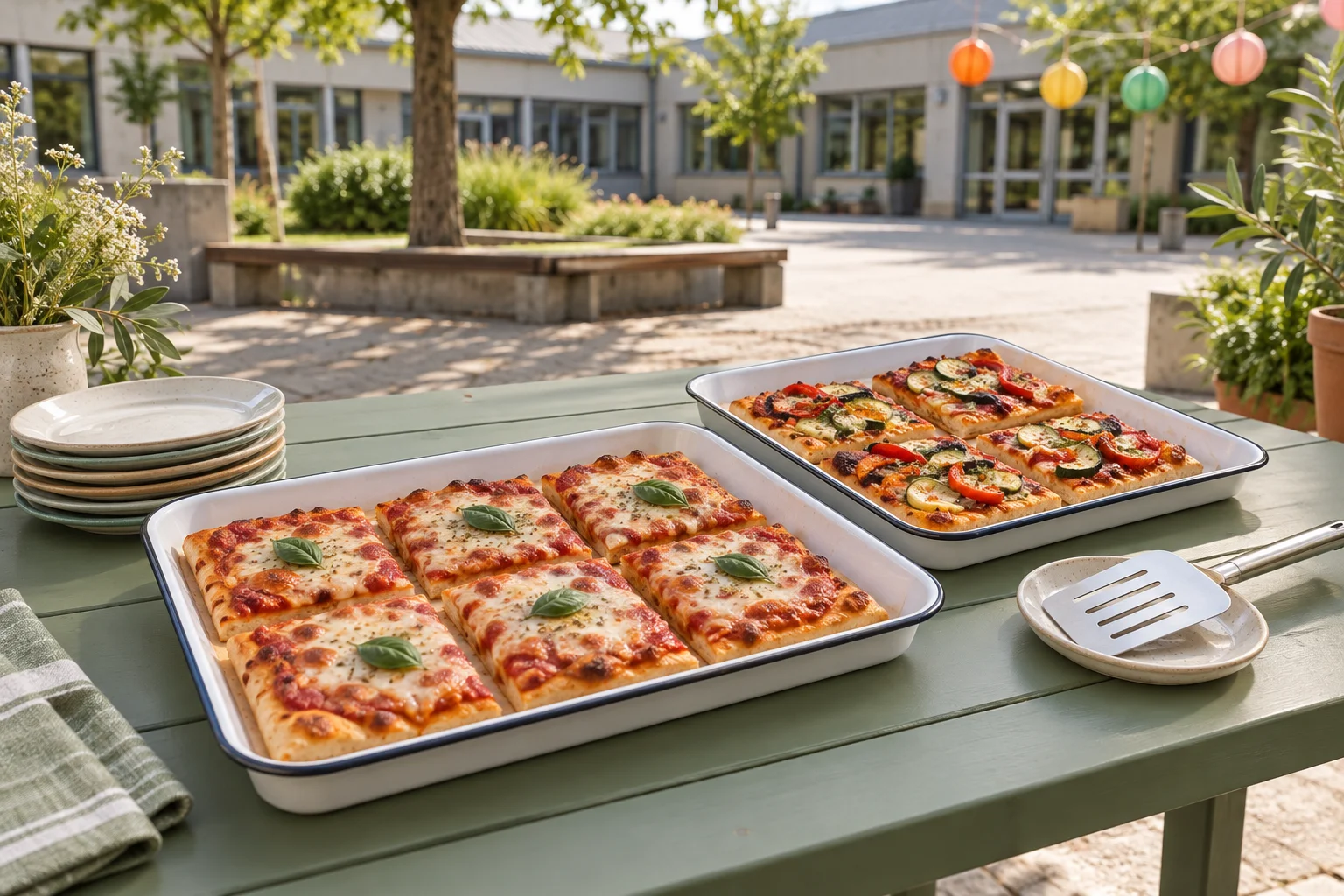
A small menu of clearly different varieties is easier to explain and replenish. Ask about preferences beforehand and consider how the choices fit the other food at the fair. Alongside tomato-and-cheese pizza, for example, a suitable vegetable version may be useful. A vegan option must work as a complete dish, including dough, sauce and finishing ingredients. Pupils can contribute to the choice without producing an unlimited list of requests. Agree which few varieties will be available and what they will be called. Plain ingredient descriptions help guests more than an invented name that leaves the actual toppings unclear.
Portion size and ease of eating belong in the menu decision. A small piece can be a taste or an accompaniment; several pieces can make up an agreed larger serving. This is not a fixed nutritional rule for each school year. Children and adults arrive with different appetites and decide how much they want to eat. Very soft or heavily topped pizza may require plates, cutlery and somewhere to sit. Do not choose solely from an appealing photograph. Ask the supplier to describe how the agreed pizza will be cut and handed over. Include drinking water and available seating in the arrangements so people can actually use their meal break.
Count advance orders separately from walk-up sales
Advance orders can provide a firmer basis than an estimate derived from the school's total size. Record the unit being ordered: one piece, two pieces or a whole pizza. Different sizes need separate quantities. Add expected walk-up sales as an identifiable assumption. In a hypothetical example, 240 equally sized pieces have been ordered in advance, and you plan another 60 for additional sales. That gives 300 in total. If each agreed tray provides twelve pieces of that size, you need 25 trays. The figure applies only to that particular tray and cutting pattern. A different pizza size cannot simply be treated as equivalent.
The extra 60 pieces are already included in this example. Adding a general reserve to every variety would increase the order again. Instead, establish whether a further order is genuinely possible and the latest time it could be placed. Firmly pre-ordered portions must remain available even if walk-up customers arrive earlier. A clear collection window and simple allocation help. Plan for the busiest periods, too: many guests may want food immediately after a shared performance. A total quantity for three hours says little about whether service will cope during a short break. Ask the supplier about capacity under those particular conditions.
Agree space and services with the school
A good location is accessible without blocking entrances, escape routes or play areas. For a food truck, consider the full setup with its open hatch, working area, any trailer and waiting guests. Vehicle length alone is insufficient. Establish access, ground conditions, manoeuvring space and arrival time before the playground fills with people. A heavy vehicle belongs only on a suitable, approved area. An indoor serving point also needs room for supplies and returns. Kitchens, classrooms and dining-hall equipment are not automatically available for the caterer to use freely.
Ask the supplier to specify electricity, drinking water, refrigeration and wastewater requirements. The school should check what is available with the responsible people. An outdoor socket does not establish that the whole setup can operate from it. Extensions and connections must be suitable for the actual use and properly planned. Rain and wind need a workable response as well: an arbitrary gazebo does not make an oven weatherproof or replace the appliance's approved operating conditions. Decide when service must be adapted or interrupted and who makes that decision. A sheltered eating area and the safe oven position may be two different places.
Assign shifts and share information before the event
A volunteer rota should show tasks and handovers, rather than just names and times. Who receives deliveries, serves food, takes payment and replenishes clean plates? Who helps when the queue grows? Arrange breaks so that essential tasks remain covered. At each shift change, incoming volunteers need to know the current varieties, reserved portions and outstanding orders. A short note at the relevant workstation may be enough. Avoid a system in which only one person knows which pizza belongs to which group. That person may also want to watch their own child's performance.
Anyone working with food needs instruction suited to the task and must follow the agreed hygiene rules. Handling money, used crockery and ready-to-eat food should not be mixed without appropriate changes of task and clean hands. People who are ill with symptoms suggesting a transmissible gastrointestinal infection should not prepare or serve food. The responsible organisation should establish with the relevant authorities which briefings and other requirements apply to this particular event. Being a volunteer does not answer that question by itself. The caterer's commercial work and occasional parental contributions must be considered according to their actual roles.
Clarify ingredients and allergies before serving
Obtain an up-to-date mapping of varieties and ingredients from the caterer, including the necessary allergen information. Visible cheese does not explain every component of a dish. Dough, sauce, pesto or a product substituted at short notice may also matter. Information must match the pizza actually being served and be accessible at the counter. Parents should be able to discuss individual allergies with the responsible organiser and supplier early on. That discussion also covers preparation, utensils and possible contact with other foods. A general menu or reference to the most common allergens does not answer every individual question.
Only agree that special portions are suitable when the supplier can actually provide the required separation. A separate sign, a different colour or removing a topping after baking does not create that condition. If suitable food cannot be provided safely this way, the family needs an alternative agreed in advance. A child should not have to explain in front of a queue on the day why they need something different. Labels can make serving easier, but do not replace the prior discussion. Staff and volunteers must know who answers questions; if uncertain, they should check an ingredient rather than pass on a guess as an assurance.
Consider income, crockery and leftovers together
If the stall is raising money for a project, calculate the full agreed costs. Travel, staffing, crockery, cleaning and other services may be added to the food price. Take a simple hypothetical example: if 300 pieces are actually sold at two euros each, revenue is 600 euros. With assumed total costs of 360 euros, 240 euros remains. That is neither a price recommendation nor a profit forecast: fewer sales or additional costs change the result. Check whether you are buying a fixed quantity in advance or whether the caterer sells directly under a different revenue-sharing arrangement. Those models must not be mixed in the calculation.
Reusable crockery needs distribution, collection and washing, or an agreement that it can be returned dirty. Existing dining-hall plates are a solution only if their use, transport and cleaning have been arranged. Disposable items also create work through replenishment and waste handling. Provide appropriate collection points under local disposal arrangements and keep them separate from clean food. Smaller quantities at the counter, replenished regularly, can save space and avoid unnecessary leftovers. They work only if the next supply arrives in time. An empty counter just before the main rush is not a useful trade-off for a few saved plates.
Close the stall with a clear handover
Agree the last serving time, equipment return and completion of dismantling separately. While children and families remain on the grounds, the vehicle's departure also needs a suitable procedure. During service, food must be protected and kept sufficiently hot or chilled using the planned method. A warm box exterior does not demonstrate safe temperature management. Fresh pieces belong on clean surfaces, and leftovers from guests' plates must not return to service. Unused supplies, pizza that has been put out and food with an uncertain storage history need different treatment at the end.
Discuss beforehand whether suitable leftovers can be accepted safely, who will refrigerate them and how they will be transported. Reducing waste starts with appropriate quantities and good storage; it does not mean distributing unsuitable food regardless. Do not simply ask parents to take every remaining pizza without considering its history. After the fair, a few concrete notes will help: pieces ordered and served, popular varieties, the busiest break, unfilled shifts and actual costs. Pass that information to the next organising group. It will allow them to plan for the real school instead of starting again with a broad estimate.