Look at the space in terms of tasks
Start with the surfaces you can actually use. You need somewhere to shape or top the dough, a safe landing place for hot trays and a clean area for cutting. These tasks do not each require a permanent separate table. In a small kitchen, one surface can serve different purposes in sequence if it is cleared and appropriately cleaned between them. A hot tray, however, needs a suitable resting place immediately. You cannot first move several bowls out of the way while holding it. Choose that position before baking and check that the open oven door and the route to the dining table remain clear.
Put away appliances and supplies that are not needed for the evening. The space you gain is often more useful than another kitchen tool. Do not block ventilation openings or move combustible items close to a hot appliance. The hob is not automatically a safe extra shelf simply because you are not currently using a pan. Residual heat or an accidentally switched-on zone can endanger objects placed there. Use surfaces and trivets suited to the intended task. If space is still short, reduce the number of ingredients standing out at one time before obstructing a walking route with another table. The useful measure is whether the next task can be done comfortably, not how many bowls fit on the counter.
Choose a pizza style that fits the kitchen
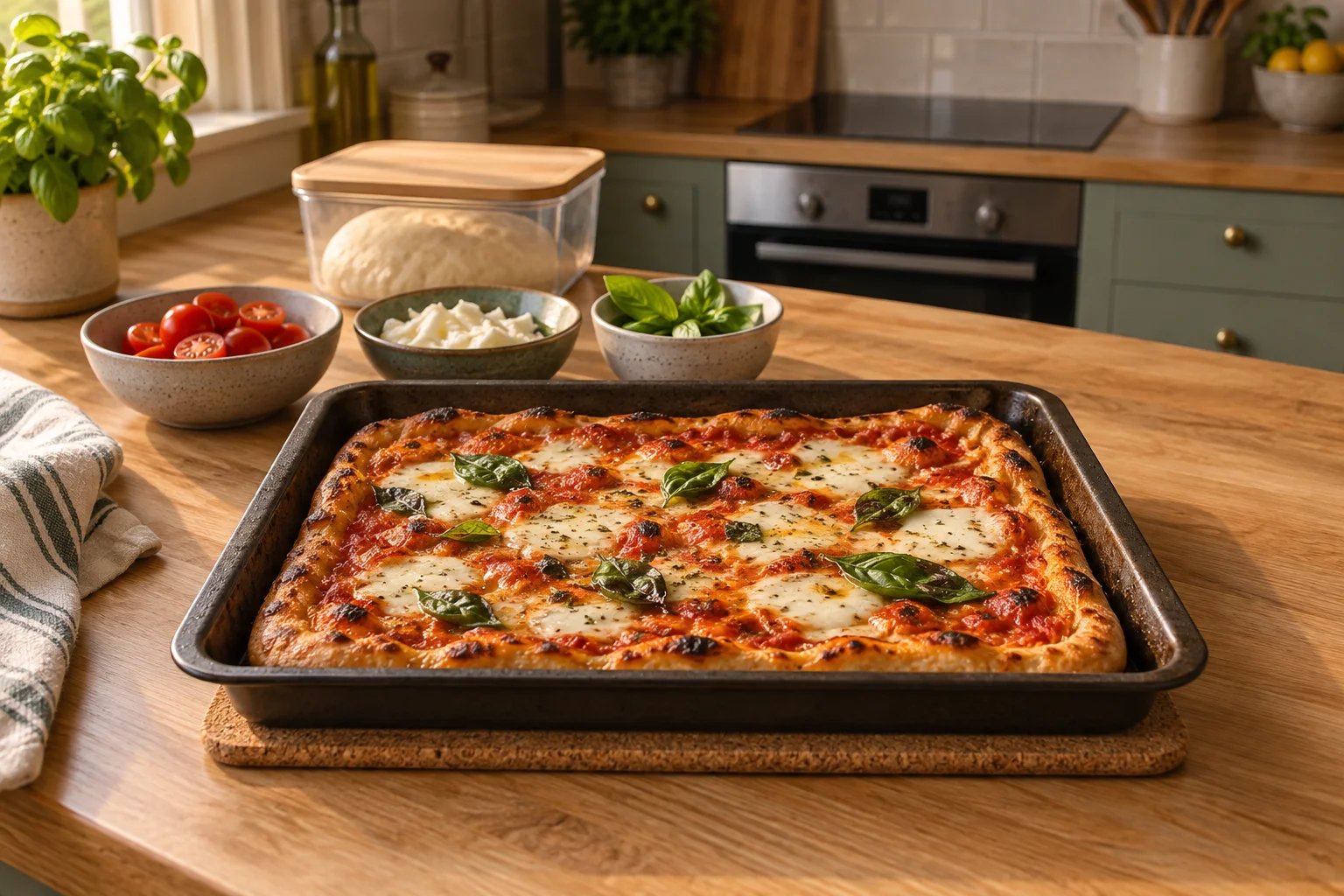
A tray pizza can be prepared in its tin and divided into pieces later. This can simplify work in a small kitchen because you do not need to transfer another round pizza onto a peel immediately before every bake. The tin, dough quantity and recipe must still fit together. A deep tray pizza follows a different process from a thin round base. King Arthur Baking also suggests considering pan pizzas when entertaining a larger group at home. This is an option, not a requirement to make a particular style. Choose preparation and baking methods that suit your oven and the space available instead of selecting a recipe mainly for its photograph.
Round pizzas can work too if shaping, topping and loading can follow one another on the available surface. Several small pizzas do not automatically reduce the work: each needs a place and appropriate topping and baking. Check the usable baking area rather than relying on the outside dimensions of the appliance. Two tins might fit beside one another on a worktop but not together on the intended oven shelf. Use that observation to determine the number of rounds. Baking on several levels at once can change the result. Follow a suitable recipe and your oven's capabilities without assuming identical performance on every shelf or simply multiplying the number of trays you normally use.
Reserve refrigerator space before planning the dough
A long dough fermentation needs suitable containers and actual refrigerator space. Consider lids, dough expansion and the height between shelves as well as the container footprint. Several shallow boxes may fit differently from one large bowl. Stacking only helps when containers are designed for it and close properly. Allow additional room for cheese, prepared toppings and other foods that require refrigeration. Do not fill the refrigerator so tightly that its cooling function is impaired. Dough weight alone tells you little about the usable storage space preparation will require. Think about how the containers will be taken out too, without repeatedly unloading the rest of the fridge during the party.
A hypothetical example makes the distinction clear: six dough balls weighing 250 grams each give 1,500 grams of finished dough. That is not 1,500 grams of flour, and the weight does not establish a particular container size. Hydration, fermentation and dividing belong to the chosen recipe. Keeping the dough together initially and dividing it later also changes the space needed over the day. Decide on that sequence before shopping. There is no single room-temperature proofing duration for every dough. Follow the particular recipe plan and account for the actual room temperature instead of placing every box out very early as a precaution. Preparing ahead should make the timing more manageable, not detach the dough from its intended fermentation.
Prepare ingredients that would otherwise occupy the counter
Make the sauce and prepare your chosen toppings in good time. This includes washed and appropriately cut vegetables, drained cheese and any ingredients that need cooking beforehand. Consider what can actually cook during the short pizza bake. Thick pieces of raw vegetables do not become suitable merely because they enter the oven alongside thin dough. A limited selection is particularly helpful in a small kitchen: a few compatible toppings need fewer bowls, utensils and decisions around the counter. A shared basic sauce with two different topping combinations may provide enough variety for your group. Choose ingredients for the meal you want rather than filling every available bowl with another possible option.
Put out only what the next round needs and keep the remaining supply appropriately refrigerated. Cooked toppings intended for later use need prompt, suitable cooling; a large hot pan should not occupy the counter for hours. Separate raw dough and flour handling from baked pizzas and ready-to-eat sides. Raw dough should not be tasted even when it contains no egg. Clean hands, equipment and surfaces appropriately after dough work. A prepared kitchen does not need to resemble a display. Covered, clearly allocated supplies leave more room to work than having every ingredient on the table at once. Small quantities can be replenished as the evening proceeds rather than left exposed for its entire duration.
Send one pizza at a time towards the oven
Divide tasks so that nobody has to squeeze through a group carrying a hot tray. One person manages the oven and announces when they need space. Others can choose ingredients at the table or top the next tin if there is a suitable clean area for it. A participatory pizza night does not mean everyone must stand directly in front of the oven together. With children, maintain clear separation from the hot working area and provide appropriate supervision. The dough station can be interesting without children handling hot trays, peels or appliances. Participation is easier to enjoy when people know where their part of the process takes place.
Do not leave the next pizza topped on a peel for an unnecessarily long time. Moisture and waiting can make loading more difficult. Establish that the oven is ready before completing the final step leading to the bake. A tray pizza can simplify part of that transfer, but it still needs a safe route. Baking paper, mats and tins must be suitable for the particular appliance and conditions. A general suggestion to use parchment does not apply to every pizza oven or every direct baking surface. Use the accessories your actual process allows instead of improvising with an unsuitable liner because the worktop is crowded. The oven's instructions remain relevant even when space is limited.
Treat baking rounds as part of the shared meal
If your oven bakes in sequence, the invitation need not promise a separate pizza for everyone at exactly the same moment. Sharing slices from several rounds can suit a sociable evening. Agree whether everyone wants to share and account for the ingredients each guest has requested. A pizza reserved for a particular person must not accidentally disappear into the general selection. Briefly explain the varieties that will follow. Guests then need not take as much as possible from the first pizza because they are unsure whether another option is coming. Time between rounds can become part of the meal when people understand the arrangement and have somewhere comfortable to sit.
Plan from your actual baking process rather than the shortest advertised baking time. Consider a hypothetical example: four pizzas bake individually for twelve minutes each, with two minutes between rounds for removal, preparation and loading. From putting in the first pizza to taking out the last, the elapsed time is 4 × 12 plus 3 × 2, or 54 minutes. Preheating is not included. The first pizza finishes after twelve minutes and the last 42 minutes later. These numbers are not an appliance performance recommendation. They show why eating in rounds may fit the process better than waiting for four pizzas to be ready together. Use timings appropriate to your recipe and oven when making your own plan.
Keep sides and drinks outside the hot working route
Place drinks, glasses and a suitable side dish where guests will already sit or gather where possible. A small kitchen becomes crowded when everyone must pass the baking area for a glass of water. A prepared salad can complement the evening if its ingredients and storage are appropriate. Arrange it so that it does not need repeated work on the only available counter during every baking round. Plates, cutlery and napkins can also be set out before baking begins. Spending a few minutes on these details reduces the number of requests that arrive precisely when a hot pizza is ready to come out of the oven.
Choose additional food according to its preparation needs, not simply the number of recipes. A warm pasta dish may require the hob, colander, sink and serving bowl at the same time. If those spaces are needed for pizza, an easily prepared side may make the evening calmer. Pasta is not impossible, but the two dishes need a shared space and timing plan. A dessert that can be prepared and stored appropriately moves work away from the baking period. Refrigerated desserts still use refrigerator space even when preparation was completed the day before. Count that space when deciding what to serve instead of discovering that the dough boxes and dessert occupy the same shelf.
Clear small amounts between rounds
Put away a container that is no longer needed before opening the next one. Collect used crockery in an agreed place and keep the finished-pizza area clean. A full sink can later block the space needed for washing hands or cleaning tools. A small, organised return area is more useful than stacking dirty dishes beside flour and toppings. The aim is not a permanently immaculate kitchen. It is to leave the next necessary action possible: cleaning hands, collecting ingredients, putting down a hot tray or cutting a pizza. This sequence gives clearing up a practical purpose and helps other people recognise where they can assist without getting in the way.
Trays and baking surfaces remain hot after a round is finished. Make their location clear to everyone and let them cool appropriately without blocking an exit or walking route. Do not cool a hot baking stone with cold water to free the space faster; follow the care instructions for the particular material and appliance. Required cooling or fan phases also form part of finishing with an electric pizza oven. If you need a second tin, allow for it in advance. An improvised quick wash of something still extremely hot is not a sensible response to insufficient workspace. The last pizza leaving the oven is not necessarily the moment when every piece of equipment can be stored away.
Plan cooling space and use a little feedback
Decide before the party whether you have room for suitable leftovers at all. Food with an unknown or unsuitable storage history does not become safe through later reheating. For appropriate cooked food at home, Germany's BfR recommends prompt cooling, dividing larger quantities among several shallow containers. Bring it below 7 °C within a few hours. The refrigerator should be no warmer than 7 °C, preferably below 5 °C. Do not wait for complete cooling on the worktop before arranging refrigeration. Food left on guests' plates does not return to the shared supply. A suitable small order is easier to accommodate afterwards than an unnecessarily large reserve that was never part of a clear plan.
After the evening, note only the details that would help next time. Which tin fitted well, where was a landing surface missing, how many rounds felt comfortable and which toppings were chosen? You may only need a smaller bowl, a different cutting position or one fewer variety. None of those changes requires a larger kitchen. You also do not need to buy another appliance simply because a round took longer than expected. First adapt the menu, quantities and sequence to the space you have. Knowing what will happen on each surface and when it will happen leaves more time for the people gathered around your table.