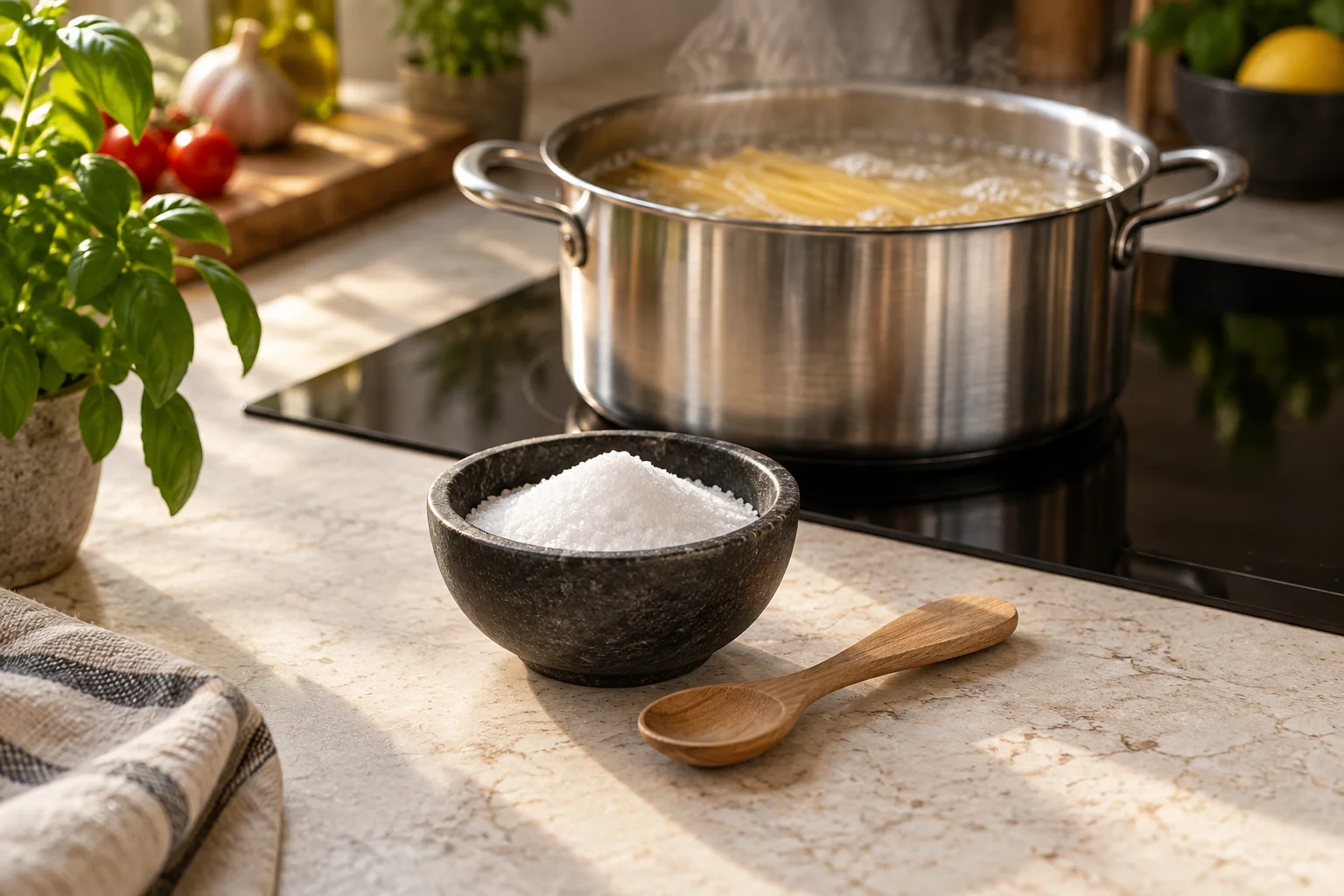
Choose a clear starting quantity
For ordinary dried durum-wheat pasta, approximately 7 g salt per litre of water is one possible starting point. That gives 14 g for 2 litres or 21 g for 3 litres. Treat the calculation as guidance and follow any different quantities specified in your complete recipe.
The reference here is a litre of water. Cooking the same pasta quantity in less water does not automatically call for the same salt quantity. Otherwise, a small pot with much less water can become considerably saltier than the generously filled pot in another method.
Account for cheese, cured pork and anchovies
Season the water more cautiously for a sauce containing plenty of Pecorino, guanciale, anchovies or salty capers. This matters particularly when several spoonfuls of cooking water will go straight into the sauce. Along with water and starch, you transfer salt too.
For cacio e pepe or carbonara, follow the quantities balanced for that particular recipe. The 7 g per litre is not a minimum that must be reached regardless of the other ingredients. Taste the finished combination before adding more salt at the end.
Weigh the salt and dissolve it
Add the weighed salt to boiling water and stir to distribute it, then add the pasta. This sequence establishes the seasoning before cooking, instead of leaving you to decide the whole quantity in the final minute.
Fine and coarse salt can be compared by weight, but not reliably by the same spoonful. Level and heaped teaspoons differ as well. A scale therefore makes repeated preparation more consistent than relying on an unusually large or small spoon from your cutlery drawer.
Add cooking water to the sauce deliberately
Shortly before draining, collect some cooking water in a heatproof container. Add a little to the sauce first, mix, then assess both flavour and consistency. This gives you more control than pouring in a large ladleful and subsequently reducing the sauce heavily.
Water evaporates during cooking while dissolved salt remains behind. Heavily reduced pasta water can therefore taste particularly salty. If the sauce is already seasoned enough, a little unsalted hot water may be a better way to loosen it, although it does not contribute the same additional starch as the cooking water.