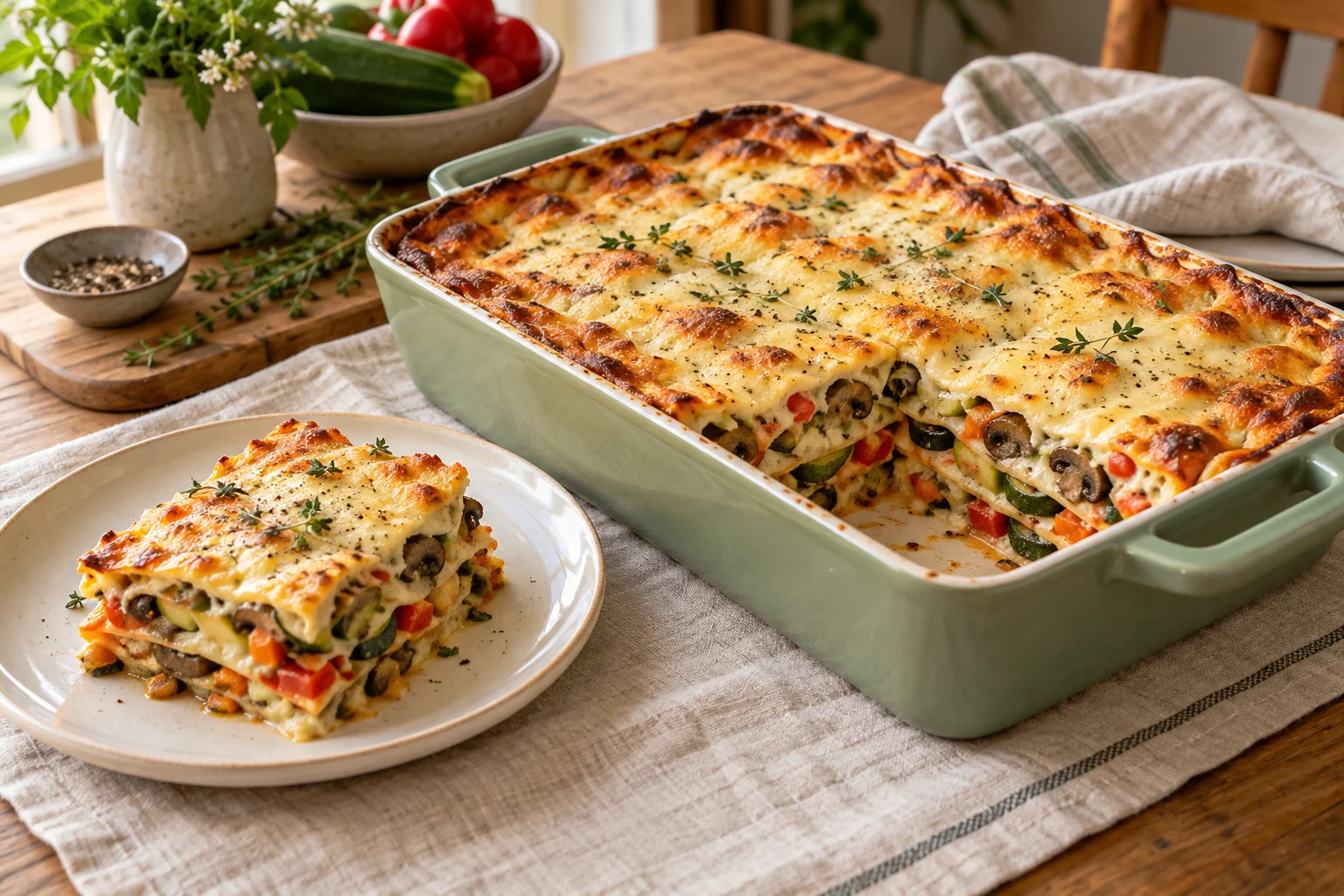
The filling needs flavour and controlled moisture
Vegetables release water as they cook. If you put raw mushrooms and courgettes between the pasta sheets, that liquid has to emerge and spread within the assembled lasagne. At the same time, the pasta needs enough moisture to soften. You gain more control by cooking the vegetables first and allowing excess liquid to evaporate in an uncovered pan. The béchamel then has a distinct job: it connects the layers, keeps the pasta moist and provides the creamy texture between the pieces of vegetable. Separating those jobs makes the filling easier to assess before anything goes into the oven.
This white lasagne contains no tomato sauce. Mushrooms contribute a savoury flavour, carrots and red pepper bring some sweetness, and courgettes supply softer pieces. It is a separate combination whose individual ingredients remain recognisable, rather than a finely chopped vegetable mince. Small, evenly cut pieces do make both layering and serving easier, though. Large raw carrot cubes or long, firm pepper strips would need more cooking and could pull entire layers apart as you cut portions. The size of the vegetables is therefore a practical part of the method, rather than merely a choice about presentation.
Quantities for four and a suitable dish
For the filling, prepare 300 g courgettes, 300 g chestnut or white button mushrooms, 200 g carrots, 200 g red pepper and 60 g onion. Weigh these as usable raw ingredients after washing or cleaning and trimming. You also need 3 tablespoons olive oil, 3 tablespoons water, salt and pepper. Make the béchamel with 1 litre whole milk, 70 g butter, 70 g plain wheat flour, a little salt and pepper, and a small pinch of nutmeg. Add 80 g grated vegetarian hard cheese and approximately 250 g thin, fresh lasagne sheets labelled as suitable for oven cooking without pre-boiling.
Choose an ovenproof dish with an internal base measuring roughly 20 × 30 cm and sides at least 6 cm high. You need enough pasta for four complete single layers covering that base. Its precise weight depends on the thickness and dimensions of the fresh sheets, so check the packet and your dish before cooking. Trim sheets to fit instead of stacking them several layers thick simply to use exactly 250 g. Allow roughly 100 minutes in total, including preparation, baking and resting. A large frying pan, two saucepans and a matching ovenproof lid for the dish make the sequence easier to manage.
Cooking the mushrooms separately
Clean the mushrooms and slice them about 4 to 5 mm thick. Use a total of 1 tablespoon of the oil to cook them in two batches in a large frying pan, allocating half that oil to each batch. They need sufficient contact with the pan base. In an overcrowded pan, liquid can gather faster than it evaporates. Cook each batch over medium to moderately high heat for around 5 to 7 minutes, turning occasionally. By the end, the mushrooms should be tender and have developed some colour. Allow any visible released water to evaporate with the pan uncovered.
Remove the cooked mushrooms and season lightly. You do not need a deeply burnt crust, and any stuck residue should not turn black before the next vegetables go into the pan. If necessary, let the pan cool safely and wipe away burnt residue instead of distributing it through the filling. Different mushroom varieties may need different preparation and cooking; large, tough stems or foraged mushrooms are not arbitrary replacements. Stick to commercially sold button or chestnut mushrooms for this sequence. Having them already cooked makes it easier to assess the finished filling without also having to account for remaining raw mushroom slices.
Softening carrots before adding courgette and pepper
Cut the peeled carrots into small cubes about 5 mm across and finely chop the onion. Cook them in the second tablespoon of oil over medium heat for around 5 minutes. Add the measured 3 tablespoons of water, cover the pan and cook for another 6 to 8 minutes. Check a carrot piece: it should yield readily, without a hard, raw centre. If the pan dries before the carrots reach that point, add a small splash of water and continue briefly. Then remove the lid so that any remaining liquid can evaporate before you proceed with the other vegetables.
Meanwhile, cut the courgettes and deseeded pepper into pieces about 1 cm across. Add them to the carrots with the third tablespoon of oil and cook uncovered for roughly 8 to 10 minutes, until tender. Stir regularly and split the mixture into batches if your pan is too small. Finally, add the mushrooms and adjust salt and pepper. When you draw a spoon through the filling, the gap should not immediately fill with a thin puddle of water. The vegetables can remain juicy: you are not trying to roast them dry or break every piece down into a soft paste.
Making a béchamel that spreads easily
Warm the milk in one saucepan without allowing it to boil over. Melt the butter in a second saucepan over moderate heat, stir in all the flour and cook the pale roux for approximately 1 to 2 minutes while stirring. Avoid strong browning. Briefly take the pan off the heat and whisk in about 200 ml of the warm milk until no dry pockets of flour remain. Add the other 800 ml in several portions, whisking smooth after each addition. This gives you more control over combining the liquid with the roux than pouring the entire litre in at once.
Bring the sauce to the boil while stirring, then simmer gently for around 5 to 10 minutes. Reach the base and corners of the saucepan as you stir. Season with salt, pepper and a little nutmeg. While warm, the sauce should spread from a spoon rather than form a firm mass that can be cut. If it thickens during a short wait, stir it smooth again before assembling the lasagne. A little additional warm milk may help, added in small amounts only if needed. Make that adjustment according to texture. Stirring in uncooked flour as a quick thickener can instead create lumps and a floury taste.
Assembling four pasta layers and three vegetable layers
Preheat the oven to 190 °C conventional heat. Weigh out 100 g of the finished béchamel and spread it thinly over the base of the dish. Divide the remaining sauce into four approximately equal portions, either by eye or using separate bowls. Divide all the cooked vegetable filling into three portions and the cheese into four portions of 20 g each. This establishes what belongs in every layer before you put down the first sheet. The litre of milk is an ingredient quantity, not a claim about the finished sauce's weight: butter, flour and evaporation change that final amount.
Cover the sauce on the base with one complete layer of fresh pasta. Add one quarter of the remaining béchamel, one third of the vegetables and 20 g cheese. Repeat that combination twice more. You now have three pasta layers, each topped with sauce and vegetables. Finish with the fourth pasta layer, the final portion of béchamel and the remaining 20 g cheese. There is no extra vegetable layer on top. Spread the sauce into the corners and over any exposed pasta edges. Leave sufficient clearance below the dish rim to contain sauce as it bubbles in the oven.
Baking, checking the centre and resting
Cover the dish with its ovenproof lid, checking that the lid is suitable for the stated temperature, and place it on the middle shelf. Bake covered for approximately 25 minutes, carefully remove the lid using oven gloves and continue uncovered for another 10 to 15 minutes. Escaping steam will be hot. The total of roughly 35 to 40 minutes is a guide for this freshly assembled lasagne; the instructions for your fresh pasta remain relevant. A chilled prepared dish or significantly thicker layers need a different assessment. The cheese should gain colour without burning before the interior is ready.
Check the pasta at the centre with a thin knife: it should pass through the layers without hard resistance. The lasagne must also be thoroughly hot inside. A food thermometer can check that all parts reach at least 70 °C for two minutes. Bubbles around the edge alone reveal little about the middle. If the surface is already brown but the pasta remains firm, cover the dish again and continue cooking. After removing it from the oven, let it rest for around 10 to 15 minutes. Then cut four portions and lift them out with a broad serving spatula.
Choosing seasonal vegetable substitutions
Small pumpkin cubes can replace carrots, for example, provided you cook them until tender before assembly. Courgettes and pumpkin, however, need different cooking times and release different amounts of water. An identical raw weight therefore does not automatically mean an identical preparation step. Judge the cooked filling: it should be tender, retain pieces and contain no free puddle of liquid. If you swap several ingredients, stay roughly within the specified overall quantity of prepared vegetables and the plan of three moderately thick filling layers. Simply piling extra raw leftovers on top changes the height and can leave the pasta insufficiently covered.
Spinach needs a different approach from pepper. Cook it according to the product, squeeze out excess moisture and chop it before adding manageable quantities to the filling. A bag of raw leaves does not become an equally large bowl of cooked vegetables. Similarly, thawed vegetables accompanied by plenty of liquid are not directly equivalent to the weighed fresh ingredients used here. If you want tomato sauce in the lasagne, rebalance the sauce quantities instead of adding an entire carton of passata on top of this plan. That keeps the substitution understandable and the amount in the dish manageable.
Identifying vegetarian cheese and suitable pasta
Choose a hard cheese explicitly marked as suitable for vegetarians, or one confirmed to be made without animal rennet. The description “hard cheese” alone does not establish that. Neither a mild flavour nor green packaging is sufficient evidence. For this dish, you want a cheese that grates well and behaves suitably when heated. If you change brands, also assess its saltiness before heavily seasoning the filling and béchamel. This version contains dairy products and, depending on the fresh sheets, may contain egg. Vegetarian does not mean vegan or automatically free of common allergens; select ingredients according to the people sharing the meal.
Dried lasagne sheets cannot replace the thin fresh sheets here without reconsidering the method. Depending on the product, they need different amounts of liquid and different cooking times; some require pre-boiling and others explicitly do not. Read this information while shopping. Homemade fresh sheets vary again according to thickness and dough composition. If your product requires pre-boiling, use a complete method designed for that preparation rather than merely extending this recipe's oven time. Gluten-free sheets and a starch-based white sauce also need their own adjustments. Choosing a matching combination of pasta and sauce in advance saves corrections during assembly.
Preparing ahead and planning further portions
You can prepare the vegetables and béchamel at different times. For a longer interruption, cool cooked components promptly in shallow containers and refrigerate them. Do not leave a large hot saucepan on the worktop for hours. When assembling later, stir the sauce smooth and check that it still spreads readily. A fully chilled lasagne will usually take longer to bake than one assembled from freshly prepared components; assess the centre and pasta accordingly. With glass or ceramic dishes, follow the manufacturer's guidance about temperature changes. An unsuitable move from a cold fridge to a hot oven is not solved by leaving the food unrefrigerated for a long period.
After the meal, cool remaining portions promptly and refrigerate at no more than 7 °C, preferably below 5 °C. Planning for several days requires attention to refrigeration conditions and the shortest relevant ingredient instructions. Alternatively, suitably package cooled portions for freezing and label them. Thaw them in the fridge and reheat to at least 70 °C for two minutes throughout before eating. For eight fresh portions, two dishes of the stated size and quantity are easier to plan than a lasagne twice as deep. When baking both together, shelf position and airflow can affect cooking time; check each dish separately.