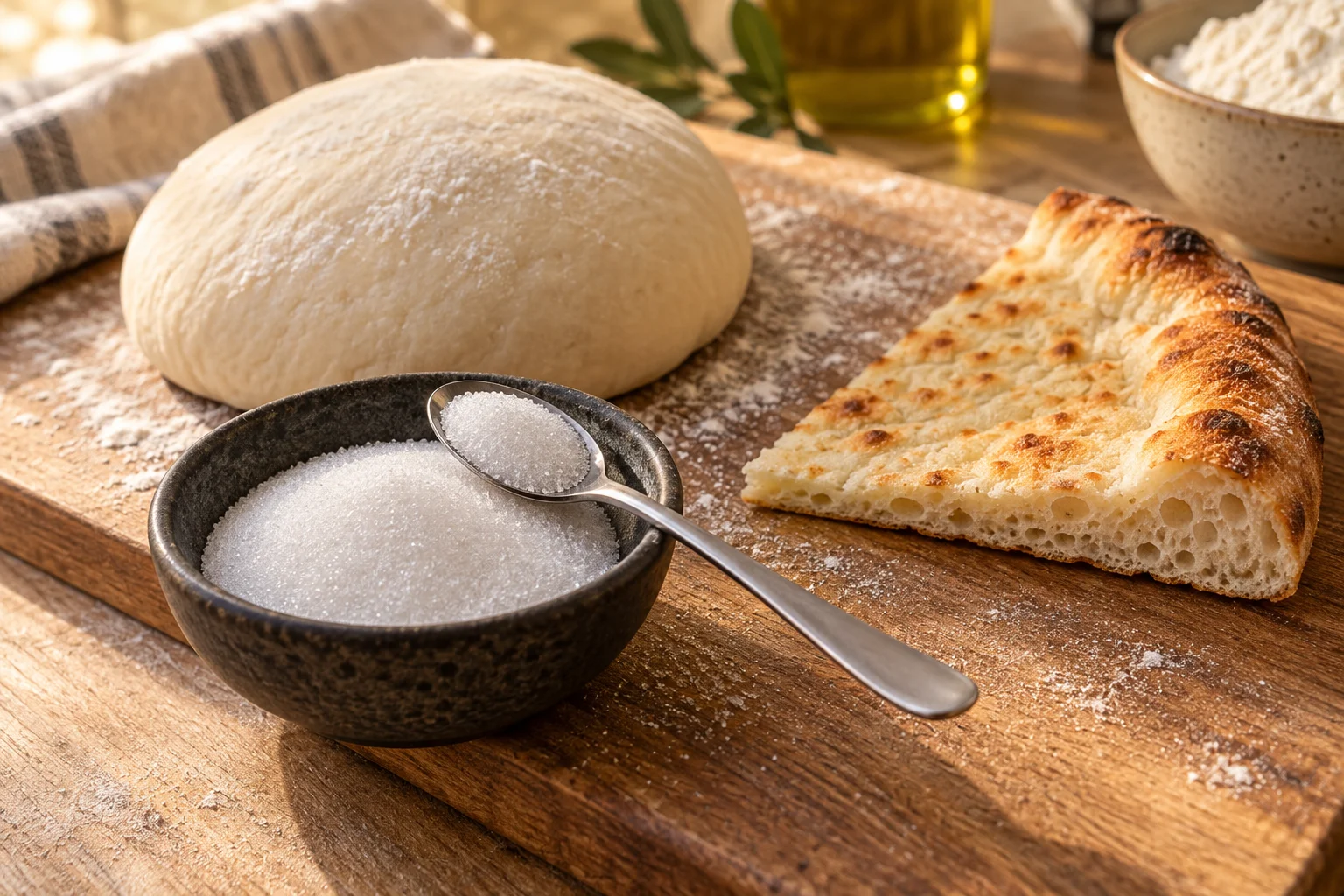
Yeast does not need a spoonful of table sugar
Pizza dough made with flour, water, salt and yeast can rise without any added sugar. Enzymes make sugars available from some of the starch in flour, and yeast can use them. An extra teaspoon is therefore not a general requirement for fermentation.
If a dough barely rises, first check the yeast quantity and condition, temperature and elapsed time. Sugar replaces neither missing yeast nor sufficient fermentation. Large amounts can actually slow yeast activity; greater sweetness does not automatically mean more lift.
Sugar affects browning
Added sugar can encourage browning, which is useful in some pizza styles with longer baking times. For pizza baked very hot and quickly, extra rapid colouring is not necessarily helpful: the surface may become dark before the dough reaches the state you want.
Choose a recipe whose dough and baking method suit each other. A New York dough containing sugar is handled and baked differently from a simple Neapolitan dough. That single ingredient does not turn one style into the other.
Calculate amounts from flour weight
If a recipe specifies one percent sugar, that means five grams for 500 grams of flour. Two percent means ten grams. These figures explain the calculation; they are not a general recommendation to add sugar to every pizza dough. Flour in a preferment counts towards the total flour weight.
Weigh small quantities rather than using teaspoons of varying size. Honey and syrup are not identical replacements for dry sugar: their water content, flavour and composition differ. The simplest approach for such variations is a recipe designed to use them.
For a pale base, check the baking process first
If the underside stays pale, first check preheating, the appropriate shelf position and the baking surface you are actually using. Very wet toppings can also change the result. Extra sugar will not compensate for a baking surface that has not heated sufficiently.
For your own comparison, change only the added sugar and keep dough weight per pizza, diameter, toppings and baking method as consistent as possible. Assess the cooked base as well as the colour. A darker rim alone does not mean the dough has baked better.