Count the people who will actually eat
Start by identifying who the meal is for. Visitors may come and go throughout a club event, while everyone at a birthday dinner eats together. The same announced guest count can therefore produce different demand. Establish expected attendance during the serving period, the role of the meal and any other food available. Pizza offered as a small reception snack needs a different plan from pizza as the only evening meal. Include helpers, musicians and the event team if they will eat from the same supply. An invitation list is not yet a catering order. The better the supplier understands your event, the better they can explain the quantities they suggest.
For a manageable private gathering, ask guests to confirm whether they will eat and choose a date for passing on the number. Exact predictions are not possible at every event, but you can discuss the uncertainty you already know about. What can change, by when, which ingredients can remain unprepared initially, and is there a minimum quantity you must pay for? A promise of precisely enough food with absolutely nothing left would be unrealistic. A supplier who explains how they handle different possible attendance levels is more useful. Check the latest replies shortly before the agreed deadline instead of leaving an early estimate untouched. Known cancellations are a reason to revise the order where its terms still permit this.
Match a manageable menu to the quantities
Many varieties initially look generous. They can also mean preparing a full bowl, a separate topping supply or another whole pizza for each choice. For a small group, a carefully selected menu is often easier to manage. Discuss which options serve different preferences: a simple Margherita, a plant-based vegetable pizza and another popular variety, for example. This is an illustration, not a prescribed menu size. Your guests and the service being offered should determine the selection. Extra choice earns its place when people want it and the kitchen can prepare it in appropriate quantities. Ask how the caterer divides the total between varieties rather than treating every option as a separate order for everyone.
Ingredients used across several dishes can simplify ordering, but individual requirements must remain clear. A tomato sauce might suit more than one dish if its actual ingredients and preparation are appropriate for each. A specially agreed portion for someone with an allergy remains clearly allocated to that guest. It is not an interchangeable reserve for the general buffet. Ask about the sizes of the available serving containers too. Adding a little pasta variety is less helpful if the caterer can only prepare it as a large batch. Sometimes the same popular dish in a suitable quantity meets your needs better than another option that few people will choose.
Count a reserve once, using clear units
A reserve should have a defined purpose. It might cover extra guests, allow for an uncertain split between varieties or provide a later round during a long celebration. Those purposes do not automatically require three separate additions. If the caterer has already included extra dough balls, there is no reason to add the same allowance again without discussing it. Establish whether the quoted number means guests, whole pizzas, slices or portions. At a combined pizza and pasta buffet, each dish could otherwise be ordered as though everyone were eating a full main portion of both. The useful question is how the dishes together make up the meal you intend to serve.
A hypothetical example makes the units visible. For a reception explicitly planned around snacks, assume two slices initially for each of 48 people. That gives 96 slices. If each pizza produces eight equally sized slices, the starting quantity is twelve pizzas. Agreeing another two whole pizzas as reserve brings the complete order to 14 pizzas, or 112 slices. These assumptions are not a recommended dinner allowance. Pizza size, toppings and the other food available might call for a different quantity. The benefit of the calculation is that the reserve is visible. It is already included in the result and should not quietly be added a second time when the final order is placed.
Replenish while people still want food
A buffet does not need every ordered portion ready on the table at the start. Smaller platters and several serving rounds can keep the selection easier to manage. Discuss which dishes can be prepared according to demand or replenished from appropriate storage. Unprepared ingredients are not an indefinitely usable reserve: they still need their required storage conditions. At a pizza truck, feedback from the serving point can influence the next baking round. With a delivery of already prepared dishes, there is less flexibility at the event itself. This difference should inform the order and any agreed delivery sequence before the day arrives, rather than being discovered when too much cooked food is waiting.
Choose who assesses demand towards the end of the meal. Looking at one half-finished plate is not enough. Are guests still on their way, is an announced break approaching, or have most people already eaten? A short conversation between the host and the serving team can prevent another full round from being prepared out of habit. Guests must also know whether more food is available. An almost empty table with nobody to ask can suggest that service has finished even when suitable ingredients remain. A brief indication of the next round and an available member of the team are more useful than permanently full platters whose contents may later be discarded.
Offer smaller first portions without pressure
At a shared serving point, smaller first portions let guests try the food they want. Anyone who is still hungry can return while the agreed service continues and food remains available. This works best when guests understand that they can come back and do not feel they must pile up a plate to avoid another lengthy queue. Arrange access so that another portion is easy to collect. Pizza can be divided into manageable slices; pasta can be served in a smaller initial helping. Choose the size in relation to the occasion and the actual dishes. A starter, a snack and the main evening meal call for different expectations.
Keep the invitation friendly: further rounds are available, and people may start with a smaller helping. Nobody needs to justify their appetite or finish a plate against their wishes. Familiar adults can help children choose without turning the buffet into a lesson about eating. Provide clean plates and suitable clean serving utensils for repeat visits as the service requires. Used plates must not contaminate food offered to everyone. Food left on a guest's plate does not go back onto a shared platter. A smaller first portion should make choosing easier; it cannot replace sufficient food or a clean, properly managed serving area where guests can ask for what they need.
Reusable items need a complete return plan
Find out what crockery the venue or caterer already has. Reusable plates, cutlery and containers are practical when borrowing, use, collection, washing and return fit together. Buying new containers for one event does not create useful repeated use simply because they are labelled reusable. Ask about suitable crates, whether dirty items can be returned and the collection deadline. An agreed washing service can simplify the arrangements, but it is not automatically included. The quantity of crockery also depends on whether items can actually be washed properly during the event or whether enough clean replacements must be ready. Count this work before assuming that a small initial stack will cover the whole evening.
Separate the used-crockery area from clean supplies and food service. If stacks of plates block the replenishment route, reusable service becomes unnecessarily awkward. A visible return point with suitable crates helps guests and helpers. Simply wiping a used plate does not make it clean serving crockery again. Material claims do not establish a disposal route either. Disposable items made from wood, bamboo or palm leaves are not automatically recyclable in the local collection system. Packaging described as biodegradable does not therefore belong in every food or garden waste bin. Use the actual materials and the local collection instructions when deciding what goes where, rather than relying on a reassuring word on the packaging.
Assess leftovers by how they have been handled
Untouched ingredients kept in appropriate storage, freshly prepared dishes and food left on guests' plates have different histories. Later use depends on how food was stored, served and handled. An attractive container cannot answer those questions. Agree in advance who will assess any suitable remaining food and whether a handover is possible. Appropriate containers, suitable transport and enough cooling capacity at the destination all matter. Plate leftovers must not return to the shared supply. A worthwhile purpose cannot make food with an unknown or unsuitable storage history appropriate for use again. This is why waste prevention starts mainly with ordering and serving, rather than with packing everything up at the end.
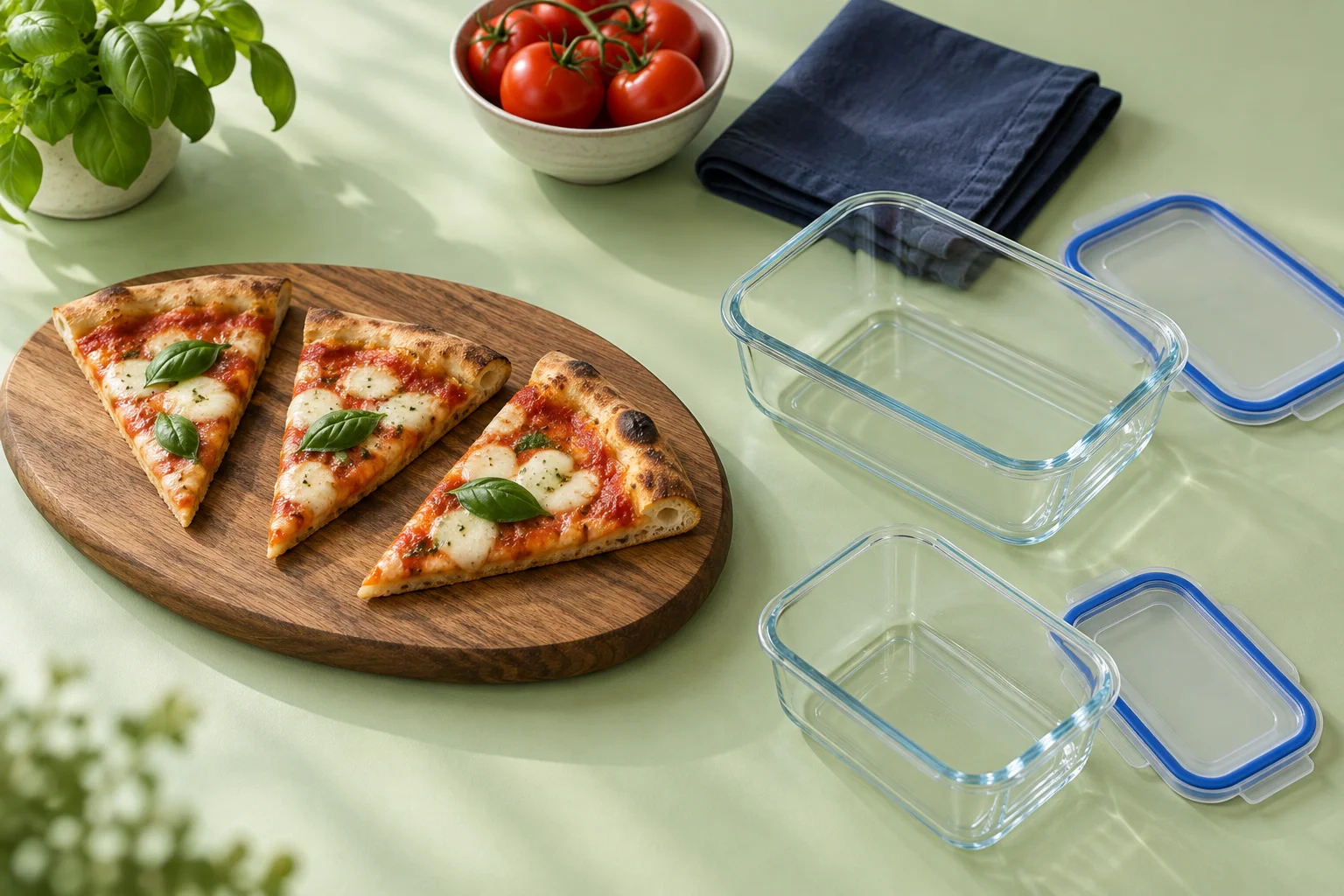
For subsequent private use, Germany's BfR recommends cooling cooked food promptly and dividing larger quantities among several shallow containers. Bring it below 7 °C within a few hours; the refrigerator should be no warmer than 7 °C, preferably below 5 °C. Do not wait for complete cooling on a worktop before arranging refrigeration. These measures assume the food's earlier treatment still makes it suitable for later use. Donation also needs an advance agreement with an organisation that can actually accept the food. Establish which items it takes, under what conditions, and who will make the handover. Neither collection nor acceptance should be assumed simply because you would like the food to be used.
Give packaging and waste clear destinations
Ask the caterer which transport packaging they take back and which items remain with you. An insulated box may belong to the business, while individual delivery cartons might become your responsibility. Transport containers, reusable crockery and waste each need their agreed destination. Put appropriate collection bins where they are needed without interfering with food or walking routes. Include the clearing-up period in the plan. More packaging and used napkins may accumulate after the caterer has left. The host should know which bins remain available and who eventually takes them to the venue's agreed collection point. A departure time does not automatically settle these remaining tasks.
Label the few collection points you need clearly. Sorting depends on the material, its condition and the local disposal route; one rule for every pizza box is unlikely to help. If the venue has its own instructions, use them in your arrangements. Helpers should know whom to ask about an uncertain item instead of inventing a separate sorting system during service. Assign someone to replace full collection containers in time. Overflowing bins beside the serving point make cleaning harder and can undermine careful separation. For a small celebration, a few accessible, managed collection points may be sufficient. They do not need to become a complicated installation that guests have to study before clearing their plate.
Use the actual outcome for the next order
Afterwards, briefly record how many people were present for the meal, what you ordered and which food remained. Distinguish unopened supplies, prepared food that was not served and plate leftovers. Each tells you something different. Was the overall order too large, did one variety fail to suit the guests, or were the first portions awkwardly sized? A picture of an empty platter alone does not prove that quantities were right: perhaps service ran out early. Equally, a small amount left over does not automatically mean the order was wrong. Feedback from the serving team and the people who ate adds the context needed to understand the quantities.
The next comparable event may only need a few specific changes: less of a rarely chosen variety, smaller initial pasta helpings, later preparation of the reserve, or a better position for the crockery return. Do not transfer quantities blindly to a different occasion. A lunchtime event with changing visitors differs from a long birthday evening even if the head count is the same. Share the observations with the caterer and use them to shape the next order. Waste reduction then becomes a set of manageable decisions that improve the food and the event itself. You need understandable quantities and honest feedback, not an elaborate reporting system for every celebration.