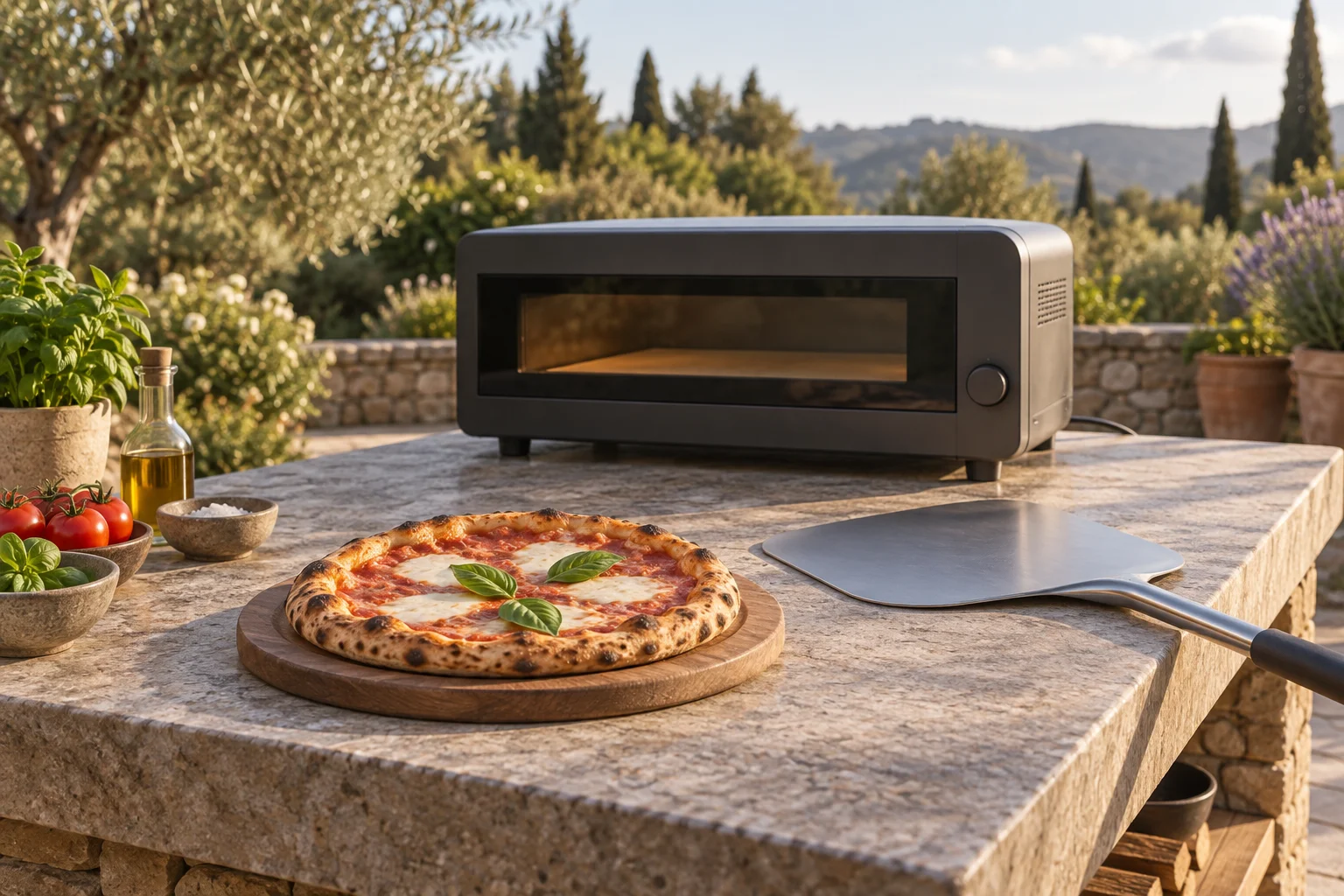
Check the approved location first
Look in the manual for the location in which the oven may be used. Electric describes its power source, not its weather protection. Some electric ovens are exclusively for indoor use, while others are outdoor appliances. A concrete example illustrates the distinction: Cozze describes its electric 13-inch Classic pizza oven as an outdoor appliance; Ooni permits the Volt 2 indoors only. A similar casing or equally high temperature does not make these ovens interchangeable. Check the exact model, generation and regional version before applying a retailer’s description to the appliance you are considering. Instructions for an earlier model are not a reliable substitute.
Next, consider what outdoors actually means at your home. An open patio differs from a narrow balcony recess, a conservatory or a garage with its door open. A roof alone does not resolve requirements for clearances or the permitted surroundings. Sketch your intended location and mark the wall, railing, roof edge, socket and walking route. You can then check the manual against a real arrangement. If the suitability of a covered area remains unclear, ask the manufacturer about that particular location. A question naming the model and describing its surroundings is much more useful than asking whether an electric appliance can go on a balcony in general.
Allow room for more than the casing
Measure more than the oven’s width. Its full depth, feet, open door, required clearances and the space needed for your hands and peel all matter. An oven can fit on a small table yet be awkward to operate. Before buying, lay out a cardboard template matching the stated external dimensions and mark the additional clearances. Hold an existing peel in front as you would when launching a pizza. If you have to step into a passage or work against the railing, a different position or smaller appliance may be a better choice. The template is only for planning; never leave cardboard beneath an operating oven.
The table needs to be level, stable, able to support the load and suitable for the heat it will encounter. Its load capacity must cover the oven and accessories together. A loose stone slab does not automatically make a shaky folding table suitable, and a heat-resistant top does not replace a stable structure. Plan a separate landing place for hot pizzas and somewhere secure for the peel. Keep oil, dough cloths, packaging and decorations outside the required clear space. A useful arrangement keeps the cook in front of the oven while guests collect slices from a serving area to one side. Hot equipment and people looking for food then cross paths less often.
Resolve the power supply and cable route before buying
Compare the voltage, rated power and manual’s requirements with the available connection. For example, Cozze lists 230 volts and 2200 watts for the model mentioned here. These are the connection specifications of one appliance, not assurance that any socket or extension lead will suit it. A kettle or patio heater on the same circuit can increase the combined load, even when plugged into a different wall socket. If you do not know the circuit arrangement or its suitability, have the connection checked by a qualified professional. A protective device that repeatedly trips is not a reason to experiment with adapters or different protective devices. Do not use damaged leads or plugs. Outdoor use also requires appropriate residual-current protection as part of the checked supply.
Where possible, plan a suitable accessible socket before settling on the oven’s position. If an extension would be necessary, the oven instructions must permit it and the lead must suit the power demand, environment and intended use. An existing indoor power strip is not automatically an option. Route the connection so nobody trips over it, it is not trapped in a door and it does not touch hot surfaces. Plug connections also need the protection specified for the situation. Check the whole route from the socket to the oven, not just the final few centimetres on the table. If the cable runs between the kitchen and dining area, changing the layout may be easier than repeatedly stepping around it while cooking.
Distinguish pizza diameter, baking surface and opening
The advertised size in inches is only a starting point. Also compare the usable baking surface and the oven opening. A square stone does not automatically accommodate a pizza as wide as its entire edge: launching, positioning and turning, where required, need room. A suitable base size is little help if a tall pan cannot pass through the opening. For pan pizza, check the pan’s external dimensions including its rim and handles, as well as the permitted height. A round pan may fit differently from a rectangular one with the same stated width. Accessories should be approved for the appliance and suitable for the intended temperature.
Choose the size around how you want to eat. For two people, two smaller pizzas in succession may be more enjoyable than one large pizza that is difficult to move. With guests, you can share slices of each freshly baked pizza while the next cooks. If everyone expects a whole pizza at the same time, an oven with a single baking space is an obvious bottleneck. A larger version helps only if it brings useful extra capacity. Measure your peel as well: a blade that catches the sides of the opening makes every movement more difficult. The oven, pizza and tools need to work together as a set.
Match temperature claims to your pizza style
A high maximum temperature can be useful for a quickly baked pizza with an airy rim. It is not automatically the right setting for every dough. A thicker pan pizza, a heavily topped base and a thin pizza need different cooking routines. Start with a complete recipe suited to your oven type and check the corresponding appliance settings. A specification such as the maximum of 450°C for the Cozze model describes a technical capability. It does not guarantee a particular colour or fixed baking time for your dough. Sugar, fat, thickness, toppings and the heat already stored in the oven also affect the result.
Check which temperature the display actually represents and how the manufacturer defines readiness for baking. The oven chamber and the stone’s surface are not the same thing. A suitable surface measurement can help you understand the conditions, provided the instrument and method are appropriate; it does not replace the instructions. While learning the oven, change one thing at a time where possible, such as a setting or dough thickness. If you alter temperature, dough weight and toppings together, it becomes difficult to explain an improved base. Make brief notes on the recipe, preheating routine and result. Those notes can give you a useful setting for your pizza without starting each round with a fresh guess.
Plan the rhythm of several pizzas
Time in the oven is only part of pizza night. Stretching, topping, launching, checking, removing and allowing the baking surface to become ready again all belong in the sequence. You therefore cannot turn an advertised short bake time into a dependable number of finished pizzas per hour. For several pizzas in succession, the fit between your routine and the particular oven matters. Keep the first evening manageable, with a modest quantity and simple toppings. A lightly topped basic pizza makes observation easier because a different filling or shape does not demand attention every time. Keep the oven supervised while it is operating.
Arrange ingredients within easy reach and keep perishable foods refrigerated until needed. Avoid stretching every dough ball in advance and leaving topped pizzas waiting on the peel. Wet toppings can progressively make the base stick to it. A short sequence of shaping, topping and launching works better, with the remaining dough balls appropriately covered. An empty serving plate and a ready cutting tool prevent hurried rearrangement when a pizza comes out. If you are cooking alone, serve in stages. A second person can cut and share pizzas at the table without reaching into the immediate hot working area. That division of work is often more useful than trying to make the baking itself a few seconds faster.
Outdoor approval does not imply identical weather resistance
Models approved for outdoor use do not necessarily tolerate the same weather. Read the instructions on rain, moisture, operation and storage. Some manufacturers permit particular weather conditions; others require a dry operating location. One blanket rule for every outdoor electric pizza oven would hide those differences. The availability of a cover also does not automatically mean an oven may operate during a shower. Covers provide the intended protection for a stored appliance and should be fitted only under the manufacturer’s stated conditions. Do not obstruct operating ventilation openings with an improvised cover. A cloth or tarpaulin placed directly over a hot appliance is not a weather solution.
Decide what you will do if the weather changes before preheating. The location must remain suitable after cooking so the oven can cool in place. Suddenly carrying a hot oven through the living room because rain has started is not a workable plan. If you expect conditions outside the permitted limits, postpone outdoor cooking or use another suitable baking option. Consider wind around lightweight packaging, bowls and dough cloths as well. Anything that might blow towards hot surfaces needs another position. An orderly setup makes cooking more pleasant and reduces the number of things competing for your attention. It also leaves clearer space for the actual work of moving pizzas in and out.
Estimate electricity use without confusing it with power
Watts and kilowatt-hours answer different questions. Power in watts describes the electrical power an appliance can draw; energy consumption also depends on time and its actual heating behaviour. As a calculation only, 2.2 kilowatts drawn continuously at full power for half an hour equal 1.1 kilowatt-hours. That is not a measured pizza-night consumption figure. Thermostat cycles, preheating, pauses and selected settings change the actual total. To estimate cost, multiply the consumed kilowatt-hours by your own electricity price per kilowatt-hour. Without both numbers, a precise cost per pizza gives an impression of accuracy that the information does not justify.
If you want to measure consumption yourself, the meter must be suitable for the power demand and operating conditions. Wanting a reading does not make an ordinary indoor plug-in meter suitable outdoors. Compare complete, similar cooking sessions including preheating rather than selecting particularly favourable minutes. Divide the total consumption only by the number of pizzas actually baked. A larger shared session can spread the preheating phase over more portions, but it also needs a suitable workflow. Do not choose solely by the lowest wattage. For a useful purchase, consider the installation, controls, required accessories and whether you will enjoy using the oven regularly or find every setup cumbersome.
Include cooling, cleaning and storage in the plan
The final bite does not finish the appliance routine. Follow the required shutdown sequence, including any cooling run-on. Clean or carry the appliance only when it has cooled completely and has been disconnected as instructed. Hot stones often look the same as cold ones; appearance alone is not proof. Keep children and pets away after the meal too. Before buying, check the weight, approved lifting points and storage space. An oven that has to pass through a narrow doorway or be carried over steps has different everyday demands from one with a permanently suitable position. Do not lift it by the door or another part not intended for carrying.
The stone, casing and accessories can have different cleaning requirements. A pan being dishwasher-safe does not make the stone dishwasher-safe, and advice for a different stone material may not apply to yours. Remove residues using the specified suitable methods and avoid suddenly cooling hot parts with water. After cleaning, check that components are dry and correctly installed. Storage also needs to protect the cable and provide a place where heavy items will not be stacked on the oven. These details make pizza night repeatable: a suitable position, short working routes, appropriate recipes and a clear finishing routine after the last pizza has been served.