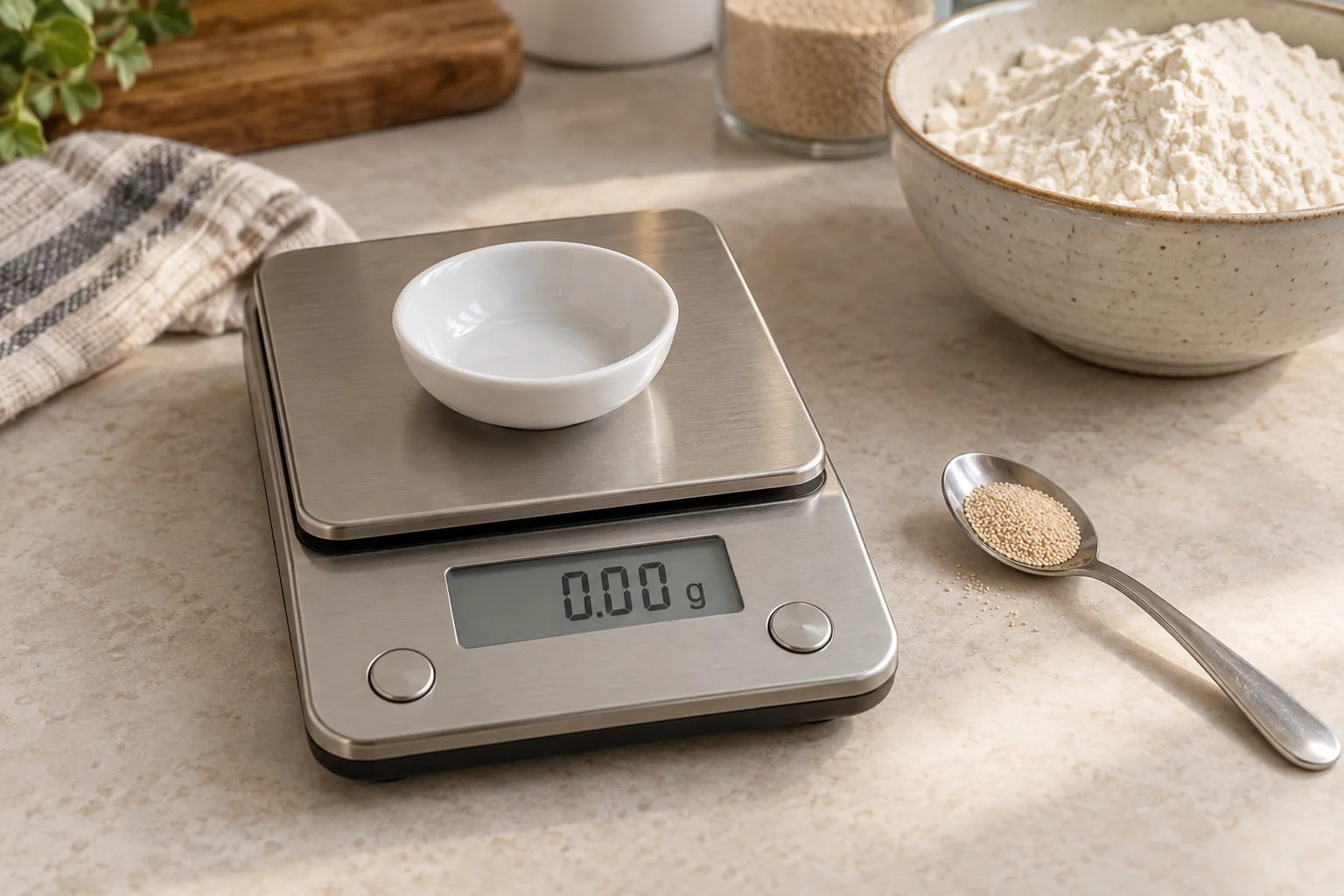
What a 0.01-gram specification means
Readability describes the smallest displayed weight increment. At 0.01 grams, a display can distinguish between 0.30 and 0.31 grams, for example. This does not automatically mean that every displayed value is correct to within 0.01 grams. A finely resolved display and a small measurement error are different properties.
Manufacturers therefore provide other specifications, such as repeatability and linearity. Repeatability describes how closely repeated measurements under the same conditions agree. Linearity concerns deviations across the weighing range. You do not need a laboratory handbook to buy a kitchen tool, but a decimal place should not be treated as a complete demonstration of accuracy.
Let the smallest recipe quantity guide the choice
If a recipe requires 0.3 grams of yeast, a scale displaying whole-gram increments cannot resolve that amount adequately. Rounding up to one gram would give more than three times the yeast and change the dough’s behaviour. For such quantities, choose an instrument with a suitable low weighing range and sufficiently fine readability. Also consider the manufacturer’s information on the smallest useful measurable amount.
A universal rule that any scale with two decimal places will do is not dependable. Compare the specifications for the quantities you actually need. Your existing kitchen scale may remain useful for flour and water, while the finer scale handles small ingredients. A sensitive small platform then does not also have to support a large dough bowl.
Use a stable surface and tare carefully
Place the scale on a firm, level surface away from draughts, vibration and hot steam. Select grams and follow its startup or readiness instructions. Put a small clean vessel centrally on the platform, tare it and wait for a stable zero reading. The vessel and ingredient together must remain within the maximum load even when the vessel’s weight has been removed from the displayed result.
Add the ingredient carefully and wait for the reading to settle. Do not hold the vessel or rest a spoon on the platform while weighing. If the display responds unclearly to tiny additions or keeps jumping, do not continue by guessing. Check the positioning, batteries and instructions, and use a more suitable instrument if necessary.
A displayed number does not replace a suitable method
If you are unsure, weigh the same vessel again under the same conditions. Widely different results reveal a problem; consistent readings alone do not prove absolute accuracy. Any adjustment specified by the manufacturer needs the appropriate reference weight and procedure. A coin or an estimated spoonful of flour is not a reliable substitute.
Transfer the weighed ingredient into the dough as completely as possible. With very small quantities, residue left in the vessel matters proportionally more. If your recipe requires less than the scale can usefully measure, follow an explicitly described dosing method or a complete recipe scaled appropriately. Do not silently round to the next convenient displayed number.