What changes when everything shares a pan
With ordinary pasta cooking, excess water is drained away. In a one-pot dish, the liquid remains part of the sauce. There must be enough to soften the pasta, and enough must eventually be absorbed, thickened or evaporated to leave a pleasant consistency. Several processes happen together: the pasta absorbs water, releases starch and is moved around; tomatoes contribute more moisture, while water escapes from the open surface. A single ratio of pasta weight to water is therefore not a universal formula for every one-pot dish. A broad frying pan behaves differently from a narrow, tall saucepan with a tightly fitted lid.
The method saves a separate pasta pan and a draining step, but it needs attention during cooking. Stay nearby, stir and assess the liquid alongside the bite. If you want to leave the hob unattended for several minutes, separately prepared sauce with conventionally cooked pasta will often suit the schedule better. For a first attempt, choose a manageable dish with one pasta shape and only a few ingredients. This makes it easier to see whether water is actually missing or the sauce simply needs a little longer to thicken. The version below uses dried durum-wheat penne and cooks uncovered.
Ingredients and equipment for two portions
For two main-course portions, use 200 g dried penne rigate with a stated cooking time of roughly ten to twelve minutes, 250 g washed cherry tomatoes, 40 g peeled onion, 3 g peeled garlic, 10 g tomato purée, 1 tbsp olive oil and an initial 400 ml hot water. You also need four washed and patted-dry basil leaves, pepper and an initial 2 g salt. Keep another 150 ml hot water ready as a reserve. Use that reserve only as needed; it is not automatically part of the starting liquid. This dish contains no cheese, and any additional salty ingredients would affect the final seasoning.
Use a broad saucepan or deep frying pan roughly 22 to 24 cm in diameter, with sufficiently high sides, a capacity of about three litres and a base suited to the hob. The pasta should have room to move. A broad wooden spoon or suitable silicone spatula helps you reach the bottom while stirring. Halve the tomatoes, finely chop the onion and mince the garlic. Measure the starting water and reserve separately before beginning. Allow about 30 minutes for preparation and cooking; the actual cooking time also depends on the penne you choose and the performance of your hob.
Prepare the flavour base
Heat the olive oil over medium heat and add the onion. Cook for about five minutes, stirring occasionally, until softer and translucent. Avoid dark browning. Add the garlic and stir for approximately 30 seconds. Then add the tomato purée and work it through the moist onion mixture for about another half-minute without letting it burn. If the base becomes too hot, briefly remove the pan from the hob and reduce the heat. Dark, burnt patches do not provide desirable extra seasoning; they can make the entire base taste bitter.
Add the halved tomatoes, dried penne, 400 ml hot water and initial 2 g salt. Stir thoroughly to distribute the tomato purée and separate any groups of dry pasta resting on the bottom. Bring everything to the boil, then reduce the heat to a steady, clearly visible simmer. Leave the pan uncovered for this version. The pasta needs repeated contact with the liquid, although the shape means some edges may project slightly above it. Do not press the noodles into a compact mass; distribute them with the spoon. Start using the cooking time as a guide once the mixture returns to the boil.
Watch the liquid and the pan base while cooking
Stir gently about once a minute, paying particular attention to the bottom and edges. Lift penne from underneath towards the surface so that all pieces meet the liquid evenly. Meanwhile, the tomatoes soften and release their juice. Keep the mixture simmering without excessive splashing or sticking. A distinct frying sound accompanied by a very thick mixture suggests insufficient liquid or excessive heat. Respond then, rather than waiting for the timer to finish. Moving the pasta carefully also makes it easier to notice a dry patch before it develops into a burnt layer on the bottom.
If the pasta is still firm and there is very little freely moving liquid, add 30 to 50 ml of the hot reserve water. Stir, continue simmering and reassess before adding more. Not every batch needs the full 150 ml. Begin checking doneness after about eight minutes, using a piece removed from the pan and cooled briefly; the packet time remains a guide. Cooking in the tomato mixture may take a different amount of time. Check the thicker pasta wall and continue until the hard centre has gone and the desired bite is reached. Keep the mixture sufficiently moist throughout that process.
Recognise the moment to serve
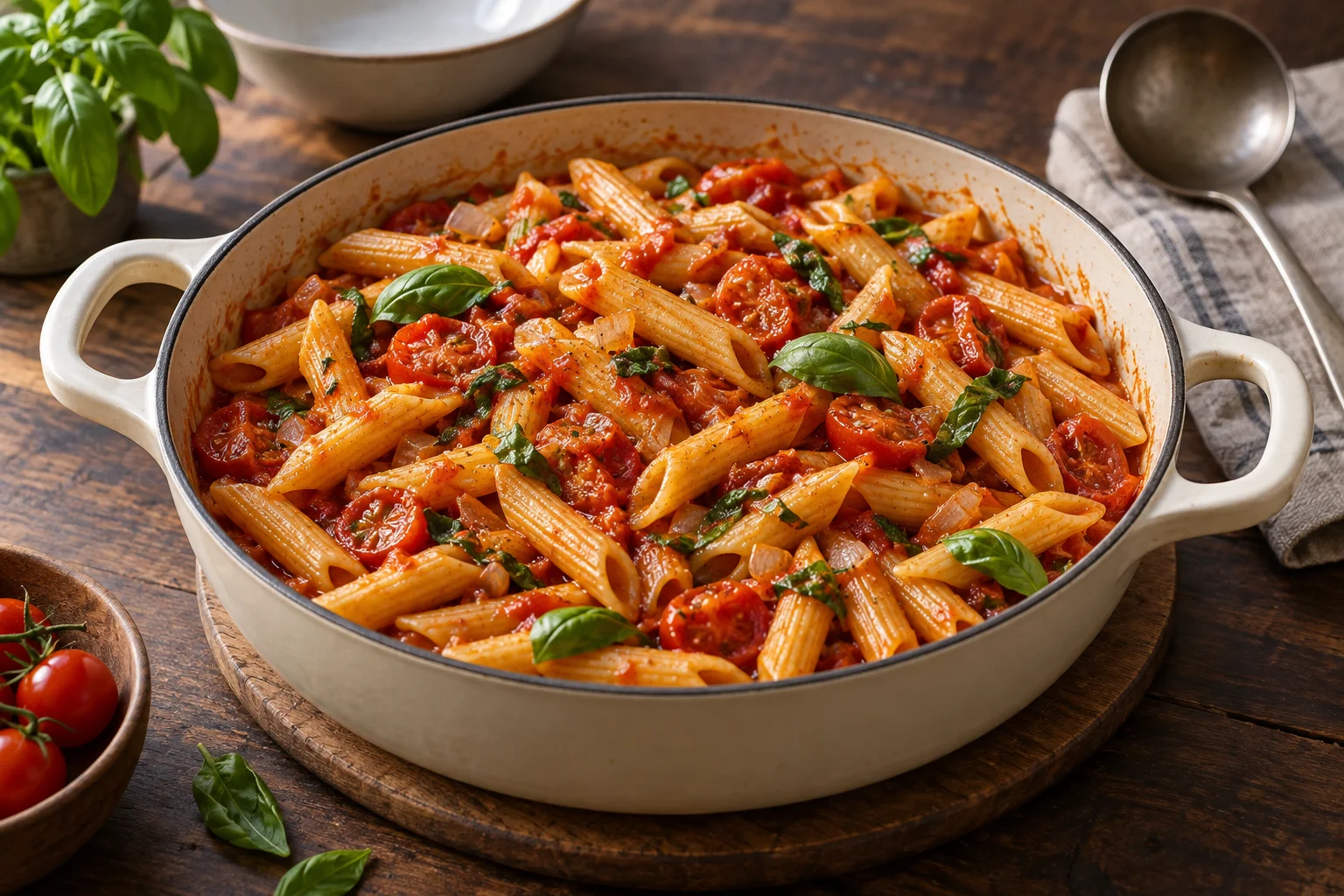
At the end, sauce should coat the penne and still flow smoothly between the pieces. It does not need to disappear completely. When you draw the spoon through the pan, a trail may remain briefly before sauce flows back into it. Remove the dish from the heat once the pasta is right. Tear in the basil leaves, season with pepper and only now decide whether more salt is needed. Combine once more and divide straight away between two plates. Leaving it for a long time in the hot pan allows the pasta to continue cooking and the sauce to become thicker.
If the sauce is slightly too thin as the pasta approaches doneness, a short period of further uncovered simmering and gentle stirring may be enough, provided the bite still allows it. If the pasta is already very soft, prolonged reduction is a poor correction. You can lift the pasta briefly into a clean bowl with a slotted spoon, reduce the remaining sauce separately in the same pan, then combine them again. This extra step is mainly a rescue for a substantial excess of liquid. For the next attempt, note how much reserve water was actually required and whether you used the same pan.
Why tomatoes, stock and lids are not interchangeable
Fresh tomatoes, chopped tinned tomatoes, passata and concentrated tomato purée contribute different amounts of available liquid and solids. You therefore cannot replace 250 g cherry tomatoes with 250 g tomato purée. Nor is a thick ready-made sauce equivalent to the starting water. If you want a different tomato base, a one-pot recipe designed around it is the better starting point. When making small later adjustments, measured additions help more than changing several wet ingredients by eye at the same time. That way, you can still identify why the sauce suddenly becomes thicker or thinner.
If you use stock instead of water, reduce the extra salt according to its seasoning. Nothing is drained from this dish; salt from stock, olives or cheese remains in the meal. A lid changes evaporation instead. Covering this uncovered version throughout cooking can leave more liquid at the end. Conversely, a recipe developed for covered cooking dries out faster if left open. Follow the intended pan arrangement rather than changing it without allowing for the effect. If you briefly cover the pan or increase reduction to make a correction, watch both the liquid and doneness instead of assuming the same remaining time will still apply.
Choose other pasta deliberately
Penne, fusilli and small shells are convenient for many one-pot dishes because they distribute easily. Their cooking times are still different. Very thick-walled rigatoni may need longer and therefore additional liquid, while a small, thin shape could already be soft. Avoid casually mixing several leftover packets. Fresh pasta is not an unchanged substitute for 200 g dried pasta either: its moisture content and short cooking time alter the whole process. Choose a recipe explicitly intended for fresh pasta in that case, rather than trying to absorb the original water quantity before the noodles fall apart.
Check the specific instructions for wholemeal or gluten-free products too. Gluten-free formulations based on rice, maize or pulses can release different amounts of starch and vary in how well they tolerate stirring when cooked directly in sauce. Explicit one-pot guidance or a suitable manufacturer's recipe is more useful than an unexamined ratio. If the entire meal needs to be gluten-free, stock, seasonings, equipment and every additional ingredient must also meet that requirement. For your first version of this tomato dish, the simplest route is to use the specified dried durum-wheat pasta and adjust the water gently during cooking.
Add vegetables according to their cooking needs
Extra vegetables change moisture levels and the space in the pan as well as flavour. Firm carrot cubes need different preparation from spinach leaves. If you want to add carrots, cut them small and cook them sufficiently before the pasta goes in. Otherwise, the noodles may be ready while the vegetables still have hard centres. Mushrooms initially release water and develop a different flavour when fried uncovered than when simply simmered. Decide which texture you want first, then arrange the sequence around it instead of putting everything into the pan at the same moment.
Small quantities of fresh spinach can often be added late, with enough time left to cook; washing and thorough draining are part of the preparation. Frozen vegetables must be fully cooked according to their packet, rather than merely thawed and folded through. Already cooked beans can make a suitable addition, whereas raw dried beans cannot. One-pot pasta containing raw meat or fish needs its own coordinated method and safe, thorough heating. This tomato version is not a cooking-time chart for those ingredients. Starting with a few plant-based ingredients keeps the process simpler and makes doneness easier to judge.
Plan four portions and larger batches
For four portions, begin by doubling the ingredients: 400 g dried penne, 500 g tomatoes, 80 g onion, 6 g garlic, 20 g tomato purée, 2 tbsp oil, 800 ml starting water, eight basil leaves and an initial 4 g salt. Keep up to 300 ml hot water separately in reserve. This calculation doubles the recipe quantities without automatically doubling actual water consumption. A larger pan has a different surface area, and a fuller pan takes longer to return to the boil. Assess the bigger batch by its available liquid and bite as well.
Cooking time is neither simply doubled nor guaranteed to remain identical regardless of the pan. Make sure there is room to stir and that the hob ring heats the base appropriately. For more people, two manageable batches may be more practical than one very full saucepan. Serving both at the same time does, however, require two cooking positions you can supervise and a clear sequence. For a large group eating at different times, separately prepared sauce and freshly cooked portions of pasta are often easier. One-pot pasta has its best consistency immediately after it is finished.
Store leftovers and make the next batch easier
Divide leftovers promptly among shallow containers so that they cool quickly, then keep them covered in the refrigerator. The temperature should be no more than 7°C, preferably below 5°C; follow any stricter ingredient requirements. Suitable cooled portions can also be frozen for later meals and subsequently thawed in the refrigerator. When reheating, every part must reach at least 70°C for two minutes. A small splash of water can loosen the thickened sauce, but the pasta will usually be softer than when freshly served. Warming it only to lukewarm is not a solution to that texture problem.
Only a few notes are needed for a repeatable method: the pasta used, the pan, the starting water and the reserve actually added. They provide useful guidance for your next batch. There is no need to record every minute or find a perfect number for every pasta shape. If the finished dish was too dry, start adding small amounts of liquid earlier next time. If it was too watery, check the pan, the lid and whether you unnecessarily added the entire reserve. These targeted changes help more than simply switching to very high heat or cooking for longer every time.