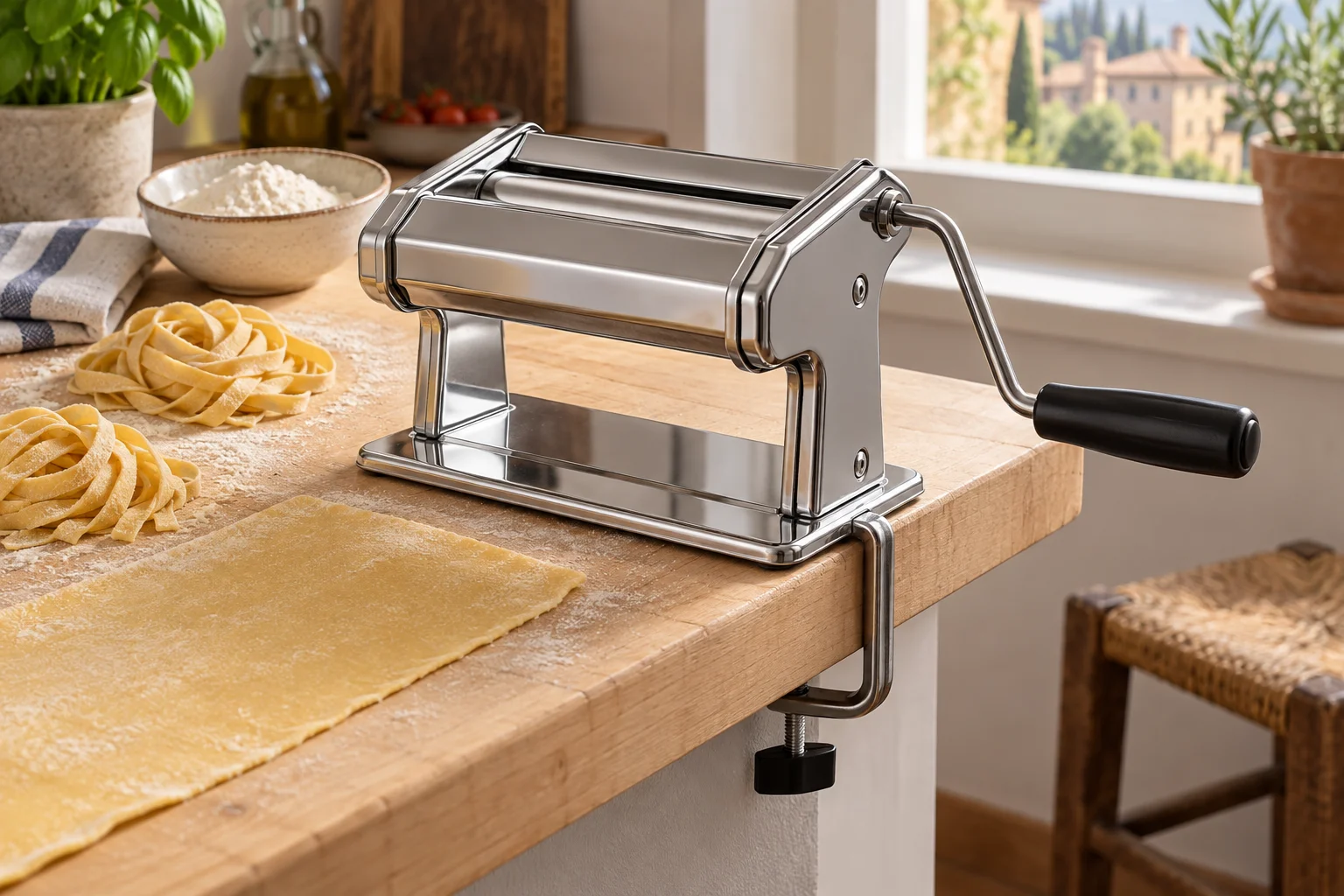
Choose according to the pasta you want to make regularly
Begin with two or three dishes you expect to prepare often. For tagliatelle, lasagne or ravioli you fill yourself, a roller is an obvious candidate. It gradually rolls prepared dough into a sheet. A suitable cutting attachment then divides that sheet into ribbons. For ravioli, you can also fill and seal the sheets by hand on the worktop. The roller handles a particular stage rather than the entire preparation. Making dough, resting it, dividing it, filling where required and finally cooking remain part of the sequence. This distinction makes claims about time savings easier to interpret in relation to the dishes you actually want.
An extruder presses an appropriately prepared mixture through a shaping disc or die. Depending on the available die, it produces different cross-sections, such as tubes or particular long noodles. Not every extruder mixes ingredients, and not every electric pasta machine is an extruder: some simply have motor-driven rollers. Read the description of the actual functions. If your priority is filled pasta in shapes you choose yourself, an adjustable roller may be sufficient. If you regularly want extruded shapes, investigate a machine designed for them. A long list of pasta names is useful only when the corresponding attachments are available and compatible with the model being offered.
A hand crank can suit modest batches
With a manual roller, you turn the crank yourself while guiding the dough with the other hand. You directly control when movement starts and stops. This can work well for small batches and occasional pasta evenings. The machine needs a stable position and usually an appropriate table fastening. Check whether you can crank comfortably in the intended location without striking a wall, cupboard or other object. Long sheets need space on both sides of the machine too. A compact appliance footprint does not mean the whole task can be completed within that same tiny area, particularly once several sheets are waiting to be cut.
A roller replaces the rolling pin for producing an even sheet, but does not remove the need to prepare suitable dough. It must hold together and suit the rolling method. After resting, divide it into manageable pieces and keep the unused portions appropriately covered. A cutting attachment can divide the sheets later, although wide ribbons can also be cut by hand. If those are the steps you enjoy, a simple manual model may provide the equipment you need. For occasional small amounts, your existing rolling pin remains an option too. The useful question is which particular task you want to make more consistent or comfortable.
Understand motorised rollers and stand-mixer attachments
A motor supplies the turning movement, leaving both hands free to guide the sheet. It does not automatically change the available pasta shapes or required dough consistency. Motorised rolling still begins with suitable prepared dough and the prescribed thickness stages. An attachment for a stand mixer you already own may perform the same job. Check exact compatibility with the base appliance, the required speed and the space around the outlet. A similar-looking connector is not sufficient proof of compatibility. Some attachments must be operated manually even when other accessories in the same range allow motor operation. Assess the complete combination rather than the motor in isolation.
Pay particular attention to model generation and production date when buying used equipment or adding a motor later. Manufacturers can change fittings and adapters. Marcato's Pastadrive guidance, for example, distinguishes particular generations and excludes some cutting or filling attachments from motor use. Confirm the actual combination using current model numbers rather than relying on a broad statement about the brand. Also look for permitted operating duration and required breaks. These can determine the schedule for a larger batch. A motor makes the movement easier, but does not automatically make the machine suitable for uninterrupted continuous operation or arbitrarily large pieces of dough.
Match an extruder with its intended recipe
An automatically mixing extruder does not necessarily measure all the ingredients itself. Depending on the model, you weigh flour and liquid beforehand or the machine supports only part of the measurement. Establish this before treating an integrated scale as complete automatic control of the recipe. For many such appliances, the mixture before extrusion is crumbly and looks different from a smooth dough ball intended for a roller. Philips explicitly describes that crumbly consistency and an appropriate flour-to-liquid ratio in its troubleshooting guidance. A successful roller-dough recipe therefore cannot simply be transferred to every pasta maker without adjustment. The working method needs to match the machine.
Check the supplied recipes for flour type, egg, water and the intended shape. Wholemeal flour, gluten-free blends or pulse flours may require separate settings or formulas. The ability to extrude ordinary wheat dough does not guarantee a good result from every other mixture. Pay attention to minimum and maximum filling amounts too. A machine designed for several portions may be unsuitable for a very small meal if its minimum batch exceeds your needs. Some dough may remain inside the mixing chamber at the end. An advertised flour input is therefore not automatically the finished pasta output. Judge the sequence against the meal you need and the actual recipe booklet.
Assess roller width and thickness settings in practice
Usable roller width determines the maximum width of a single sheet. A wider sheet can be helpful for lasagne or several rows of ravioli, but requires more space for guiding and laying it down. A narrower sheet is often easier to handle and may suit plenty of dishes. Lasagne sheets do not necessarily have to cover an entire dish in one piece; appropriately sized sections can work, depending on the recipe. Consider the whole work area as well as the baking dish. A wide roller provides little benefit if its output would immediately have to overlap on your available counter space.
Compare thickness settings within the particular model. The number on a knob is not a universal millimetre measurement across brands. What matters is the stated range and the recommendation for your intended pasta. Thinner is not always better: a filled sheet must support its filling and seal properly. Check whether the control is accessible and the stages are explained clearly. In use, a wider setting is followed progressively by narrower ones as the instructions specify. A large number of settings is of limited value if the useful range for your dishes is missing or the control is awkward to reach during the work.
Compare attachments using the actual contents of the package
Distinguish smooth rollers from cutting rollers and extrusion dies. A sheet roller produces sheets, but does not automatically cut tagliatelle. Some machines have a fixed cutting section; others accept interchangeable attachments. Check the precise contents list for the set on offer. An accessory photograph may show an item sold separately. Sets with similar names can also differ by country or model generation. When considering an extension, confirm the appropriate width and exact connection. Being able to remove a cutter does not mean every other shape from the same brand can be fitted. Start with the shapes you expect to use regularly rather than every possible accessory.
A ravioli attachment fills and joins sheets using its own method; it is not a universal tool for any filling. Consistency, sheet format and operation must all suit it. If you prefer varied fillings and sizes, a roller with simple hand tools can offer more flexibility. A drying rack is another possible accessory rather than an automatic requirement. Fresh pasta that will be cooked shortly mainly needs space to avoid sticking together. This does not establish safe drying for pantry storage. Before adding equipment, consider whether a clean suitable tray or your existing worktop can provide the necessary space. Accessories should make a specific stage easier.
Check fastening, clear working space and safe operation
For a table clamp, confirm that the worktop thickness falls within the permitted clamping range. There must be room underneath for the lower section and screw. A deep apron, drawer edge or strongly rounded front may prevent secure fastening. Delicate surfaces need protection compatible with the clamp that does not weaken its grip. Check positioning with the appliance cold and switched off. A heavy machine does not automatically remain secure against the sideways force from cranking. A motorised version must follow its own standing and fastening rules; instructions for the hand-cranked version do not necessarily transfer unchanged to every motor configuration.
Plan the path of the dough sheet and keep the stop control accessible. Hands, clothing, jewellery and long hair must stay away from moving rollers, cutters and feed openings. Do not push dough into the appliance with unsuitable tools. Before changing attachments, cleaning or removing a blockage, switch an electric drive off and disconnect it from the power source. A motor that has merely stopped is not sufficient for these tasks. With a hand machine, keep the crank still and follow the instructions. Children should not operate the moving feed area. These requirements help keep the workspace manageable even when the dough sheets become long.
Include cleaning and the time until the meal is ready
Read the cleaning instructions before purchasing. Many mechanical rollers are cleaned with a dry brush or cloth and must not be immersed or placed in a dishwasher. Individual removable components may have different instructions. With an extruder, mixing containers, augers and shaping discs can often be cleaned separately while the drive unit remains dry. This does not give every part the same dishwasher permission. Philips, for example, identifies exceptions for particular front components, while KitchenAid and Marcato describe their own roller-care methods. Use the instructions for the actual model version. Accessible, separately replaceable components may be more valuable in everyday use than an extra rarely used pasta shape.
Compare the time until the meal is ready, not merely the minutes until the first strand emerges. The sequence includes weighing, dough preparation, resting where the method requires it, shaping, boiling water, sauce and cleaning. Multiple batches add attachment care and prescribed operating breaks. An extruder may produce an initial portion quickly while the overall process for many guests takes considerably longer. A roller may suit a small prepared dough batch even when filling ravioli by hand afterwards needs time. Look for a sequence that combines the sauce and pasta sensibly. A manufacturer's timing is meaningful only for its stated conditions and the particular stage being measured.
Compare price and equipment for the same task
Compare offers that can actually complete your intended task. An illustrative calculation shows why: 80 euros for a base machine, 120 euros for a later motor and 40 euros for a required attachment total 240 euros. These are hypothetical figures, not current market prices. An imagined complete offer at 180 euros would be a cheaper comparable option only if it supplied the same required functions and appropriate compatibility. Equally, the later motor is not a necessary cost when you intend to use the crank. Add up your actual requirements rather than every extension that could theoretically be fitted at some point in the future.
For used equipment, look for the complete clamp and crank, clean undamaged rollers, suitable attachments and available instructions. Damaged electrical parts or uncertain motor compatibility do not become minor issues because the price is low. Three questions help finish the selection: which pasta do you want to make, how many portions belong in each sequence, and which setup and cleaning method fit your kitchen? A simple roller may be enough for sheets and ribbons. For regular extrusion, investigate appropriate recipes, dies and batch sizes. The suitable machine is the one whose actual working method you can use for the dishes you intend to prepare.