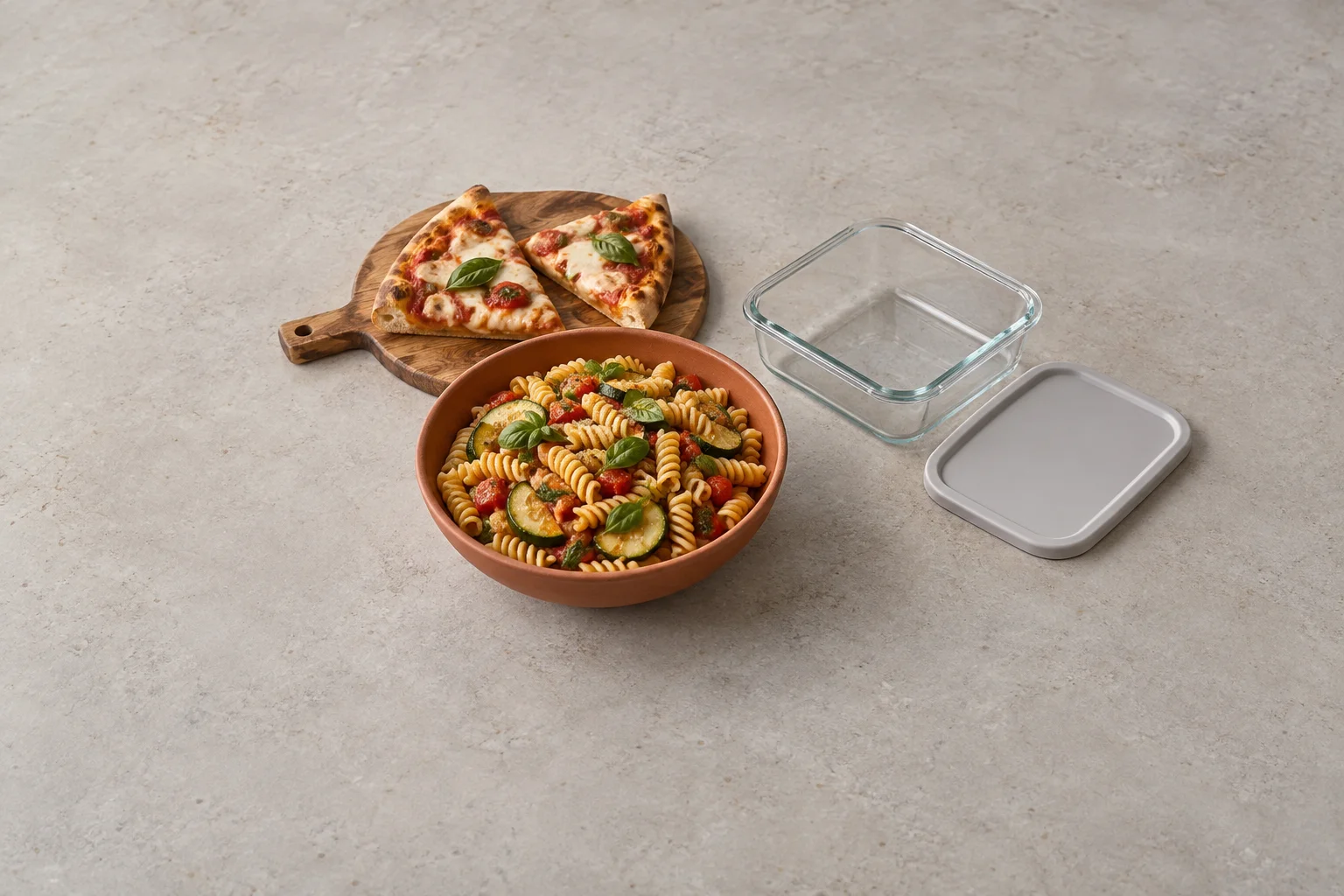
Check usable ingredients before shopping
Begin with a brief look in the cupboard, refrigerator and freezer. What is available, which pack is already open and which ingredient fits the meals you intend to make next? A small amount of tomato sauce could be allocated to pizza, for example, while vegetables might suit pasta. Plan around the actual products and their storage history. Remembering an opened pack is not enough if you no longer know when it was opened. Check its instructions and decide what can reasonably be used before shopping. You can then buy the missing ingredients instead of purchasing a complete new supply for every dish and discovering the older products afterwards.
Place suitable older supplies where you will see them first and put newly bought products behind them where their storage requirements allow. Germany's BZfE recommends this approach for manageable household stocks. Retain the product name, date and necessary storage information when transferring food into another container. Two similar boxes are of little help if their contents or dates later become unclear. An elaborate system is unnecessary. A readable short label and an agreed place for ingredients planned for near-term use may be enough. The plan must fit real life: if you are eating out tomorrow, do not reserve several perishable ingredients for an imaginary meal that nobody will cook.
Calculate dry, raw and cooked food separately
Dried pasta can be weighed to match the dish before cooking. What remains in a dry pack differs from a plate of cooked noodles. In a hypothetical example, you have 450 grams of dried pasta and need 300 grams for the chosen dish. That leaves 150 grams as a dry supply, provided it is stored appropriately. There is no reason to cook the entire pack simply because it has been opened. The required weight depends on the actual recipe and the people eating. The same number cannot be transferred directly to fresh filled pasta or an already cooked portion. Identify which state a recipe or quantity describes before using it in your calculation.
With pizza, distinguish remaining flour, prepared raw dough, toppings and baked slices. These foods have different characteristics and storage needs. Raw dough is not ready to eat even if it contains no egg. Planning a dough supply requires an appropriate fermentation schedule and, where intended, a suitable freezing process. An extra unplanned period of warm fermentation does not automatically extend its usefulness. When carrying ingredients into another meal, identify their state: dried pasta, cooked pasta, raw peppers or cooked vegetables. This gives you a clearer starting point for the next preparation than an unspecified bowl of leftovers. It also prevents raw ingredients from being treated as though their cooking had already been completed.
Reserve suitable portions before serving
If you deliberately cook for another meal, use clean utensils to set aside the intended quantity in appropriate containers before the rest is served. This makes allocation clearer and protects that portion from shared service. It does not replace suitable cooling or clean handling. Prepare only the extra amount you can actually store and use soon or freeze appropriately. A larger batch is of little benefit if the refrigerator is already full and the pot then waits in the room for hours. The planned supply should have a specific next use rather than being produced only because making more initially seems convenient. Include cooling and storage capacity in that decision.
Keep components separate where this helps their later use. A suitable tomato sauce can be used differently from pasta already completely mixed with it. Herbs or a fresh finishing addition can also be added at the next serving if they have been stored appropriately. A mixed dish, by contrast, must be considered as a whole, including its more perishable ingredients. Do not simply add newly prepared food to a container holding an older remainder. Plate leftovers do not belong to the cleanly reserved supply either. Making these distinctions simplifies planning: you know which quantities were intended for another dish and which must not return to the shared stock.
Make cooling part of the cooking process
Plan cooling space before cooking. For suitable cooked food in private households, Germany's BfR recommends prompt cooling and dividing larger quantities among several shallow containers. Bring the food below 7 °C within a few hours. The refrigerator should be no warmer than 7 °C, preferably below 5 °C. Do not wait for complete cooling on the worktop before arranging refrigeration. One deep pot and several small shallow portions do not cool at the same rate. Account for your refrigerator's capacity so that the added food does not impair its cooling function or prevent other food from remaining appropriately chilled. Storage is part of preparing the second meal, not a task to consider only when the kitchen is finally cleared.
These steps assume that the food's earlier handling still makes it suitable for later use. A freshly labelled box cannot make a dish with an unknown or unsuitable storage history safe again. Careful storage matters particularly for cooked starchy foods such as pasta. The BfR explains that certain Bacillus cereus bacteria can produce the heat-stable toxin cereulide as they multiply. Later reheating does not reliably remove that problem. The practical response is to prevent long uncontrolled standing times in the first place. An ordinary smell does not prove a safe history, and a small taste is not an appropriate way to establish that history either. Choose later uses only for food whose handling supports them.
Understand dates and the condition of the product
Best-before and use-by dates have different meanings. A best-before date describes the qualities assured until that date for an unopened product stored correctly. Passing it does not automatically mean the food must be discarded. Once a pack is opened, actual handling and instructions for the opened product also matter. The printed date does not simply become a shelf-life promise for a pasta sauce cooked from its contents. A use-by date is different: the food concerned should not be eaten after that date. It can present a problem without showing signs you can reliably detect. Keep this distinction when deciding which ingredients to include in the next meal.
Always consider the specific product and its history. Damaged packaging, mould, unusual changes or uncertain storage are not reasons to create a new flavour by adding seasoning. Equally, you do not need to discard a suitable dry supply merely because its pack is incomplete. Check appropriate dry ingredients for moisture and pests and follow the storage instructions. Do not apply one fixed number of days to every pasta dish. Freshly cooked plain pasta, a fresh filled product and a dish combining several refrigerated ingredients have different starting points. Mixing them later does not reset the age or earlier storage of their components, and placing them in a new container does not change that history.
Plan a suitable second dish from cooked pasta
Cooked pasta needs different treatment from dried pasta when used again. Treat it as an existing component and add a suitable sauce or appropriately cooked vegetables. If the pasta is already soft, another long cooking period is unlikely to produce the texture you want. A pan with an appropriate amount of suitable liquid can support even reheating; the amount depends on the pasta and sauce. A bake is another option if its recipe, dish and cooking process fit the actual quantity. It is not an automatic answer for every pasta dish and cannot make unsuitable leftovers usable again. Choose the preparation around what the food actually needs.
For suitable leftovers, the BfR recommends reheating to at least 70 °C for two minutes throughout the food. A hot surface or steaming edge does not establish the temperature in the middle. Distribute the quantity appropriately, stir where the preparation permits and check adequate heating. Microwave instructions and possible uneven heating also belong in the plan. A cold pasta salad, meanwhile, requires appropriately handled and cooled components from the outset. Hot pasta should not simply be mixed into sensitive raw ingredients and then left standing for a long period. Choose the next use according to the food available rather than forcing an arbitrary remainder into any appealing recipe regardless of its history or condition.
Use pizza and toppings according to their needs
Suitable baked pizza slices can contribute to a later meal. Choose a reheating method according to the number of slices and your available equipment. A pan, oven or suitable air fryer can each provide a different process. The slices need space, and heating must suit their thickness and toppings. A crisp bottom alone does not demonstrate that the whole portion has become sufficiently hot. The BfR recommendation for thorough reheating applies here too. Also follow the suitability requirements of containers, liners and appliances. A single number of minutes cannot fit every pizza and every starting condition. Arrange the method around the actual food rather than relying only on how its crust looks.
Unused suitable toppings are often more flexible than an already baked pizza. Appropriately stored peppers, mushrooms or tomato sauce may form part of a subsequent pasta dish. Store and use opened cheese according to its actual instructions, not merely because another recipe has space for it. If a sauce is planned for two purposes, divide it cleanly into the intended amounts. In a hypothetical calculation, 120 grams from 400 grams of suitable sauce are reserved for the planned pizza. That leaves 280 grams for another explicitly suitable use. This is not a recipe recommendation. It illustrates allocating the same supply once instead of counting the entire quantity separately for two meals.
Decide about freezing early and in useful portions
If suitable food will not be used as intended, decide in good time whether freezing makes sense for that food and your later preparation. A freezer cannot rescue leftovers that have already been stored unsuitably. Freeze only appropriate food in suitable, clearly labelled containers and quantities you will actually need. Divide a large amount so that a small meal does not require thawing the entire supply. Keep the contents and freezing date identifiable. Consider the expected texture after thawing too. Pasta that is already very soft or a fresh leafy salad does not automatically fulfil the same role afterwards. Freezing should support a practical next meal rather than postpone every decision indefinitely.
Plan the next step at the same time. Thawing and subsequent use depend on the particular food and intended preparation. Where thawing is needed, a refrigerator provides a more controlled process for suitable refrigerated foods than leaving them on the worktop for a long period. Products intended by their instructions to be cooked directly from frozen follow their own specified method. Raw frozen fresh pasta differs from an already cooked noodle portion. Keep these states clear on the label and check the thorough heating required for the particular dish. Freezing does not reverse the earlier history and is not a reason to move uncertain quantities repeatedly between warm, chilled and frozen conditions.
Keep a simple plan for the next meal
Briefly note the intended use of suitable reserved ingredients. A planned tomato and vegetable pasta is easier to make than several unnamed boxes that should be used up sometime. Add only what is genuinely missing from this plan to the shopping list. Existing dry pasta, suitable sauce and a freshly added herb may be enough. If fewer people will eat the next meal, adjust the quantity before cooking another complete pack. The benefit is making a specific meal easier. A small remainder does not need to grow into another large supply through numerous additional ingredients bought solely to use it. Keep the proposed dish proportionate to both the food and the people available.
Over a few cooking evenings, notice what regularly remains. Too much dried pasta put into the pot calls for a different adjustment from an unpopular pizza topping or an oversized sauce pack. Weigh out the next quantity accordingly, choose a suitable pack or plan the second use when shopping. A small suitable remainder is not a failure, and nobody needs to eat beyond their appetite. The useful aim is a kitchen where quantities and next steps remain understandable. Knowing what you have, how it was handled and when it will be used makes pizza and pasta easier to plan on another day as well. The system can stay as simple as the meals it helps you prepare.