Start with your pizza and the oven you have
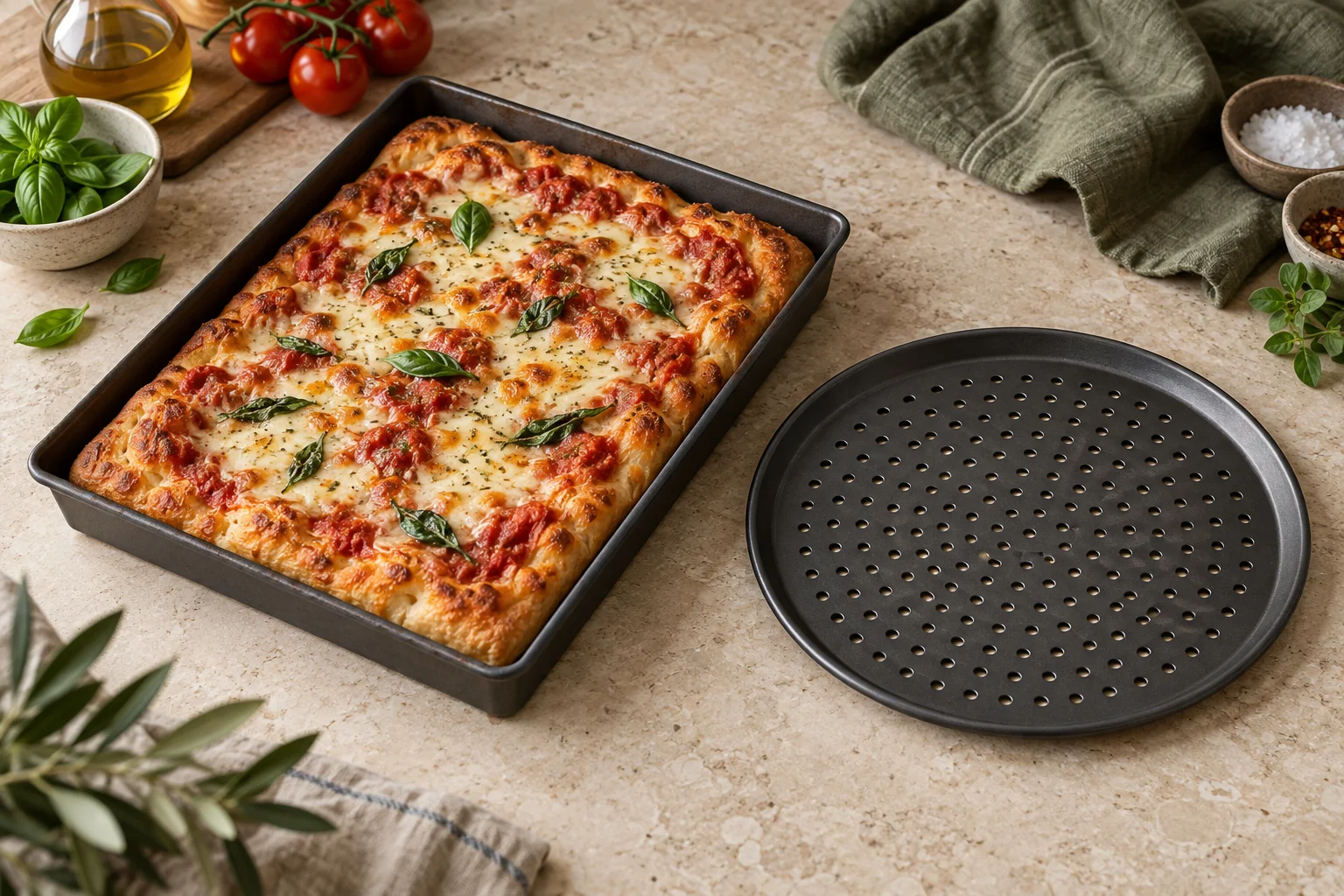
A thin round pizza needs a different support from a thick rectangular pizza with a crisp cheese edge. First decide which you expect to bake regularly. A shallow pan makes it easier to remove a thin pizza. A deeper solid pan supports softer dough while it rises and bakes. If you normally cut rectangular slices for several people, a suitably sized rectangular pan makes good use of the available space. Your most frequent use is a more helpful starting point than a set containing as many different diameters as possible, especially when only one of those sizes is likely to leave the cupboard.
Next, consider the oven. A domestic oven with a rack, a small electric pizza oven and a wood-fired appliance have different requirements. Check the oven instructions for permitted additional pans and how to use them. A pan can withstand high temperatures yet still be unsuitable for a particular oven, perhaps because it obstructs required air paths. If the baking tray you already own suits the pizza and the recipe temperature, it is a reasonable place to begin. An additional specialist pan is most useful when it provides something specific: the intended dough thickness, a particular edge or a portion size you can handle more easily.
Outside dimensions determine fit; inside dimensions determine dough quantity
Two different measurements matter when shopping. Outside dimensions, including rims and handles, determine whether the pan passes through the opening and leaves sufficient space inside. The usable internal base determines how much dough it holds at a particular thickness. Sides that slope outwards make this distinction particularly noticeable. A pan advertised as 30 centimetres wide may be appreciably narrower at its base. Look for a drawing with internal measurements, or ask for them before adapting a recipe. Height matters too: the finished dough and toppings need space above the rim, as well as enough clearance from the oven's upper elements or other parts.
Measure the intended position on the correct rack level while the oven is completely cold. Allow the clearances required by its manufacturer and space for removing the pan with oven gloves. A pan that only just fits can be awkward to grip when loaded. If buying several pans, also check whether the oven supports simultaneous baking on those levels. Two pans that fit do not automatically produce two evenly baked pizzas per round. In a smaller household, a well-fitting medium pan can be more useful than the largest possible tray, especially if the latter is difficult to wash in the sink or store in a cupboard.
Solid base, perforated pan or pizza screen
A solid pan keeps dough, oil and released moisture within its walls. It therefore suits pizza whose dough rises directly in the pan, as well as a deeper base with a substantial edge. Moisture still matters. A solid base does not automatically make very wet toppings suitable for baking. Drain mozzarella as the recipe requires and cook vegetables beforehand when the method calls for it. For an oiled pan pizza, the amount of oil, dough and baking method work together. Do not transfer the oiling method for a deep solid pan indiscriminately to a perforated one, where oil could drip straight into the oven.
A perforated pan has a continuous metal surface with holes punched through it. A pizza screen instead uses an open mesh. Both expose parts of the underside and can help moisture escape. However, they need dough that can be supported on that surface. Very soft dough may press into the openings, while sauce and cheese can drip through. Choose a recipe intended for that kind of support. Adding baking parchment changes its behaviour by covering the openings, and the paper has its own heat limits. A perforated pan is also an additional baking surface with particular properties, rather than a direct substitute for baking straight on a stone.
Consider material, colour and finish separately
Aluminium is relatively light and conducts heat well. Steel has different thermal and weight characteristics; thickness and construction also influence how a pan behaves in an oven. The material name alone is therefore not enough for comparison. A very thin sheet and a substantial pan made from the same metal can feel and bake differently. A well-finished continuous rim provides somewhere to grip and can stiffen the shape. Check the manufacturer's information about resistance to warping under the intended use. Greater weight does not by itself prove higher quality, particularly when you will regularly be moving a full pan with both hands.
Colour mainly affects the absorption of radiant heat; it is not the same property as the thermal conductivity of the underlying metal. Dark pans often encourage stronger browning than comparable light pans. That can be welcome for a crisp base, but it makes attention to the underside worthwhile. A dark colour also does not identify the finish reliably: seasoned steel, enamel and treated aluminium need different care. Find out exactly which surface is present. Descriptions such as non-stick or professional do not replace a temperature limit or care instructions. What matters is how the specific pan fits your baking method and how it may be used and cleaned.
Check temperature limits and food contact
The permitted temperature must apply to the complete pan, including its finish, handles and other components. Do not confuse Fahrenheit with Celsius. A hypothetical pan approved up to 250°C would not suit an oven being operated at 450°C. Broiler use, direct flame and empty preheating are separate questions too. A high stated oven limit does not automatically permit those uses. Find the instructions for the particular product and compare them with your oven requirements. If information is missing or contradictory, resolve that point before purchasing; a general marketing statement about pizza accessories does little to establish whether this particular combination is suitable.
Acidic or salty food should not be heated, kept warm or stored in direct contact with uncoated aluminium. Germany's BfR recommends coated aluminium containers for those uses. Applied to pizza-pan selection, the food-contact surface needs to suit the toppings you intend to use. Oil is not a dependable replacement for an appropriate surface. A treated pan still has its manufacturer's use and care restrictions, and dark colour alone does not establish unrestricted resistance to acidic food. Remove finished pizza for serving and storage. This also leaves the pan available for baking, instead of turning it into a longer-term container for leftover food.
Adjust recipe quantities using the base area
For a rectangular base, multiply the internal length by its internal width. Here is an illustrative calculation: 20 by 30 centimetres gives 600 square centimetres, while 30 by 40 gives 1,200. The larger pan has twice the base area. To preserve the same dough thickness, a recipe quantity of 750 grams of dough becomes 1,500 grams. Scale all the dough ingredients by the same factor. Sauce and toppings can initially be adjusted according to area too. This adapts the same recipe to a different pan; it does not set a universal weight for every rectangular pizza or establish how many people it will feed.
For round bases, compare the squares of their diameters. Moving from 28 to 32 centimetres gives 32² divided by 28², or approximately 1.31. You need around 31 percent more dough for the same thickness, rather than the roughly 14 percent increase in diameter. This assumes comparable usable bases. Strongly rounded corners, a different edge or an intentionally thicker pizza affect the practical allocation. Do not multiply baking time by the area factor. A larger surface, different pan colour and extra loading of the oven can change heat distribution. Continue to judge the bake using the recipe guidance, the underside and whether the centre is cooked through.
Choose a complete baking method for the pan
Some recipes let the dough rise in a cold oiled pan; others use a prepared pizza on a separate support. Choose a complete sequence that suits the pan you have selected. Proofing dough in a cold pan cannot casually be combined with preheating that same pan. If a recipe places the pan on a preheated stone or steel, the oven, support and pan must all permit the combination. This is not a universal requirement for perforated pans. Begin with the rack position specified by the suitable method too, instead of automatically moving to the lowest level simply because you have bought a new accessory.
While baking, assess the top and base together. Once the pizza is sufficiently stable, carefully lift it with a tool suitable for the pan surface. If the base becomes dark well before the topping is ready, changing the rack position or adjusting temperature within the permitted range may help. A thick wet topping also calls for a change in quantity or preparation. If everything remains pale and soft, replacing the pan may not address insufficient preheating. Change one cause at a time on the next bake. That makes the result easier to interpret than shifting several settings at once and being unable to tell which change mattered.
Plan for removing, cutting and cleaning
A loaded pan needs to be comfortable to carry safely. Look for a rim you can grip and prepare a sufficiently large heat-resistant resting place. Use dry, suitable oven gloves for removal; a thin tea towel is not an equivalent substitute. For pizza with a browned cheese edge, loosen the edge with an appropriate tool before cooling cheese sticks firmly to the pan. Then remove the pizza as its recipe directs, so it does not spend unnecessary time sitting in its own steam. A perforated pan remains open underneath during cooling only if it rests on a suitable raised support, rather than flat on a solid board.
Prefer a suitable board for cutting. Permission to use metal spatulas does not automatically allow sharp knives or pizza wheels against the finish. Let the pan cool sufficiently before cleaning and avoid moving it abruptly from a hot oven into cold water. Whether detergent, soaking, a dishwasher or subsequent oiling is appropriate depends on the surface. Seasoned steel requires different care from enamel or a factory-applied release finish. Clean holes and rims too, without removing material with unsuitable sharp tools. Store the pan clean and completely dry. If stacking it with other cookware, an appropriate protective layer helps prevent damage to a delicate surface.
Make the buying decision with a few useful details
Finally, compare two or three suitable pans using the same questions. Does the outside shape fit the intended oven? Is the usable base area known? Does the surface suit the recipe and temperature? Can you handle the full pan comfortably? Add whether you need a solid or perforated base and what care you are prepared to provide. This turns a broad discussion of materials into a practical choice. A deep solid pan can make sense for regular pan pizza, while a shallow suitable pan may be enough for thin round pizza. A useful description explains those differences without promising that one product wins in every situation.
Before buying multiples, work out how many pans your actual sequence requires. Three trays do little to help when there is insufficient preparation space, oven capacity or refrigeration. A second identical pan can make preparation for successive rounds easier, provided the dough can wait in it as the recipe allows. When comparing imported products, include shipping and possible additional charges rather than treating a low individual price as an automatic saving. Keep the model details and care instructions. Once the base size suits the recipe and the whole sequence fits your kitchen, you have settled the main questions that make a pizza pan a useful purchase.