Identify what actually needs cleaning
Inspect the fully cooled oven in good light. Loose flour on the stone, a spill of sauce, soot on a glass door and grease on an interior wall are different jobs. Treating everything with the same wet sponge spreads dirt and may introduce moisture where it does not belong. Divide the work mentally into baking surface, fuel area, interior, door and exterior. Not every oven has all these areas. An electric pizza oven has no wood ash tray, for example, but may have a filter that needs separate cleaning. An open gas oven may have no glass door to maintain.
The aim is a usable baking surface free of loose material and troublesome deposits. Dark discolouration alone does not automatically indicate inadequate cleaning. A porous stone changes appearance with use, whereas flaking material or accumulated grease needs a closer look. Check the material information for your particular model: cordierite, other refractory materials, coated sheet metal and stainless steel are not interchangeable. The instructions determine suitable tools and products. Keep them handy for the first clean and find the relevant sections instead of turning another oven's cleaning method into a general rule.
Shut down properly and allow complete cooling
Cleaning starts with the normal shutdown procedure. For a gas oven, turn off the burner and gas supply as instructed; for wood and pellets, end combustion following the prescribed steps. Do not pour water into a hot oven to finish tidying sooner. Stone, metal, glass and remaining embers can stay hot considerably longer than the outside handle area. A switched-off display says nothing about whether the interior is safe to touch. Plan hands-on cleaning after complete cooling, possibly the following day. Neither a date nor a fixed number of hours replaces actual cooling.
Electric models must first complete any required cooling cycle. For the Volt 2, for example, Ooni requires a 30-minute wait after entering standby before turning off the main switch or disconnecting the power. This does not mean the oven is already completely cold afterwards. For subsequent manual cleaning it must be fully cooled and disconnected from the mains. Other appliances have different shutdown sequences; their own instructions apply. Keep children and pets away during cooling and leave the hot oven in its safe position. This is not yet the time to move it or put it into storage.
Prepare a few suitable tools
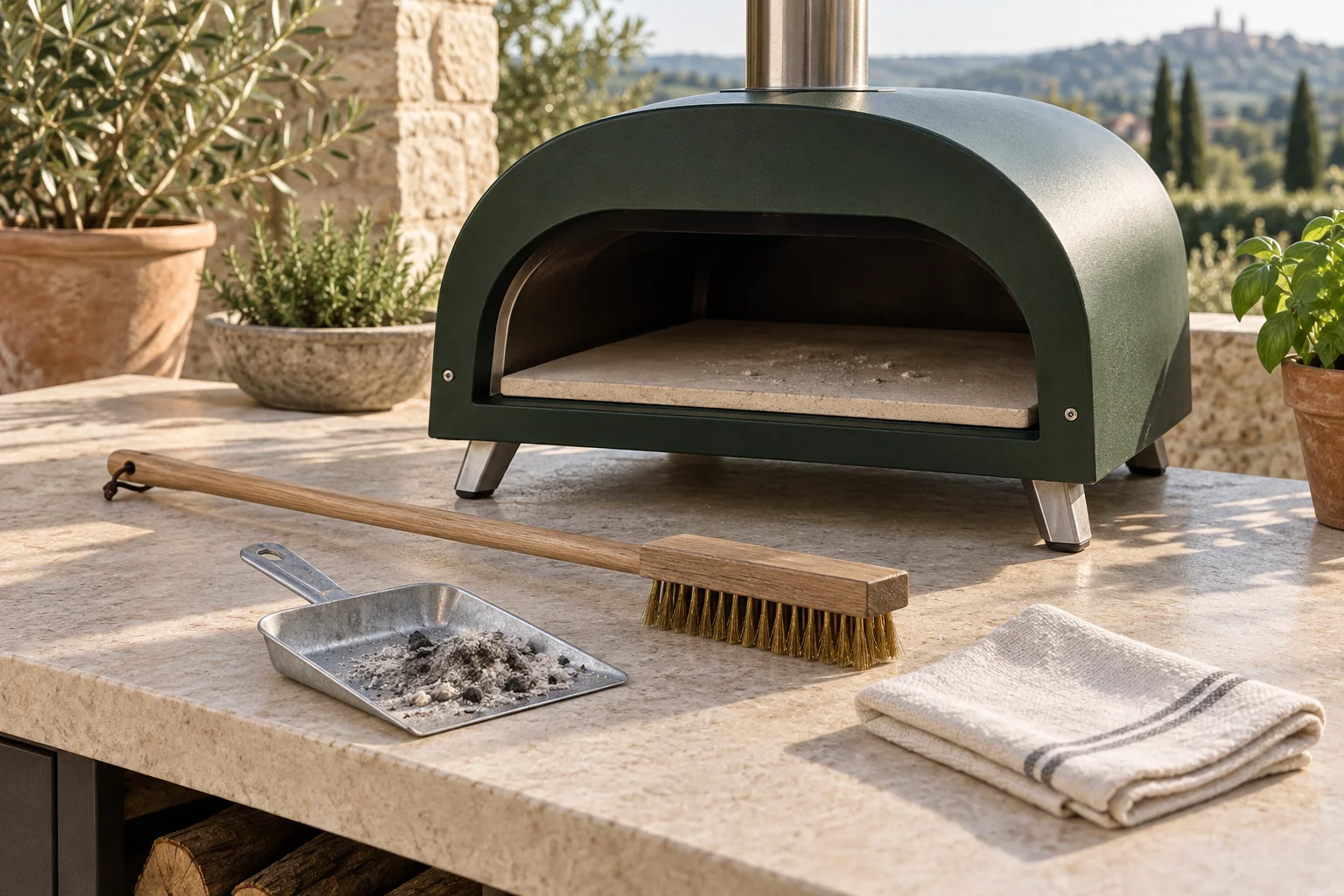
A suitable oven brush, a small collection container and a clean cloth are often enough for dry residue. A long handle helps reach the baking surface without putting your hand deep into the chamber. Before and after use, check the brush for loose bristles and ensure its head is firmly attached. Detached parts do not belong on the next pizza. Whether metal bristles, a scraper or a softer brush are suitable depends on the surface. A robust metal bench scraper for uncoated steel is not automatically the right tool for a delicate stone or coated interior wall.
Set aside a second cloth for the exterior so ash and grease do not spread across the shell. Wear the gloves specified by the manufacturer; even a cold oven can have sharp edges. Keep cleaned parts and dirty tools on separate surfaces. Treat ash appropriately rather than casually vacuuming it with an ordinary household vacuum cleaner. If a manufacturer mentions a handheld vacuum for dry food debris in an electric oven, that does not authorise its use on wood ash or concealed embers. These distinctions make preparation easier because you will not have to switch between unsuitable tools halfway through the job.
Remove loose residue from the pizza stone
Start on the cold stone with dry residue that comes away easily. Brush it towards a collection area in a controlled way, rather than pushing it into gaps, under heating elements or into air openings. Lift a removable stone only as instructed and support its weight securely. A permanently installed baking floor stays in place. Work on stubborn patches with an approved tool and light pressure. Trying to dig out a dark mark with a pointed knife can damage the surface. A smooth discoloured area and a raised crust do not require the same treatment.
Ooni expressly prohibits water, soap and chemical cleaners on the Volt 2 pizza stone. This illustrates why general household suggestions such as soaking or vinegar solution do not suit every baking stone. Other manufacturers describe different care methods for particular refractory floors; do not transfer them between materials. Do not oil a stone as though seasoning a frying pan either. Check for cracks and broken pieces while cleaning. Do not simply continue using a damaged stone: clarify replacement or any expressly permitted continued use with the manufacturer. A surface that looks clean after treatment has not thereby had structural damage repaired.
Handle ash and fuel residue separately
For wood and pellet ovens, collect fully cooled residue from the designated fuel areas. Embers can remain hidden beneath pale ash for a long time; colour does not reliably establish safety. A suitable metal container with a lid, placed on a non-combustible surface away from combustible materials, provides appropriate temporary storage. Thin plastic containers, paper bags and the normal kitchen bin are unsuitable. Dispose of the material finally only when completely cold and in accordance with local requirements. A blanket recommendation to use compost or the garden does not suit every kind of ash or every local disposal rule.
Remove only fuel trays or containers whose removal forms part of normal maintenance. Clear accessible areas without distorting air openings or pushing dirt deeper inside. Sticky dark deposits in a pellet appliance can indicate incomplete combustion. Also check fuel dryness, the prescribed clear air paths and filling according to the instructions. Cleaning alone does not necessarily correct the cause. Similarly, blocked burners, unusual soot formation or damaged seals should not prompt arbitrary dismantling. These findings belong in troubleshooting for the particular model and, where necessary, with a qualified service provider. For ovens with a chimney or flue, include its inspection and cleaning in the maintenance described by the model instructions. Follow the specified intervals and methods; leave work beyond approved user maintenance to a qualified service provider.
Treat interior walls and glass differently from the stone
Instructions may prohibit moisture on the stone while allowing a damp cloth elsewhere. For the Volt 2, for instance, Ooni describes damp-wiping specified interior surfaces and the glass door on a cold appliance disconnected from the mains. Water must not enter the door vent, and surfaces are dried immediately afterwards. A damp cloth does not mean showering the interior. Remove dry particles separately first so they do not turn into a smeared layer. Watch where residue travels as you wipe, particularly near heating elements and openings.
Depending on the instructions, a dry cloth followed by a slightly damp one may be enough for a glass door. Do not use arbitrary scrapers, scouring pads or strong alkaline oven sprays just because they worked on another kitchen oven. Coatings, seals and ventilation openings may be different. Nor should you spray a product throughout the chamber as a precaution. The exterior usually needs fingerprints, dust and grease splashes removed. Use a product permitted for its material and dry afterwards. A cleaner for bare stainless steel is not automatically approved for painted surfaces, controls or food-contact areas.
Use heat cleaning only as an approved procedure
Some manufacturers describe an additional hot cleaning cycle in which suitable residue on the baking surface chars or turns to ash. Temperature, duration, starting condition and airflow belong to that particular procedure. Do not set every pizza oven to an assumed pyrolysis temperature, and never exceed the appliance's approved limits. An oven without a prescribed cleaning cycle does not become a self-cleaning oven through this treatment. Large grease accumulations are especially poor grounds for simply increasing the heat. Ooni expressly warns against operating the Volt 2 with excessive grease deposits inside.
If your model provides such a procedure, follow its sequence, including preparation and supervision. Afterwards, the required cooling starts again before you remove ash or other residue by hand. The hot cycle replaces neither brushing nor inspecting the baking surface before the next pizza. It also does not eliminate the need to clean filters, glass or the exterior. If unusual odour, smoke production or an obvious defect persists, do not blindly repeat the same heating cycle. End the procedure as instructed and establish the cause before cooking food in the oven again.
Reassemble dry parts and make a brief check
Replace removed parts only when they are fully dry following their specified cleaning method and are undamaged. Check the stone's position, its intended supports and clear openings. A filter must return in the correct orientation; reset its indicator only after the corresponding cleaning has actually been completed. A fully dried filter is expressly required for the Volt 2. Model-specific parts like these have their own procedure. Do not store cloths or brushes in the cooking chamber, where they could be forgotten during the next preheat.
Finish by checking the baking surface: no loose bristles, piles of crumbs, broken fragments or forgotten tools. Visually inspect accessible cables, hoses and connections for anything unusual without altering their installation. A damaged component needs attention before the next use. Only a completely cooled, dry oven should receive its appropriate cover or move into its intended storage place. Covering a damp appliance does not remove the moisture. Instructions allowing an oven to be stored indoors do not automatically allow a connected gas cylinder to be kept in the same indoor space.
Keep the next pizza night's cleaning manageable
Easier cleaning begins with topping the pizza. Excess dusting flour, sauce running over the rim and very large amounts of cheese create additional residue. Prepare the peel so the dough slides without sitting in a pool of loose flour. Top the pizza shortly before launching and check that it moves beforehand. Release a stuck base at the work surface rather than throwing it into the oven with a sudden jerk. For other foods, use the intended pans or dishes instead of placing fatty ingredients directly on a stone unsuitable for them.
A short sequence is enough for your routine: shut down correctly, cool completely, remove residue by area, clean the appropriate surfaces, dry, reassemble and inspect. Add more extensive work when the actual condition or model instructions call for it. This avoids both grinding every mark back to the stone's original colour and continuing to bake with accumulated grease or obstructed airflow. Keep the few suitable tools clean and together, and note only your oven's particular requirements, such as filter care or a mandatory cooling cycle. Next time, it will be clear what needs to be ready before heating begins.