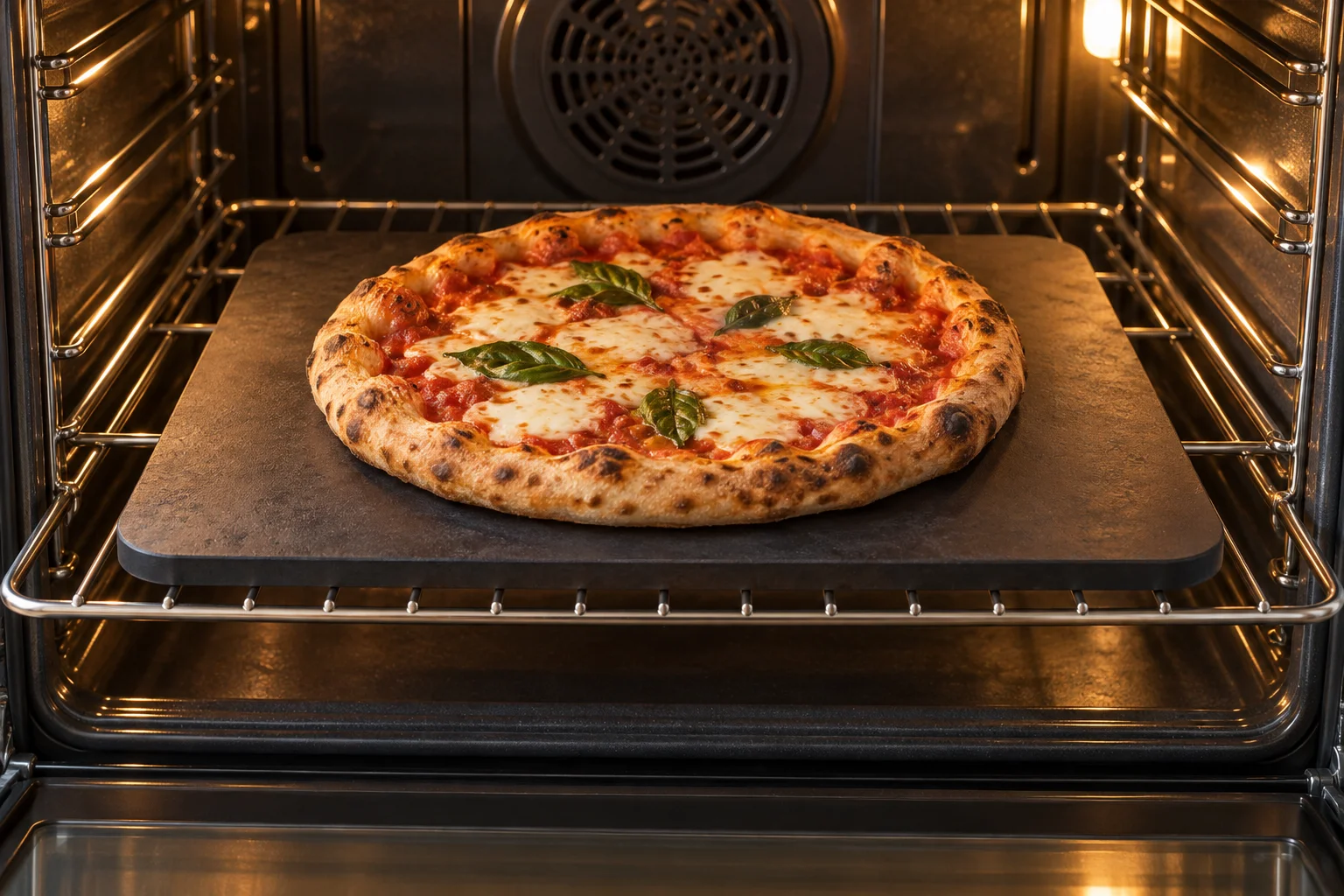
Understand what steel changes during baking
A pizza steel is a solid metal plate that absorbs heat before baking and transfers it to dough through direct contact. Compared with many common baking stones, steel transfers heat more quickly. This can help a thin pizza base brown more strongly in a kitchen oven. It does not mean every pizza improves on every plate. A very hot steel can darken the underside while thick or wet toppings still need more time. A suitable combination matters more than the material alone. A pan pizza is also a different setup from dough resting directly on the plate.
Heat transfer and the amount of heat stored are different properties. A plate's capacity to absorb heat depends partly on its mass and material. How quickly it passes heat into dough involves contact and material properties. A thicker plate therefore does not automatically preheat faster. It adds weight and may behave differently between successive pizzas from a thinner model. Assess the steel against your intended use: one or two pizzas in an evening, a longer series or frequent pan dishes. For an existing dedicated pizza oven, an alternative steel is an option only if that oven's manufacturer expressly permits it.
Check dimensions and weight before first use
Measure the actual usable space in the cold oven, allowing for supports, shelves, the door and required clearances. The plate must do more than just squeeze inside: it must rest securely on a suitable rack or its intended supports. It must not obstruct airflow or heating elements beyond permitted limits. Check the support's load rating too. A large solid plate can be considerably heavier than an ordinary baking tray. Take the product's stated weight seriously and include any pan and its contents if they will stand on the steel.
Next, compare the plate with your pizza's size. A round pizza 30 cm across leaves only about 1 cm of space on either side of a 32 cm-wide plate. That is not a generous landing area if the pizza moves slightly off-centre during launching. A longer plate does not solve inadequate width. Choose a slightly smaller pizza instead of allowing its edge to hang over the plate. Also plan how to grip and remove the cold steel safely with both hands. Use a product intended for food preparation with suitable edges, not an arbitrary coated construction sheet of unknown composition.
Prepare the surface appropriately
Some pizza steels arrive seasoned; others require an initial treatment described by the manufacturer. Seasoning here means building a thin baked-on oil layer on suitable steel. It is different from normal preheating before each pizza. Check your product's instructions before adding oil. A prepared model does not automatically need another full treatment. Remove packaging and inspect the plate for transport damage or residue. Whether washing is needed before the first use follows from the supplied instructions, not simply from the word “seasoned”.
When a further treatment is expressly required, spread the oil very thinly and wipe excess oil away again. A thick shiny puddle does not create a particularly good protective layer and can leave a sticky surface. The specific oil, temperature and duration belong to the steel's instructions. Do not confuse Fahrenheit and Celsius in American manufacturers' guidance. Nor should you substitute directions for a coated frying pan or baking stone. An oil treatment for steel does not transfer to stone. For the actual pizza bake, you do not need a fresh layer of oil beneath the dough unless your recipe or the particular design expressly calls for it.
Position the cold steel at a suitable height
Place the plate in the cold oven before preheating. This lets you control its weight and position without moving a hot object around a confined cooking chamber. Start with a shelf height suited to the oven, plate and recipe. Moving closer to top heat can brown the toppings more strongly; lower in the chamber, that balance changes. One fixed shelf position therefore does not suit every combination. Clearance from an upper heating element or grill must always remain within permitted limits. Do not add a second plate above or below unless the setup supports the load and airflow.
Before heating, check how the peel will move too. You need to reach the pizza without catching the handle on the door or pushing dough towards a heating element. Moving an empty peel through the cold setup is enough to reveal an obvious space conflict. This is particularly useful with deep plates. Later, the hot plate stays in place; you move the pizza to turn and remove it. A thin layer of oven-glove material does not make a heavy hot steel something to casually transfer between shelf positions.
Use preheating and measurements sensibly
Preheat the oven with the plate installed according to the chosen recipe and manufacturer guidance. The air display may reach its target before the steel has absorbed enough heat. Blanket promises such as “ready in ten minutes” or “always needs an hour” are therefore unhelpful. Thickness, starting temperature, oven output and mode all affect the process. Use this period to prepare dough, sauce and toppings. If the first topped pizza is ready but the steel is not, the workflow becomes unnecessarily difficult: wet dough may stick to the peel while you wait for the oven.
A suitable infrared thermometer can measure the surface if its settings suit that surface. Bare or shiny steel in particular reflects heat radiation from the surroundings, making readings misleading without appropriate measurement conditions. A dark seasoned steel is not automatically measured accurately with every preset emissivity either. Follow the instrument's instructions, keep the entire measurement spot on the plate and do not measure through oven glass. Do not add tape or paint to the baking surface to reproduce an industrial measurement technique. A surface reading also describes neither the air nor the eventual internal temperature of your pizza.
Launch a pizza that moves freely
Shape a dough ball to suit the plate and place it on an appropriate, lightly dusted peel. Keep the base reasonably even in thickness and leave the rim free of sauce. Excess toppings add weight and make launching harder; very wet ingredients can soften the base further. With a small movement, check that the whole pizza can slide. Release stuck areas while still at the work surface. If a hole has opened and sauce is leaking through, correct the problem before the pizza enters the oven. A hurried shove onto the hot steel is not the solution.
Open the oven only as long as necessary and place the pizza onto the clear surface in a controlled movement. Make sure it rests entirely on the plate. Paper is not a universal safeguard: oven, baking surface and paper must all permit the intended use and temperature. Many papers are unsuitable for temperatures used in pizza baking. Anyone wishing to use paper needs to plan the whole setup accordingly. A greased or coated pan on the steel also needs its own approval; in particular, do not put an arbitrary glass dish onto the hot plate. Direct contact between very hot and sensitive materials is not a suitable place to improvise substitutes.
Watch the top and base together
Monitor both parts of the job while baking: the toppings should cook appropriately and the base should bake through. If necessary, lift the pizza slightly with a suitable peel to inspect underneath. Turn it only once the base has set enough to avoid stretching or tearing. One side may brown faster because of heat distribution in the oven. The pizza itself reveals this, not a timer alone. The right removal point depends on dough thickness, toppings, starting temperature and the actual balance of heat.
If the base becomes too dark while the top lags behind, an even hotter plate is not automatically helpful. For the next pizza, consider another permitted shelf height, less moisture, a thinner base or adjusted settings. Use a grill or broiler only where the oven, recipe and accessories are suitable, and remain attentive. Do not change everything at once. If instead the top darkens while the base remains pale, examine preheating, contact with the steel and topping quantity. Black flour particles beneath an otherwise pale pizza also call for a different correction from an underside burnt all over.
Allow recovery between pizzas
Each pizza draws heat from the plate. Before another pizza, the steel may therefore need time to regain suitable conditions. The air display alone does not reliably represent this process. With appropriate measurement, compare the same point or points as before. An unused hot edge does not represent the contact zone that has just cooled. Prepare the next pizza so it does not wait fully topped for a long time. During a longer series, ready dough balls and prepared ingredients are more helpful than several fully topped pizzas sitting on unsuitable surfaces.
Remove loose burnt residue before the next pizza using the method intended for your setup. Do not reach across the hot plate with a short cloth or pour water onto it. If a large amount of cheese or sauce has landed on the steel and there is no safe prescribed method for cleaning between bakes, interrupt the series and let the setup cool through its normal procedure. Sliding another pizza over the dirt does not solve the problem. Briefly record the useful recovery sequence for your next evening. It applies to this setup and pizza, not automatically to every plate thickness and recipe.
Clean cold, store dry and adapt other oven use
After baking, let the steel cool completely before removing it or cleaning it by hand. Clear dry residue with a scraper or brush suitable for its surface. If the manufacturer permits water and mild washing-up liquid, rinse residue off carefully and dry the plate completely straight away, including underneath and around its edges. Uncoated carbon steel can rust when damp. Whether a thin maintenance oil layer or further seasoning is then needed depends on its condition and product instructions. A blanket ban on washing-up liquid is no more useful than assuming every steel can go into a dishwasher.
Store the dry, cold plate with its weight securely supported and no risk of falling over. Depending on the model, leaving it in the oven may be allowed, but changes the setup for other dishes too. Remove or reposition it only while cold when another recipe or cleaning programme requires this. A steel should not remain unnoticed during an oven pyrolysis cycle for which it or its surface is not approved. After several pizza evenings, the useful details of your routine will be clear: pizza size, shelf height, preheating, topping quantity and recovery. These few points let you use the steel purposefully without starting from scratch each time.